If you often take out small portions, an upright freezer with compartments is worth considering first. For larger batches, a chest freezer may be a good fit if you have enough floor space and can organise the food. Before adding another appliance, check whether taking stock and organising things better will be enough. Then compare the frozen storage capacity, dimensions, installation requirements and kWh/an shown on the energy label.
Who is this choice for?
Households that reach for food every day
You freeze a variety of portions and want to find them without rummaging around, so easy access and separating food matter more than a large open space. UFC-Que Choisir highlights the importance of being able to handle the drawers and remove food easily from the compartments.
Households that store food in batches
You keep large stocks or packages in different sizes, so the usable capacity and how you organise the food are key. UFC-Que Choisir points out that a chest freezer offers open storage, and how well it is organised also depends on how you manage your food.
Households with limited space
You have a specific spot for your freezer, perhaps in an unheated room. The dimensions, opening clearance, ventilation and permitted ambient temperature all affect which options are suitable. Check the model’s manual and the manufacturer’s installation instructions.
What to look for before you buy
Upright freezer
Consider one if: you often take out different portions and want to keep them separate in drawers or on shelves.
Bear in mind: check that you have enough height clearance, room for the door to open and easy access to the upper compartments.
Chest freezer
Consider one if: you store food in batches or have bulky packages, and have enough floor space.
Bear in mind: food stored at the bottom needs to be organised so it’s easy to find.
Larger fridge-freezer
Consider one if: you also need to replace your fridge and a single appliance can meet both needs.
Bear in mind: compare the freezer capacity, not the appliance’s total capacity, as well as the kWh/an for the options you’re considering.
Organise your existing storage better
Consider this if: you mainly struggle to see what food you already have, rather than running out of capacity.
Bear in mind: this won’t give you more freezer capacity if the space you have is genuinely insufficient.
Start by estimating how much frozen storage you really need, then check it against the space available and how often you take food out. If you still need another appliance, compare its kWh/an and freezer capacity on the energy label rather than assuming its consumption based on its format.
| What matters |
What to check |
Who is it most relevant to? |
| Access and storage |
Compare drawers, shelves or baskets, and check whether you can easily reach the food you use often. UFC-Que Choisir recommends considering how easy the compartments are to handle. |
When I take out different portions every day, I want to find them without moving everything else. Around 27% of consumers prioritise access and how food is organised. |
| Usable freezer capacity |
Think about the batches you usually store and compare the freezer compartment’s capacity in litres. Don’t confuse it with the total capacity of a fridge-freezer. If you freeze fresh food, also check that the appliance has the right freezing function. |
If I store batches or large packages, I need enough space for them without making them difficult to organise. Around 27% of consumers prioritise usable capacity. |
| Location and installation |
Measure the appliance and check the space needed to open it. Follow the ventilation clearances and ambient temperature range shown in the manual. Requirements vary by model. |
When an appliance needs to fit in a specific space or an unheated room, I check the dimensions and permitted conditions first. Around 26% of consumers put location suitability first. |
| Energy use and actual need |
Take stock before you buy. If you need extra capacity, compare the kWh/an and freezer capacity shown on the energy labels, as recommended by the European Commission when comparing these appliances. |
If better organisation could make my current storage work, I’d rather avoid another appliance. Otherwise, I compare the energy consumption shown on the labels. Around 20% of consumers prioritise limiting the number of appliances and their energy use. |
Mistakes to avoid
-
Choosing based only on the number of litres
The total capacity of a combined appliance isn’t the same as the capacity of its freezer compartment. The layout matters too: a compartment that works well for small portions may be less practical for large packages.
Compare the stated freezer capacity and think about how you’ll store the food you usually keep.
-
Assuming any freezer will work in a garage
Permitted ambient temperatures and ventilation requirements vary between appliances. A space that looks big enough doesn’t necessarily provide the clearance needed to open the appliance or allow proper ventilation.
Check the temperature range and installation instructions in the manual for the model you’re considering.
-
Assuming the format tells you how much energy it uses
Choosing a chest or upright freezer doesn’t, by itself, mean you’ll use less energy. These appliances run continuously, and ADEME notes that fridges and freezers are among the appliances affected.
Compare the kWh/an on the energy labels of appliances that suit your needs, and first check whether better organisation of your food stocks will be enough.
Brands to know
Whirlpool
A useful range to explore when looking at domestic chest and upright freezers.
- The brand’s French catalogue lists the two formats separately.
- Descriptions of how easy the appliances are to organise come from the manufacturer. Check the features and installation requirements of each appliance.
Liebherr
A useful French catalogue to browse for domestic chest freezers.
- Liebherr describes some appliances with FrostProtect as suitable for low ambient temperatures.
- This feature isn’t available on all models. Check the temperature range and the manual for the appliance you’re considering.
Bosch
A useful French catalogue to browse for freestanding freezers with drawers or shelves.
- Bosch highlights features such as transparent drawers to help organise food.
- The features available and how useful they are depend on the appliance. The manufacturer’s description isn’t an independent comparison between brands.
Freezers available on Joybuy
This selection includes upright freezers with drawers to separate portions, and chest freezers for storing larger batches. Compare their capacity and footprint with your space and how you plan to use them.
 No image available
Heinrich´s, 161 L upright freezer, energy rating C
The upright design with compartments may suit you if you want to keep different food stocks separate. The product listing specifies No Frost protection, three freezer drawers and two drawers, as well as an LED display.
Stated capacity: 161 L. Stated temperature range: −14 °C to −22 °C.
Joybuy
 No image available
COMFEE' RCU60WH2(E), 60 L upright freezer, energy rating E
The drawers can help you separate food in this compact upright freezer. The product listing specifies three drawers, a reversible door and adjustable temperature.
Stated capacity: 60 L.
Joybuy
 No image available
TCL CF182EWE0FR, 140 L chest freezer with basket, energy rating E
The chest freezer and its basket may suit batch storage, with a separate area for smaller items. Organise food stored at the bottom so it’s easy to find.
Stated capacity: 140 L. The product listing mentions a counterbalanced lid and temperature control.
Joybuy
 No image available
AUCMA, 291 L convertible chest fridge-freezer, energy rating E
Its stated large capacity may suit batch storage if you have enough floor space. The product listing specifies a removable basket and the option to switch between fridge and freezer modes.
Stated annual energy consumption: 226 kWh/an. The product description specifies a minimum ventilation clearance of 10 cm around the appliance.
Joybuy
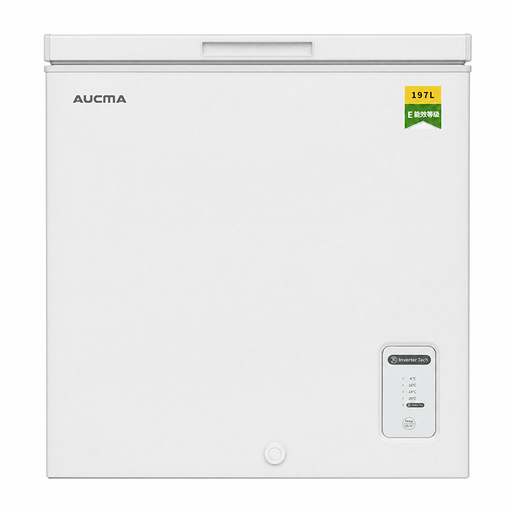 No image available
AUCMA, 197 L convertible chest fridge-freezer, energy rating E
This convertible chest freezer may suit your batch storage needs if it fits in your room. The product listing specifies a removable basket and the option to switch between fridge and freezer modes.
Stated annual energy consumption: 197 kWh/an. The product description specifies a minimum ventilation clearance of 10 cm around the appliance.
Joybuy
Frequently asked questions
Will any freezer work in a cellar or an unheated garage?
Don’t assume so. Check the room temperature and compare it with the permitted ambient temperature range and installation instructions for the appliance you’re considering. Some models are designed for low temperatures, but this doesn’t apply to all of them.
How much space should I leave around the freezer?
Follow the clearance instructions in the manual for your model and make sure its door or lid can open properly. Electrolux notes in its support guidance that ventilation requirements vary by appliance, so don’t apply one set clearance to every chest or upright freezer.
Can a freezer compartment freeze freshly prepared food?
Not necessarily. To freeze fresh food, check that the compartment is designed for this purpose. The Ministry of Agriculture associates this function with a four-star compartment that can quickly bring the centre of the food to −18 °C.
How should I manage food stocks and defrosted food?
Take stock regularly so you can see what you have and avoid buying things twice, as ADEME advises. The Ministry of Agriculture advises against refreezing defrosted food because of the risk of bacterial growth.
What should I check on the energy label, and what about the guarantee in France?
The European Commission says that the energy label for relevant fridges and freezers includes the energy rating, kWh/an and compartment capacity. The label must be displayed for applicable products sold online. For a new product bought in France by a private individual from a professional seller, the Ministry of the Economy states that the legal presumption that a fault existed at the time of purchase lasts for two years under the legal guarantee of conformity. If you’re replacing an old appliance, also ask the seller about like-for-like take-back: the DGCCRF explains that the « one-for-one » take-back principle applies when a new product is sold.


