What to look for
Start with the available space and the amount you actually need to store, then compare the specifications of the exact model rather than relying solely on its format or energy label.
| Priority |
What to check |
Your needs |
| Capacity and access |
Compare the usable frozen-food capacity, width, depth and height. Check how the lid or door opens, the required ventilation clearances, and whether the drawers or baskets can be removed. |
I want to store more than I can in a fridge freezer while still being able to find portions easily. A chest freezer makes room for large containers; drawers make everyday organisation easier. |
| Installation in an unheated room |
Note the room’s minimum and maximum temperatures, then compare them with the appliance’s climate class and specified operating range. Also follow the ventilation and levelling instructions in the manual. |
My freezer will be installed in a garage, cellar or utility room. The chest-freezer format alone does not confirm that the appliance is suitable for the temperatures in that room. |
| Energy consumption and power cuts |
Compare kWh/year, usable frozen-food capacity and noise level between appliances with a similar capacity. Check the storage time during a power cut, freezing capacity in kg/24 h and the model information available via the EPREL QR code. |
I want to limit the energy used by an appliance that runs continuously and protect a substantial food supply during a power cut. The energy label letter alone does not allow this comparison. |
Joybuy options
These Joybuy options include upright freezers, chest freezers and a large-capacity fridge freezer for family food storage at home.
 Image unavailable
Heinrich´s 161 L No Frost upright freezer, C energy rating
An option for regular access to food and compartmentalised storage.
Advertised capacity of 161 L, with 3 drawers, 2 shelves, LED display, Fast Freeze function, alarm and reversible door.
Check the dimensions, annual energy consumption, storage time during a power cut and climate range before installing it in a garage or cellar. The 161 L capacity may be limited for a very substantial family food supply.
View on Joybuy
 Image unavailable
AUCMA 291 L convertible chest freezer, E energy rating
This 291 L chest freezer is suitable for a substantial food supply and bulky products, provided you have dedicated floor space.
Advertised features include top opening, removable basket, LED lighting, five-level digital control, adjustable feet and a defrost drain.
Check the climate range, storage time during a power cut and freezing capacity. As the appliance is convertible, make sure that freezer mode is active before storing frozen food in it for an extended period.
View on Joybuy
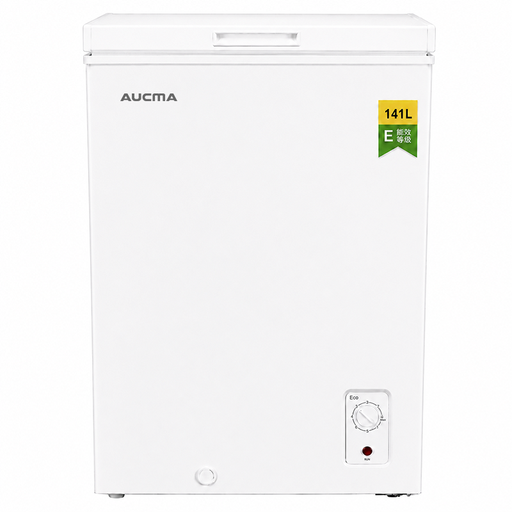 Image unavailable
AUCMA 141 L convertible chest freezer, E energy rating
A practical additional storage solution when space is more limited.
Advertised capacity of 141 L in a 632 × 554 × 848 mm format, with removable basket, seven-level mechanical thermostat and defrost drain.
Check the climate requirements, storage time during a power cut and freezing capacity. Also confirm that freezer mode is selected before storing a supply of frozen food.
View on Joybuy
 Image unavailable
TCL CF182EWE0FR 140 L chest freezer, E energy rating
This chest freezer can provide additional household storage, with a basket for smaller items.
Advertised features include 140 L capacity, dimensions of 637 × 556 × 846 mm, counterbalanced lid, castors, adjustable feet, mechanical control and front drainage.
Check the model’s annual energy consumption, storage time during a power cut, freezing capacity and climate range. Its capacity may be insufficient for intensive family storage.
View on Joybuy
 Image unavailable
Sonlu CC-520WE 444 L fridge freezer, E energy rating
This option is aimed at households replacing their fridge as well and looking for a large total capacity in the kitchen.
Advertised features include 444 L total capacity, Total No Frost, energy consumption of 289 kWh/year, noise level of 40 dB and an SN-T climate class from 10 °C to 43 °C.
Check the capacity actually allocated to freezing, the dimensions and the compartment layout before choosing it for a large supply of frozen food. Based on the stated range, it is not suitable for a room where the temperature falls below 10 °C.
View on Joybuy
Frequently asked questions
How can I tell whether a freezer is suitable for an unheated garage or cellar?
Measure the room’s minimum and maximum temperatures, then compare them with the climate class and operating range of the exact model. Bosch states that this class appears on the rating plate; some specific chest freezers claim compatibility down to -15 °C, but this does not apply to every model.
What should I compare on the energy label of a new freezer?
At a minimum, compare the A to G energy class, annual consumption in kWh, the volume of the frozen compartments and the noise level. The European Commission explains that the label provides these details, while the QR code gives access to detailed model information in EPREL.
Is a chest freezer necessarily less practical than an upright freezer?
No. A chest freezer is ideal for large quantities and bulky products thanks to its open space, but it needs to be organised using baskets, labelled bags or designated zones. An upright freezer makes drawer-based organisation and frequent access easier; however, check that the drawers can be opened and removed in the space provided.
Which specification matters during power cuts?
Look for the exact model’s storage time during a power cut and consider a temperature alarm if you keep a substantial food supply. According to Que Choisir’s testing protocol, this criterion is the time needed for the temperature to rise from -17 °C to -9 °C without power, which may vary between appliances.
What should I do with my old freezer in France?
A freezer comes under France’s waste electrical and electronic equipment recycling scheme. The ministry responsible for ecological transition recommends not leaving it with ordinary household waste: check whether the retailer offers take-back, or find out about local collection services or a suitable collection point.


