If you mainly store large packs, consider a chest freezer. If you often take out individual portions of meals, an upright freezer with drawers will generally make them easier to organise. A compact model is better suited to occasional extra storage, while a fridge-freezer is worth considering if you’re replacing your fridge too. In every case, compare the usable freezer capacity, the space needed to open the appliance and whether it’s suitable for the room where you plan to install it.
Who are these formats for?
People who prepare meals in advance
If you freeze meals in portions or pre-prepared ingredients, consider how easy it is to find them in the drawers or baskets. The E.Leclerc Observatory of New Food Consumption Practices includes freezer storage among the ways people prepare meals in advance.
Households stocking up in bulk
For large packs, bulk buys or family-sized reserves, compare the net capacity with the size of your containers. UFC-Que Choisir says chest freezers can hold up to 600 L, while upright models generally hold around 200 L, with some reaching 400 L.
Households considering a garage or pantry
If the room may get cold, check the model’s permitted ambient temperature range before choosing its capacity. For example, Beko says the HSM46740 can operate at temperatures as low as −15 °C. This feature is not available on all freezers.
How do the formats compare?
Chest freezer
Consider it: for large reserves or bulky containers, if you have enough floor space.
Bear in mind: you’ll need to organise the contents to reach food at the bottom.
Upright freezer
Consider it: if you regularly take out portions and want to organise them across several drawers.
Bear in mind: make sure a large dish will fit in the usable drawer space.
Table-top or under-counter freezer
Consider it: for extra storage when space is your main constraint.
Bear in mind: check that the capacity will be enough if you start freezing more meals or buying more food.
Fridge-freezer
Consider it: if you’re replacing your fridge too and want to keep everything in one appliance.
Bear in mind: only part of its total capacity is available for frozen food.
If you need more than a standard freezer compartment can offer, start with your main priority, then check the specifications of the model you choose.
| What matters | What to check | Who is it for? |
|---|
| Storage capacity |
Net freezer capacity; freezing capacity in kg/24 h if you add lots of food at once. |
If large packs and family reserves are overflowing from your current freezer compartment, having enough space becomes the main priority. Around 31% of consumers prioritise capacity. |
| Access to portions |
Number and size of drawers or baskets; whether your usual containers will fit. |
If you regularly take out a prepared meal without shifting your whole stock, organisation matters just as much as free space. Easy access to portions comes first for around 31% of consumers. |
| Available space |
Appliance dimensions, door or lid clearance, and the space required as set out in the instruction manual. |
If your kitchen or pantry is short on space, you need to be able to install and open the appliance easily every day. This is the main constraint for around 23% of consumers. |
| Installation conditions |
The model’s permitted ambient temperature range; stated holdover time in hours during a power cut. |
In an unheated room, or if a large stock makes power cuts a concern, suitability and holdover time matter more than the format. Around 15% of consumers put these conditions first. |
What should you avoid before buying?
-
Choosing based on capacity alone
A chest and upright freezer with similar capacities won’t give you the same access to your food: one has an open space, while the other divides storage between compartments.
Compare the dimensions of your largest containers with those of the drawers or baskets, and check how easy it is to reach the bottom of a chest freezer.
-
Assuming any model will work in a garage
The permitted ambient temperature depends on the appliance, including chest freezers.
Compare the room temperature with the range given in the product details and instruction manual for the exact model.
-
Comparing energy ratings alone
The letter rating doesn’t tell you how much food the appliance can hold or how much energy it uses each year. The European Commission says the energy label for household fridges and freezers uses a scale from A to G.
When comparing appliances of a similar size and capacity, also check the annual kWh consumption, freezer capacity and noise level shown on the label.
-
Overlooking holdover time during a power cut
If you’re building up a large reserve, the model’s stated holdover time is an important factor. UFC-Que Choisir assesses this during a simulated power cut as part of its testing process.
Check the holdover time in hours for the model you’re considering. If you often freeze a large shop in one go, also check its freezing capacity in kg/24 h.
Brands to consider, model by model
Bosch
Some Bosch upright freezers include features designed to help you organise your food.
- Bosch lists No Frost, VarioZone and a Big Box compartment for the GSN58AW30.
- Check the features and usable dimensions of the specific model you’re interested in.
Whirlpool
The brand offers chest and upright freezers. Compare their layouts to find one that suits the way you store food.
- A chest freezer can suit large packs, while an upright model with drawers makes it easy to separate portions.
- Compare capacity, holdover time and freezing capacity in the product details for the models you’re considering.
Beko
Consider the HSM46740 chest freezer if you need to install it in a cold room.
- Beko says this model can operate at ambient temperatures as low as −15 °C.
- Don’t assume another Beko model has the same operating range without checking its instruction manual.
Liebherr
Some Liebherr chest freezers are designed for use in unheated rooms.
- Liebherr lists FrostProtect and suitability for temperatures as low as −15 °C for certain appliances.
- Check the stated ambient temperature range for the model you choose before installing it in a garage or cellar.
Appliances for different storage needs
These Joybuy products include a fridge-freezer to consider if you’re replacing your fridge too, an upright freezer for organising portions, and chest freezers from 99 to 141 L for extra storage. Compare their capacity with the quantities you usually store before choosing a format.
 Image unavailable
Candy CFQQ5T817EPS, 467 L 4-door fridge-freezer
Worth considering if you’re replacing your fridge too. The 467 L refers to the total capacity, so compare the freezer compartment capacity separately with the amount you need to store. The product name lists Total No Frost and an E energy rating.
View on Joybuy
 Image unavailable
Heinrich´s, 161 L No Frost upright freezer
Consider this if you want a dedicated freezer with separate space for portions. The product is listed with three drawers, an alarm and a C energy rating. Check the usable drawer dimensions for your meals, as well as the external dimensions to make sure it will fit.
View on Joybuy
 Image unavailable
CHiQ JR99DWE, 99 L chest freezer
This capacity is better suited to extra storage than to very large stocks. A removable basket can help keep smaller items separate; remember to allow room to reach in from above. The product name lists an E energy rating.
View on Joybuy
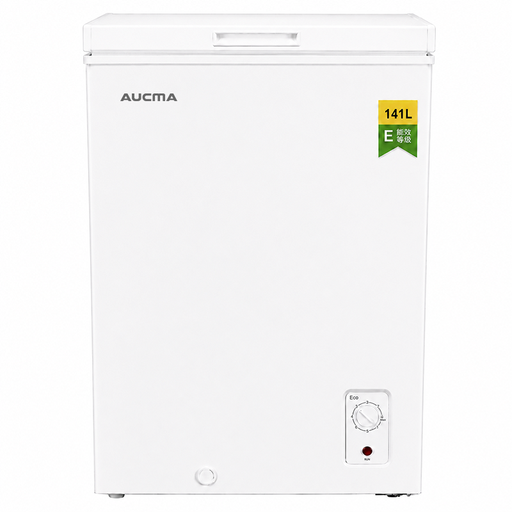 Image unavailable
AUCMA, 141 L convertible chest freezer
Worth considering if you want extra storage and would find the convertible function useful. The product is described as suitable for use as either a fridge or freezer, and comes with a removable basket, a seven-level thermostat and an E energy rating. Check which mode suits your storage needs and whether the room is suitable for installation.
View on Joybuy
 Image unavailable
TCL CF182EWE0FR, 140 L chest freezer
This chest freezer can provide extra room for prepared food or groceries, as long as 140 L is enough for the quantities you store. It’s listed with a storage basket, a counterbalanced lid and an E energy rating. Make sure there’s enough space above the appliance to open the lid.
View on Joybuy
Frequently asked questions
Chest or upright freezer for prepared meals?
Choose the format that makes it easiest to find what you need most often. An upright freezer makes it easier to separate portions in drawers, while a chest freezer gives you more flexibility for large containers if you organise the space. UFC-Que Choisir says chest freezers generally offer more capacity, but check the capacity and usable dimensions of each model.
What should you look for on a freezer’s energy label?
Alongside the A to G rating, compare annual energy consumption in kWh, the capacity of the freezer compartments and the noise level. This scale appears on the European energy label described by the European Commission. When choosing between two appliances, consider these figures alongside their format and the capacity you need.
Can you put any freezer in an unheated garage?
No. Check the ambient temperature range for the exact model in its product details and instruction manual. Beko says the HSM46740 can be used at temperatures as low as −15 °C, and Liebherr lists some FrostProtect chest freezers for this temperature. This doesn’t apply to every appliance from these brands.
How should you factor in holdover time during a power cut?
Check the stated holdover time in hours for the model you’re considering; don’t assume it based on capacity alone. UFC-Que Choisir measures how long food stays below −9 °C during a simulated power cut as part of its testing process. Bear in mind that the figures in product details may be based on different testing conditions.


