Households that stock up in bulk
If you buy in bulk, freeze home-grown produce or prepare several meals in advance, capacity may be the deciding factor. A chest freezer is worth considering if you have a suitable room and enough floor space.


Choose a chest freezer if your main aim is to stock up in bulk and you have a suitable floor space; go for an upright freezer if you need to keep food separate and access it often. Before comparing capacities, check the delivery route, the clearance needed to open the lid or door, ventilation requirements and the permitted room-temperature range for the model you’re considering.
If you buy in bulk, freeze home-grown produce or prepare several meals in advance, capacity may be the deciding factor. A chest freezer is worth considering if you have a suitable room and enough floor space.
If you regularly reach for vegetables, meals or other food categories without wanting to rummage through a deep freezer, the drawers and compartments in an upright freezer may matter more than maximum capacity.
Whether it’s going in a kitchen, utility room, cellar or garage, the freezer needs to fit through the delivery route, allow room to open its door or lid, and have suitable ventilation and room temperature. These checks may rule out an appliance that would otherwise be large enough for your storage needs.
For storing larger quantities, first decide whether capacity or easy access to food matters more. Then check that your chosen format can be delivered and installed in the room you have in mind. A small under-counter freezer is better suited to extra storage, while a fridge freezer may be enough if you don’t need a large, separate freezer.
Worth considering: for storing large quantities in a room with enough floor space. Que Choisir’s guide describes chest freezers with capacities of up to 600 L.
Bear in mind: an open tub gives you flexibility for bulky containers, but food at the bottom can be harder to reach unless you organise it into baskets or sections.
Worth considering: if you often take food out and want to organise it in drawers or compartments.
Bear in mind: according to the formats described by Que Choisir, upright freezers generally have less capacity than the largest chest freezers. You’ll also need to allow room to open the door and access the drawers.
| Factor | What to check | Who is it for? |
|---|---|---|
| Storage capacity | Compare the stated capacity with the amount of food you want to store, then measure the space and delivery route. | If I want to store bulk buys, home-grown produce or prepared meals, my first priority is enough space in one appliance. Around 29% of consumers prioritise capacity. |
| Access and organisation | Check the drawers or baskets, and how easy it is to reach food at the bottom. | If I often take out different types of food, I want to find what I need without moving everything else. Easy access is the priority for around 29% of consumers. |
| Available space | Measure the installation space and access routes, and allow room to open the appliance. Also follow the ventilation clearances in the manual. | In a narrow room, I need to be able to get the appliance in and open its door or lid fully. Around 21% of consumers prioritise these installation requirements. |
| Room conditions and power cuts | Check the permitted room-temperature range, the stated storage time in the event of a power cut and whether the appliance has any temperature alarms. | If I’m putting the freezer in a cellar or garage, or my stored food would be difficult to replace, I want an appliance suited to the room and to know how it performs during a power cut. Around 21% of consumers put this concern first. |
The set temperature inside a freezer doesn’t tell you the minimum room temperature at which it can operate. If the room isn’t heated, check the temperature range in the manual for the specific model rather than relying on whether it’s a chest or upright freezer.
A large capacity won’t help if the appliance won’t fit through a doorway, the lid hits an obstruction or air can’t circulate as required.
Note the external dimensions, measure the delivery route and check the manual for opening and ventilation clearances before comparing capacities.
The permitted room-temperature range varies by appliance. Liebherr and Beko state that some of their chest freezers can operate at temperatures as low as −15 °C, but this doesn’t apply to every model.
Compare the minimum and maximum temperatures specified for the exact model with the conditions in the room you have in mind.
The open tub can hold containers of different sizes, but small portions and older items can be hard to find beneath other food.
Sort food into baskets or boxes, label them and keep items you plan to use first within easy reach. If you mostly take out food by category, consider an upright model with drawers too.
If you’re storing a lot of food, how long it stays frozen during a power cut is a separate consideration from capacity. Que Choisir recommends taking this storage time into account.
Compare the stated storage times under similar conditions and check whether the model has an alert for rising temperatures.
Worth considering if you’re looking for a high-capacity chest freezer or planning to put one in an unheated room. Always check the exact model.
Worth considering for chest freezers designed for storing larger quantities, especially if you’re planning to install one in an unheated room.
Worth considering for an upright or integrated model if keeping food separate in drawers matters more than the capacity of a large chest freezer.
This selection of Joybuy models includes an upright freezer with drawers and chest freezers ranging from 95 to 140 L. They’re options to consider if you want easy access to food or extra storage. If you’re aiming to store very large quantities, compare the capacity you need for your food before choosing one of these sizes.
 Image unavailable
Worth considering if keeping food separate and taking it out by category matters more than having a very large capacity.
The product name lists three freezer drawers, a No Frost function, an LED display and an alarm. Check the dimensions, permitted room-temperature range and storage time during a power cut for your chosen location.
 Image unavailable
Worth considering if you need a little extra storage, rather than space for very large quantities.
The product is described as convertible between fridge and freezer modes, with a removable basket and a seven-level thermostat. If you’re putting it in a cellar or garage, check the permitted room-temperature range. Also check its storage time during a power cut.
 Image unavailable
Worth considering as extra storage if a compact chest freezer suits your needs.
This model has a removable basket, an adjustable thermostat and a sliding lid. It requires manual defrosting. Also check the permitted room-temperature range and its storage time during a power cut.
 Image unavailable
Worth considering if a 140 L chest freezer suits the amount you need to store and the space you have available.
The product name lists a basket, a counterbalanced lid and a temperature control. Check the delivery route and the clearance needed to open the lid, then check the permitted room-temperature range and stated storage time during a power cut.
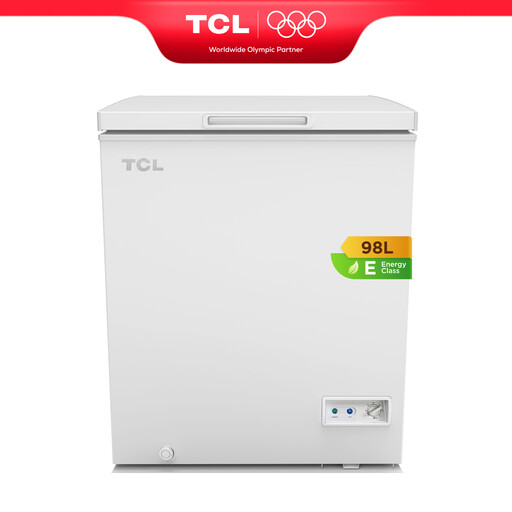 Image unavailable
Worth considering as extra storage if 98 L is enough for the food you want to keep.
The product name lists a basket, a counterbalanced lid and a temperature control. Before choosing a location, check the dimensions, opening clearance, permitted room-temperature range and storage time during a power cut.
No. The room temperature must stay within the permitted range for your chosen model, and you’ll need to allow for the ventilation specified in its manual. Liebherr and Beko state that some of their chest freezers can operate at temperatures down to −15 °C, but this doesn’t apply to all freezers.
Measure the space and the entire delivery route, then check how much room is needed to open the lid and ventilate the appliance. As a guide to the format, Que Choisir commonly cites chest freezers measuring 110 to 140 cm wide and around 70 cm deep. Only the dimensions of the model you choose can confirm whether it will fit.
Organise the freezer into categories using baskets or boxes, and label portions with the date. Keep the food you plan to use first within easy reach. If you often take out different types of food, an upright freezer with drawers may suit you better.
Take it to a collection point for waste electrical and electronic equipment rather than putting it in general waste. The French Ministry for the Ecological Transition explains this scheme for household appliances. Ask the retailer or your local authority about the collection or drop-off options available to you.