If you’re building up a stock of meals and groceries that you won’t need to access often, consider a chest freezer. If you regularly take out individual portions, an upright freezer with drawers makes it easier to keep everything organised. A large fridge-freezer is mainly worth considering if you’re replacing your fridge too: compare its freezer capacity, not just its total capacity. In all cases, check the space it needs, its stated storage time in the event of a power cut, and the ambient temperature range it can handle if you’re planning to put it in an unheated room.
Which option is right for you?
Households that stock up in bulk
If you buy in bulk, freeze meals in batches or keep seasonal supplies, start by comparing freezer capacity and the stated storage time in the event of a power cut. If the appliance won’t be going in the kitchen, where you’ll put it also becomes a key consideration.
Households that freeze individual portions
If you often take out a prepared meal, look at how the drawers, baskets or shelves let you separate portions and find them again. Bosch offers removable compartments on some of its upright freezers, but the layout varies by model.
Households replacing their fridge too
If you’d like to keep fresh and frozen food together in one large appliance, check the freezer capacity separately. Measure the appliance and the route to its final position before choosing a fridge-freezer.
What sets the different formats apart?
Chest freezer
Consider it: for storing a large stock that you won’t need to access often, if you can organise food by category.
Bear in mind: access is from the top, so you’ll need room to open the lid and reach food at the bottom.
Upright freezer
Consider it: if you regularly take out individual portions and want to store them in easy-to-reach compartments.
Bear in mind: the appliance’s height and drawer layout need to suit both the room and the size of your containers.
Large fridge-freezer
Consider it: if you’re replacing your fridge too and would prefer fresh and frozen food in one appliance.
Bear in mind: the total capacity includes the fridge section, so check that the freezer compartment will genuinely hold enough for your needs.
| Consideration | What to check | Who it matters to |
|---|
| Storage capacity |
Compare the freezer compartment’s capacity in litres, then check its dimensions against your containers. With a fridge-freezer, don’t mistake the total capacity for the freezer capacity. |
If I want to store lots of groceries or prepared meals, I need enough room for my supplies without relying on the total capacity shown for the whole appliance. Around 36% of consumers would prioritise storage capacity. |
| Access to portions |
Look at the model’s drawers, baskets or shelves, and how its door or lid opens. |
If I often take out a prepared meal, I want to find the right portion without rummaging through the other food. Around 29% of consumers would put access and organisation first. |
| Installation |
Measure the space, access route and clearance needed to open the door or lid. If it’s going in an unheated room, check the ambient temperature range the model can handle. |
If space is limited or I’m planning to use a cellar or garage, the appliance needs to be suitable for the conditions where it will be installed. Around 21% of consumers would make suitability for the room their top priority. |
| Maintenance and food storage |
Check the energy label and, depending on your needs, look at defrosting, alerts and the stated storage time in the event of a power cut. |
If I want to store food without having to defrost the appliance frequently, I also pay attention to continuous operation and power cuts. Around 14% of consumers would prioritise these maintenance and food-storage considerations. |
Mistakes to avoid
-
Choosing based on capacity in litres alone
An appliance may have the capacity you need but still be too large to get into the room, or leave too little space to open its door or lid. With a fridge-freezer, some of the stated capacity is taken up by the fridge section.
Measure the delivery route, the space where it will go and the clearance needed to open it. Check the freezer compartment’s capacity in litres separately.
-
Assuming any chest freezer will work in an unheated room
The ambient temperature range an appliance can handle depends on the model, not just whether it’s a chest freezer. Beko says the HSM35050 works down to −15 °C, as does Liebherr’s CFe 1870 Pure, but this doesn’t apply to all their other models.
Compare the stated temperature range for the appliance you’re considering with the conditions in your cellar or garage.
-
Assuming every model in a format has the same features
No Frost, frost-reducing features, alarms and interior storage vary from model to model.
Check the model’s product information for its cooling system, defrosting and alert functions, and drawers or baskets.
-
Thinking freezing removes all food safety risks
ANSES says that home freezing at −18 °C stops bacteria from multiplying, but most microorganisms survive.
Freeze food promptly, label portions, and follow food safety guidance for keeping food cold and defrosting it.
Brands to consider, model by model
Beko
The range includes chest freezers worth comparing if you need extra food storage.
- Beko states that the HSM35050 has a capacity of 350 L, a storage time of 43 h in the event of a power cut, and works in ambient temperatures down to −15 °C.
- These specifications apply to the HSM35050 only: check the details for the model you’re considering.
Bosch
Some upright freezers in the range have removable compartments or shelves to help you organise your food.
- Bosch says the GSN58AWCV offers 366 L of freezer capacity, No Frost and a storage time of 13 h in the event of a power cut.
- The layout, alerts and other features depend on the model; don’t assume they’re included just because it’s an upright freezer.
Liebherr
The brand offers chest freezers and large fridge-freezers, whose capacities need to be read differently.
- Liebherr states that the CFe 1870 Pure chest freezer has a capacity of 281 L and works in ambient temperatures down to −15 °C.
- The 659 L stated for the XRFsf 5225 appliance is the total capacity, not the freezer compartment alone.
Whirlpool
In France, Whirlpool offers a range of chest freezers designed, among other things, for storing large quantities.
- This range is worth considering if you’re looking for a chest freezer to keep supplies separate from your fridge.
- Check each model’s capacity, storage time and layout: the range overview doesn’t describe every model.
Chest and upright freezers on Joybuy
These two appliances illustrate the two dedicated freezer formats: an upright freezer for organising portions and a chest freezer for extra storage. Compare their stated capacities with the amount of food you actually plan to keep.
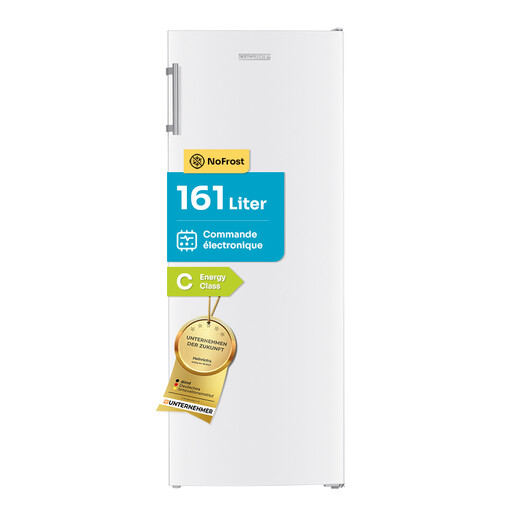 Image unavailable
Heinrich´s 161 L upright freezer, No Frost, white
Worth considering if you’d like to organise portions in an upright freezer rather than stack them in a chest freezer.
The product name lists a capacity of 161 L, three freezer drawers, No Frost, an alarm and energy class C. Check that this capacity suits your needs, along with the dimensions, storage time in the event of a power cut and ambient temperature range, before deciding where to put it.
View on Joybuy
 Image unavailable
TCL CF182EWE0FR chest freezer, 140 L
Worth considering if you’re looking for extra storage and can access your food from the top.
The product name lists a basket, a counterbalanced lid, an adjustable thermostat and energy class E. Compare the 140 L capacity with the amount you plan to store. Also check the storage time in the event of a power cut and the ambient temperature range if you want to put it in an unheated room.
View on Joybuy
Frequently asked questions
Can you put a chest freezer in an unheated garage?
Yes, if the model is designed for the ambient temperature in your garage; its chest format alone doesn’t tell you that. Beko states that the HSM35050 works down to −15 °C, as does Liebherr’s CFe 1870 Pure. Check the stated temperature range for the model you choose.
What should you compare on a freezer’s energy label?
Compare annual energy consumption in kWh, as well as freezer capacity and noise levels, between appliances suited to the same use. The European Commission says that the energy label for the relevant refrigeration appliances also shows their energy class; the letter alone doesn’t tell you their annual energy consumption.
Will a prepared meal stay safe indefinitely at −18 °C?
No. According to ANSES, home freezing at −18 °C stops bacteria from multiplying, but most microorganisms survive. Freeze meals promptly, keep food cold and defrost them in the fridge, in the microwave using the defrost setting, or quickly by cooking or reheating.
What should you do with your old freezer in France?
When replacing your appliance, ADEME says you can hand the old one to the retailer or delivery driver, or take it to the section for electrical and electronic equipment at a recycling centre.


