For storing large quantities, choose a chest freezer if capacity and space for bulky food matter more to you than being able to reach items at the bottom straight away. An upright freezer is a better choice if you often take out individual portions and want to organise them in drawers. In either case, check the dimensions, how long the freezer can keep food frozen during a power cut, and the permitted temperature range for the room where you plan to install it.
Who is each type best suited to?
Households with a large food store
If you freeze bulk buys, home-grown produce or large batches of meals, and have a dedicated room, consider a chest freezer for its capacity. According to UFC-Que Choisir, this type can hold a large volume of food. However, you’ll need to be able to reach items at the bottom and keep track of what’s in stock.
People who often take out individual portions
If you regularly need to find a particular dish or ingredient, the drawers in an upright freezer make it easier to sort food into categories. Check that its usable capacity and compartment sizes can also accommodate the bulkiest items in your store.
Households fitting out an unheated cellar or garage
If the room gets very cold in winter, first choose a model whose operating range covers the temperatures recorded there. Neither a chest nor an upright freezer is automatically suitable for use in cold conditions.
Which features set them apart?
For storing larger quantities, chest and upright freezers suit two different priorities: available storage space on the one hand, and ease of sorting and access on the other. If you only need a little extra freezer space, an under-counter freezer or the freezer compartment in a large fridge-freezer may be enough, provided you check its usable capacity.
Chest freezer
Consider one: for bulk buys or large batches of food, if you have enough floor space in the room.
The trade-off: items at the bottom are harder to find, so baskets and keeping track of your stock become more important.
Upright freezer
Consider one: if you want to sort food into categories and often take out individual portions.
The trade-off: drawers can limit the space available for large items. Check their dimensions, not just the total capacity.
| Feature |
What to check before buying |
What matters to consumers |
| Capacity and bulky food |
Compare the usable capacity in litres with your containers, then measure the floor space and the clearance needed to open the lid. |
If bulk buys or home-grown produce quickly fill my freezer, I want to be able to store larger items too; around 31% of consumers prioritise this capacity. |
| Access and organisation |
Check the drawer dimensions and how easily they can be removed, or the baskets supplied with a chest freezer. |
If I often need to take out a dish or ingredient, I want to find it without moving everything else. This ease of access is a priority for around 31% of consumers. |
| Where you’ll install it |
Compare the room’s actual temperatures with the ambient temperature range permitted for the exact model. |
In a cellar or garage that gets cold in winter, I need to know whether the appliance can work at the temperature it reaches; around 25% of consumers put this compatibility ahead of other criteria. |
| Size of your food store and ongoing use |
Consider whether you need a separate appliance and compare the kWh/year figures for models of similar capacity. |
If my food store is modest, I’d rather check that I’ll genuinely benefit from a second appliance; around 13% of consumers put getting the right size first. |
Mistakes to avoid before buying
-
Choosing a chest freezer based on capacity alone
A chest freezer also needs to fit through your doorways, with enough room to open the lid and reach your food. UFC-Que Choisir notes that chest freezers are often 110 to 140 cm wide and around 70 cm deep; the dimensions of the model you choose are what matter.
Measure the access route, the space where it will go and the clearance needed to open the lid before settling on a capacity.
-
Assuming an SN-T rating is suitable for a freezing garage
According to Beko’s guide, SN-T corresponds to an ambient temperature of 10 to 43 °C. This doesn’t mean an appliance can operate below 10 °C, even if some models separately state that they can work down to −15 °C.
Check the room’s minimum temperature in winter and look up the operating range for the exact model in its product details or manual.
-
Judging energy use by the energy class alone
A freezer runs continuously, as ADEME points out. The energy rating letter doesn’t replace the annual energy consumption figure when you’re comparing appliances intended for similar uses and capacities.
Compare their kWh/year figures and check that a dedicated appliance’s capacity matches the amount of food you actually store.
-
Assuming a chest freezer always keeps food frozen for longer during a power cut
How long a freezer stays cold depends on the model. UFC-Que Choisir assesses this as a separate criterion and, in its testing, measures the time taken for the temperature to rise from −17 °C to −9 °C without power.
Compare the stated storage times for the models you’re considering and, where available, test results based on clearly stated conditions.
Brands to consider, model by model
Beko
Beko offers chest freezers, some of which feature MinFrost or are designed to operate in a cold room.
- For a cold cellar or garage, a model such as the HSM27050 is stated by Beko to operate down to −15 °C.
- Check this suitability for each model: the SN-T rating, given as 10 to 43 °C in Beko’s guide, doesn’t prove on its own that the appliance can operate below this range.
Liebherr
Liebherr offers both chest and upright freezers. The brand highlights FrostProtect for some installations in unheated rooms, and StopFrost on certain chest freezers.
- These features are worth considering if you plan to install the appliance in a cellar or want to limit frost, according to the specifications provided by Liebherr.
- Check the permitted ambient temperature and the features included in the manual for the model you choose.
Bosch
Depending on the model, Bosch’s freestanding upright freezer range includes features designed to make storage and frequent access easier.
- Check the drawers and any Big Box, alarm or No Frost features against your containers and how you plan to use the freezer.
- These features aren’t available on every upright freezer: Bosch’s specifications for the GSV36VWEV state a capacity of 249 l and a storage time of 11 h, with no No Frost.
Whirlpool
Whirlpool offers chest freezers in a range of capacities, including some models designed for installation in a cold room.
- The stated specifications let you compare models for different needs: Whirlpool gives a storage time of 32 h for the WHM4612 and says the WHM2112 can operate down to −15 °C.
- These figures apply to two different models. Check both the storage time and the permitted ambient temperature for the model you choose.
Freezers for different storage needs
This selection of Joybuy models includes chest freezers and an upright freezer for separate food storage. The 95 and 99 L chest freezers are better suited to a smaller or supplementary food store. For larger quantities, compare each stated capacity with the space your food really needs.
 Image unavailable
AUCMA, 291 L convertible chest freezer
Worth considering for a large separate food store, if you have enough room for it.
The product title lists fridge or freezer mode, a removable basket, LED lighting and five-level digital controls.
If you plan to keep it in a cold cellar, check the permitted ambient temperature. Also compare how long it can keep food frozen during a power cut.
View on Joybuy
 Image unavailable
Heinrich´s, 161 L No Frost upright freezer, stainless steel
Consider this model if organising portions matters more to you than the capacity of a large chest freezer.
The product title lists three freezer drawers, two additional drawers, an alarm and a reversible door hinge. The stated range of −14 to −22 °C refers to the appliance’s temperature setting, not the room’s ambient temperature.
Before choosing where to put it, check its dimensions, permitted ambient temperature range and how long it can keep food frozen during a power cut.
View on Joybuy
 Image unavailable
TCL CF182EWE0FR, 140 L chest freezer
This capacity may suit a medium-sized separate food store. Check that it can hold your usual containers.
The product title lists a storage basket, a counterbalanced lid, temperature control and adjustable feet.
Compare the model’s annual energy consumption in kWh and its storage time during a power cut. If the room is unheated, check its ambient temperature range too.
View on Joybuy
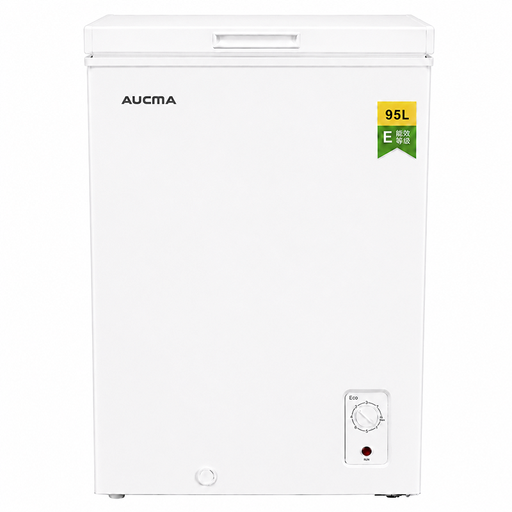 Image unavailable
AUCMA, 95 L convertible chest freezer
Worth considering for a small or supplementary food store rather than for very large quantities.
The product title lists fridge or freezer mode, a seven-level thermostat, a removable basket and a drain for defrosting.
Check the ambient temperature range and how long it can keep food frozen during a power cut, especially if you plan to install it in a cellar.
View on Joybuy
 Image unavailable
CHiQ JR99DWE, 99 L chest freezer
This capacity is better suited to extra freezer space than to storing large quantities for a family.
The product title lists a removable metal basket, an adjustable thermostat and a sliding lid. The description says it needs to be defrosted manually.
Before comparing it with other chest freezers, check the permitted ambient temperature, how long it can keep food frozen during a power cut and its kWh/year figure.
View on Joybuy
Frequently asked questions
Can you install any freezer in a cold cellar or garage?
No. You need to check the ambient temperature range for the exact model. Beko’s guide gives a range of 10 to 43 °C for the SN-T class. If your room drops below 10 °C, look for a model explicitly stated to work at that temperature rather than relying on the type of freezer.
How do you compare how long freezers stay cold during a power cut?
Compare the figures in hours for the specific models and check the conditions under which they were measured. UFC-Que Choisir, for example, measures how long the temperature takes to rise from −17 °C to −9 °C without power. You can’t work out how long a freezer will stay cold simply from whether it’s a chest or upright model.
What should you look for on a freezer’s energy label?
As well as checking the energy class, compare annual energy consumption in kWh for appliances with similar capacities and intended uses. ADEME points out that a freezer runs continuously, so it’s worth considering differences in capacity and energy consumption in relation to the size of your food store.
What should you do if a new freezer doesn’t match its description?
In France, you can claim under the statutory legal guarantee of conformity from the professional seller if the product doesn’t conform to its description. The Ministry of the Economy states that you have two years from delivery to make a claim. An optional commercial guarantee is separate from this statutory protection.


