
Livraison le jour même ou le lendemain

Qualité garantie

Débloquez vos offres de bienvenue: Livraison GRATUITE | Jusqu'à -80 % | 30 jours d'essai gratuits à JoyPlus
Téléchargez l'application
Looking to buy a chess robot for training or as an unforgettable gift? The idea of facing off against an artificial intelligence on a real chessboard is compelling. But be warned: the market is flooded with models making often-exaggerated claims. As tech experts, our mission is to help you see things more clearly. Follow our guide to sidestep marketing traps and choose the automated chessboard that won't let you down.
Before you even start comparing spec sheets, it's crucial to understand the most common buyer disappointments.
To avoid making a mistake, focus on a few key technical parameters that make all the difference.
The heart of a good chess robot is its artificial intelligence. Don't be swayed by the number of levels; instead, look at the ELO rating range it covers. A good system should be able to adapt to a complete beginner (ELO below 800) as well as a highly experienced club player (ELO above 2000). The robot's ability to simulate different playing styles is also a real asset. A quality chess AI should be able to surprise you and push you to improve.
The entire magic of physically playing chess against a computer depends on the quality of its mechanics. There are two points to check:
A modern chess robot shouldn't be a closed system. Check its ability to connect to online platforms. A Lichess- or Chess.com-connected board, for example, allows you to play against human opponents from around the world, with the robot physically moving your opponent's pieces on the board. Also, ensure there's a companion app for analysing your games and the ability to receive software updates (OTA, Over-the-Air) to evolve your chessboard and ensure its long-term relevance.
To illustrate these criteria, we've selected a model that stands out for its versatility and is suitable for several types of players.
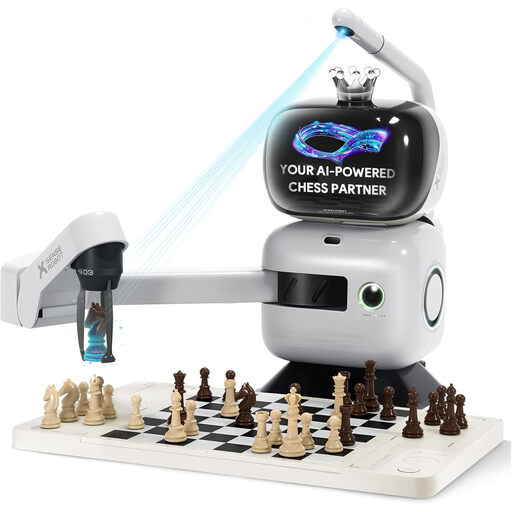
Why we chose it: Ideal for anyone looking to seriously improve their game. It offers a training partner that adapts to your level, from absolute beginner to seasoned club player, and lets you play online to test your skills against other humans.
Its AI covers an ELO range of 200 to 3200+ across 25 distinct levels, offering a real, progressive challenge—a far cry from artificially inflated levels.
Lichess.org integration for online play; game analysis via the app to track your progress.
Why we chose it: Perfect for introducing a child to chess in a fun, screen-free way. It provides a structured learning environment and a physical interaction that captures their attention.
It includes over 1,200 built-in lessons and exercises, accessible for life with no subscription required. The experience is entirely self-contained after a one-time Wi-Fi setup.
100% screen-free operation for maximum concentration; voice guidance to help children learn the rules and strategies.
Why we chose it: This is the quintessential gift for a chess player. It combines cutting-edge technology, a sleek design, and an immersive physical playing experience that will impress any enthusiast.
The robotic arm offers placement accuracy of under 1 mm and an 8-second-per-move tempo, perfectly mimicking a human opponent for an authentic gaming experience, not just a gimmicky tech demo.
Lifetime over-the-air (OTA) software updates ensure the robot evolves over time; dedicated warranty and support provide a worry-free purchase.
Our team of experts selects the best in high-tech products for you, tested for quality, innovation, and safety.
Yes, provided you choose a model with very low difficulty levels and educational aids. Features like voice guidance, built-in exercises, and the ability to take back a move are particularly useful for younger players. A model like the SenseRobot, which offers structured learning and a screen-free experience, is an excellent option for children aged 6-8 and up, ideally with adult supervision at the beginning.
Absolutely. The most advanced models, known as "connected chessboards," can sync with online chess platforms like Lichess.org. You start a game against a human opponent on the platform, and your robot physically moves your opponent's pieces on your board. It's an excellent way to combine online play with the experience of a physical board.
The lifespan depends on the build quality, especially the durability of the robotic arm. A well-designed model with quality components can last for many years. Another important factor is software support. Prioritise brands that offer regular over-the-air (OTA) updates to fix bugs, improve the AI, and add new features. This is what ensures your investment won't become obsolete after just a few years.