
Livraison le jour même ou le lendemain

Qualité garantie

Débloquez vos offres de bienvenue: Livraison GRATUITE | Jusqu'à -80 % | 30 jours d'essai gratuits à JoyPlus
Téléchargez l'application
A new baby changes everything about your home's layout, making every square metre precious. For parents in flats or compact living spaces, it's a familiar challenge: how do you manage bath time and nappy changes without dedicating an entire room to it? The changing table with an integrated bathtub emerges as the perfect solution. But be careful—behind this promising idea lie pitfalls that can quickly turn a smart purchase into a bulky, unusable piece of furniture.
As the Head of Product Recommendations at Joybuy, my role is to decode the market for you and help you make a truly informed choice. Let's break down the common mistakes to avoid and the criteria that really matter when choosing a model that will make your life easier.
Nursery equipment must be safe and practical. That's non-negotiable. Unfortunately, some models sacrifice these fundamentals for the sake of design or a rock-bottom price. Here are the most common flaws to watch out for.
To avoid these setbacks, here are the technical points that make all the difference in daily use.
Your first step: check for compliance with the European standard EN 12221-1+2:2008+A1:2013. This certification guarantees that the product has passed a series of stability, durability, and safety tests. Notably, it requires raised side barriers to prevent any risk of falls. If you're considering a changing table with a bath on wheels, make sure the braking system is both reliable and easy to engage. When it comes to your child's safety, there's no compromising.
Switching from 'changing' mode to 'bath' mode is the heart of the issue for this type of unit. There are two main systems:
The choice will largely depend on the clearance space you have around the unit.
Don't just rely on promotional photos. Take out your tape measure and precisely measure the available space in your bathroom or baby's room. Consider the total footprint once the transition mechanism (swivelling or sliding) is deployed. For a changing table for a small bathroom, every centimetre counts. Some models are foldable, making them the ultimate space-saving nursery gear. However, ensure that folding and unfolding can be done in the blink of an eye and without any effort.
Rather than an endless list, we've matched user profiles with products that meet their specific needs, based on the safety and practicality criteria we've just discussed.
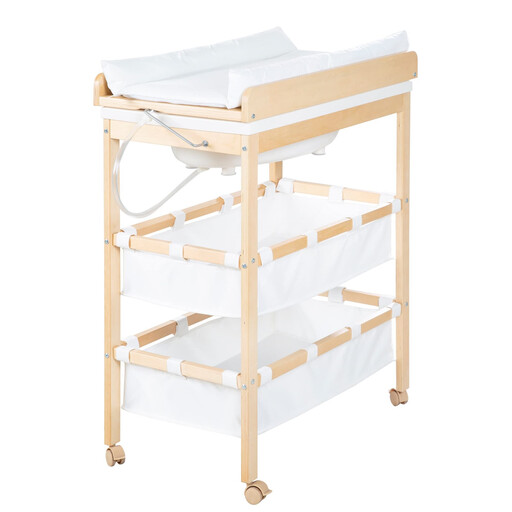
The user profile: Ideal for parents in flats who need to shuttle the unit between the bathroom and the nursery. Its high mobility and swivelling mechanism are designed for spaces where every centimetre is precious.
Its wooden frame and 4 lockable castors tackle the problem of instability. The two large fabric storage bins ensure everything is kept within arm's reach, solving the issue of inaccessible storage.
Key benefit: The changing top simply swivels to the side without needing to be completely removed. Highlights: Compliant with the EN 12221 standard, ergonomic changing height (94 cm), changing mat included.
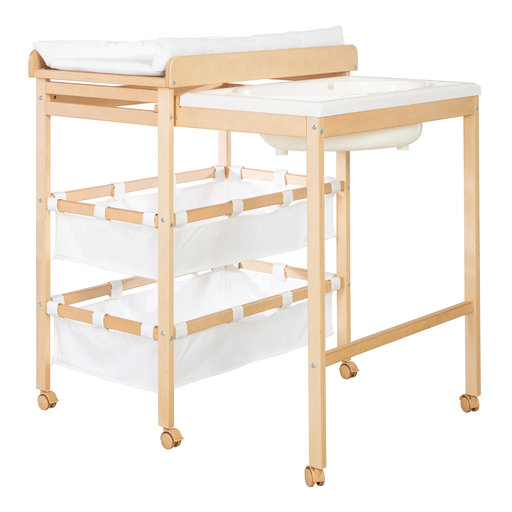
The user profile: Perfect for those who want an ultra-smooth transition between bath time and changing. The slide-out system is a real bonus for intensive daily use, making the evening routine much simpler.
The slide-out mechanism minimises complex handling and the risk of splashes (that notorious water management pitfall). Its sturdy frame on 6 lockable castors ensures maximum stability, even when the tub is extended and full of water.
Key benefit: The integrated bathtub slides effortlessly under the changing top. Highlights: Compliant with the EN 12221 standard, 6 castors for superior mobility and stability, large storage areas.
We have curated a full range of products that meet our strict selection criteria and current safety standards.
Most models include a small drainage hose. Simply point it towards a bucket, shower, or your main bathtub to drain the water. A word of advice: check the length of this hose before buying to ensure it's compatible with your setup.
Generally, these combo units are designed for use from birth up to 11 kg (approximately 12 months). The bathtub becomes too small and unsafe once your child can sit up on their own. The changing top can be used for a little longer, but always follow the manufacturer's specific recommendations.
Yes, provided it is well-designed. A model on wheels is safe if it complies with the EN 12221 standard and has effective brakes. The essential habit: always engage the brakes before placing your baby on it. Also, remember to regularly check that the screws are tight and the overall structure is solid.