
Livraison le jour même ou le lendemain

Qualité garantie

Débloquez vos offres de bienvenue: Livraison GRATUITE | Jusqu'à -80 % | 30 jours d'essai gratuits à JoyPlus
Téléchargez l'application
The arrival of a baby turns your home upside down, and suddenly every square foot becomes precious. For parents in apartments or small houses, optimising space can become a real headache. On paper, a changing table with an integrated bath seems like the miracle solution. But beware of ideas that seem good but aren't. A poor choice can quickly turn this 2-in-1 unit into a cumbersome and impractical burden. Before you take the plunge, let's review the design flaws that make some models unusable after just a few months.
To avoid these disappointments, it's best to focus on a few key technical points. A good baby bath and changing combination unit must meet a specific set of criteria for safety, ergonomics, and practicality.
Your child's safety is the top priority. The first thing to do before any purchase is to check that the product complies with the European standard EN 12221-1+2:2008+A1:2013. This certification guarantees that the structure, materials, and stability of the unit have been rigorously tested for risk-free use.
Examine the base of the unit closely. A solid wood or high-quality plywood frame will always be more durable than simple particleboard. If you opt for a model on wheels, ensure that at least two of them (ideally all four) have an effective and easy-to-engage brake.
Switching from "changing" mode to "bath" mode should be effortless and achievable with one hand. There are two main systems:
Another crucial point is the height of the changing surface. Aim for a comfortable height, between 90 and 100 cm, to save your back. Finally, the presence of a drainage hose is THE life-changing detail, saving you the chore of lifting a tub full of water.
A good changing unit with a bath and storage must offer storage solutions that deliver on their promises. Favour models with rigid shelves or reinforced fabric bins that can handle the weight of products and nappy packs without sagging.
The changing mat itself must be comfortable, but above all, safe and hygienic. Make sure it has raised edges to limit the risk of falls and is made from a waterproof, easy-to-clean material that is certified phthalate-free.
Every family has its own constraints and priorities. Here is a selection of solutions tailored to specific user profiles.
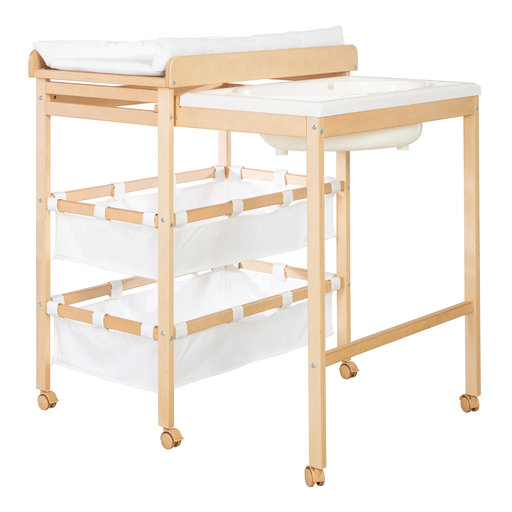
The profile: This parent is looking for an all-in-one solution that doesn't compromise on storage. The sliding system keeps the changing top and bath accessible without disrupting everything, while the two large compartments keep all essentials close at hand.
The sliding rail mechanism is designed for heavy use. The two large, reinforced textile bins offer genuine storage volume without sagging over time, helping to keep the space tidy.
Sturdy plywood structure and 6 castors with brakes for safe mobility. Ergonomic changing height (94 cm) to protect parents' backs.
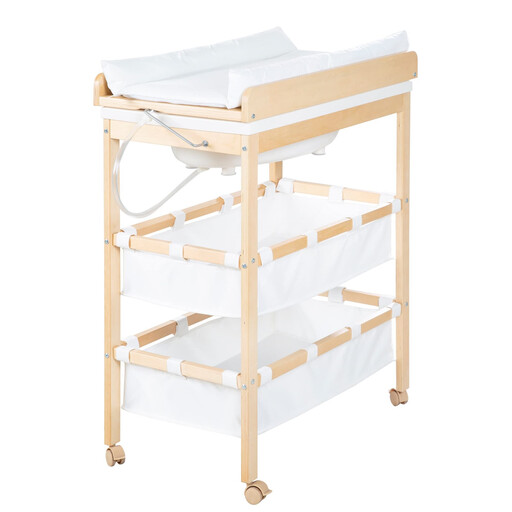
The profile: For those living in a studio or small apartment where every square inch counts. This model with a pivoting changing top is the ultimate space-saving changing table solution, as accessing the bath requires no side clearance.
Its simple and robust pivoting mechanism avoids the alignment issues common in entry-level sliding models. Its ultra-compact design concentrates all functions into a minimal footprint.
Minimal footprint thanks to the pivoting system. Compliant with the EN 12221 safety standard and equipped with castors with brakes for safe use, even in the smallest of spaces.
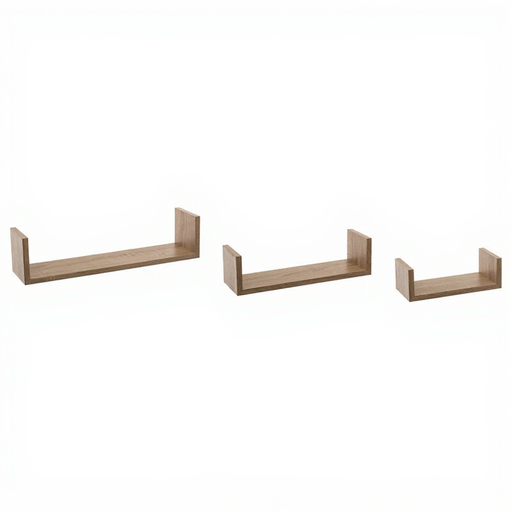
The profile: Some parents prefer to separate functions or repurpose a standard dresser into a changing table. The catch: where do you store the products? The solution is to use the often-overlooked vertical space to create a functional changing station.
Rather than relying on the often token storage of an all-in-one unit, this approach uses wall space to organise care products and keep them out of reach of curious little hands.
Flexibility and modularity. Wall shelves like the Fixy set can be installed at the desired height, above or next to the dresser, for a 100% customised and practical changing station.
We've selected a full range of furniture that ticks all the boxes: safety, practicality, and durability.
Generally, these combination units are designed for use from birth up to about 12 months (maximum weight of 11 kg). The bath itself becomes too small once the child can sit up unassisted. In any case, strictly follow the manufacturer's recommendations.
Yes, provided you invest in a quality model. It all comes down to the sturdiness of the frame and, most importantly, the reliability of the brakes. Before each use, make it a habit to check that the brakes are securely locked. And the golden rule: never, ever leave your child unattended.
The secret to well-designed models is the drainage hose. This accessory, which may seem trivial, saves you the chore of lifting the water-filled bath to empty it into the shower or a bucket. It's an essential comfort feature to check for before buying.