Managers of daily hotel buffets
You want a chamomile infusion guests can recognise without having to decipher a blend. A recipe made from 100% chamomile makes it easy to say exactly what you’re serving.


If you’re choosing just one option for a hotel coffee station, go for a tea bag infusion made from 100% chamomile. It’s the straightforward choice for guests who ask for chamomile. If your evening service calls for a second option, add a blend clearly named after its ingredients. It will have a different flavour profile, but it won’t replace a pure chamomile option for guests looking specifically for that.
You want a chamomile infusion guests can recognise without having to decipher a blend. A recipe made from 100% chamomile makes it easy to say exactly what you’re serving.
You’d like to offer a fruity or botanical infusion alongside pure chamomile. The time of service tells guests where the drink fits on the menu, not how it affects sleep.
You need to choose a tea bag count that suits your service and check that you can reorder the product through your usual supply channel.
For anyone choosing infusions for a hotel coffee station, the recipe comes first: pure chamomile meets a different need from an evening blend. Pack size and restocking options can then help you choose which products are right for your service.
| Criterion | What to check | Who is it for? |
|---|---|---|
| Pure chamomile | Does the ingredient list say 100% chamomile, with no other plants or flavourings? Check the number of tea bags too. | If I’m serving guests with varied tastes, I want to be able to offer chamomile with no added flavour; around 40% of people responsible for this choice would prioritise this simplicity. |
| Evening variety | Compare the proportion of chamomile, other plants, flavourings and brewing instructions in each blend. | To add variety to the evening menu, I’m looking for a recipe with flavours that stand apart from pure chamomile; around 30% of people would prioritise this variety. |
| Pack size and restocking | Check the number of tea bags, total weight, date on the packaging and whether you can restock through your supplier. | When I regularly replenish the buffet boxes, I want a practical pack size and a product I can find again; this would be the top criterion for around 30% of people. |
An infusion made from 100% German chamomile is not the same as a recipe that combines it with mint, lavender or fruity flavourings. They don’t meet the same need.
Label the pure option clearly, and name blends after their ingredients or dominant flavours.
Blends containing several plants need a little more explanation. For example, E.Leclerc’s product listing for Tiséa after-meal infusion states that it contains 10% liquorice and includes a warning for people with high blood pressure.
Keep the packaging and ingredient list close to the serving area. Also check the date and storage instructions for the product you’re serving.
These names suggest a product range or a time to enjoy an infusion; they don’t prove that it affects sleep or digestion.
Instead, describe the plants, flavours and when you serve the drink, without making any therapeutic claims.
These products show some of the options available, from pure chamomile to more distinctive blends. Compare the exact recipe rather than making assumptions about an entire brand.
Carrefour France’s product listing describes an infusion made from 100% German chamomile, in a pack of 25 tea bags at 1.5 g each: a simple everyday option.
Auchan France lists 100% organic German chamomile, in a pack of 20 tea bags weighing 18 g in total.
Twinings France describes its Bonne Nuit infusion as a blend of chamomile (54%), lime blossom (12.5%), apple and raspberry flavourings.
E.Leclerc offers both pure chamomile and separate blends, including an after-meal infusion in a box of 25 tea bags.
Auchan France’s product listing describes an evening infusion made with lemon balm, chamomile, orange leaf, verbena, lime blossom and lavender, in a pack of 25 tea bags.
For a hotel coffee station, these two tea-bag options serve different purposes: pure chamomile for the everyday selection, and a botanical blend to add variety to the evening menu.
 Image unavailable
This infusion offers chamomile in individually wrapped tea bags, making it a straightforward buffet option with no blend of plants.
Joybuy France’s product listing states that it contains 100% organically grown chamomile. Check the packaging for brewing instructions and the date before making it available to guests.
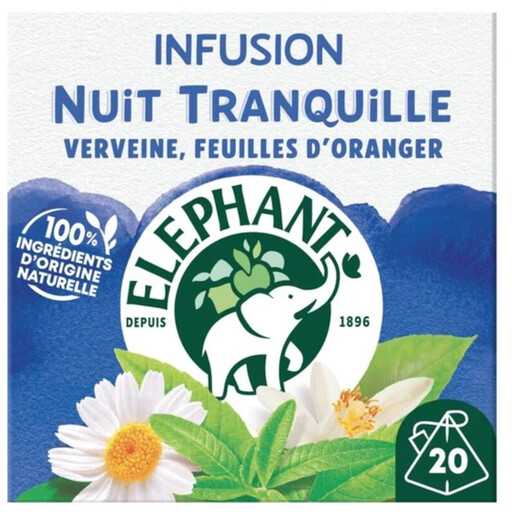 Image unavailable
This blend can add a botanical option to your evening menu alongside pure chamomile, rather than replacing it.
The box contains 20 tea bags, weighing 30 g in total. Chamomile isn’t the main ingredient, so check the packaging to describe the blend and follow the brewing instructions. Don’t attribute any effect to the name Quiet Night.
If you’re offering just one product called “chamomile”, an infusion made from 100% chamomile is the most straightforward choice. You can add an evening blend if you’d like to offer another flavour, as long as you describe it by its ingredients rather than presenting it as an equivalent alternative.
No. Use the instructions for the product you’re actually serving. Auchan France recommends brewing Auchan Bio in 200 ml of just-boiled water for 3 to 5 minutes, while Twinings France recommends brewing its chamomile, lime blossom and raspberry blend in 250 ml of water at 100 °C for 5 minutes.
Check the product name, ingredients, any stated allergens, quantity and date, then make this information available near the tea bags. The DGCCRF includes these details in its guidance on labelling prepacked food in France; also follow the storage instructions for your chosen product.
Not if you want to meet a specific request for pure chamomile: E.Leclerc’s product listing states that this blend contains 14% chamomile. It also contains 10% liquorice and advises people with high blood pressure to avoid excessive consumption.
No. A range name doesn’t prove any such effect. To help guests choose, describe the plants, flavours and brewing instructions for each infusion instead.