For those who want to keep their infusion separate from their coffee
If you’re looking for a floral cup with no fruit, spices or other added plants, a blend labelled as 100% German chamomile, such as Carrefour Classic’ and Auchan Bio, fits the bill.


With a coffee at teatime, choose 100% German chamomile if you’d like a second cup without any other plants or flavourings. If you’d prefer a fruity or spicy note in your infusion, compare the ingredients in each blend: some contain much less chamomile, and blends containing liquorice need a little extra consideration.
If you’re looking for a floral cup with no fruit, spices or other added plants, a blend labelled as 100% German chamomile, such as Carrefour Classic’ and Auchan Bio, fits the bill.
If you’d like another flavour to accompany your teatime coffee, recipes combining chamomile with apple and raspberry flavouring, or with honeybush and cinnamon, offer two distinct blends to compare.
If a particular plant or flavouring matters to you, read the full ingredients list. TISEA Après repas, for example, contains liquorice and isn’t the same as chamomile on its own.
To enjoy alongside a coffee at teatime, start by thinking about the flavour you’d like in your second cup. Then check the ingredients and the instructions for the specific product you choose.
| What to look for | Check | Who is it for? |
|---|---|---|
| Chamomile on its own | An ingredients list stating 100% German chamomile, rather than relying on the name on the front of the pack. | I want coffee to remain the focus of teatime and an infusion with no fruit or spices on the side. Around 36% of consumers prioritise this simple composition. |
| Fruity or spicy blend | The proportion of chamomile, other plants, spices and any flavourings. | If I’d like my second cup to have a distinctive flavour too, I’ll compare a fruity blend with a spicy one. This kind of blended flavour comes first for around 29% of consumers. |
| Caffeine in the infusion | The full ingredients list and, if this is a deciding factor, the specific product information on the packaging. | My coffee is already the caffeinated drink for this break; I don’t want to add more without realising it. Checking this is a priority for around 21% of consumers. |
| Plants and warnings | The ingredients, highlighted allergens and any warnings, particularly if the blend contains liquorice. | Before choosing a blend, I need to know whether any added plant is suitable for me. Around 14% of consumers put this consideration first. |
The name can refer to a single-herb infusion or to a blend containing fruit, spices, other plants or flavourings.
Check the ingredients list and the proportion of chamomile, if stated, especially if you’re looking for a cup with no added flavours.
According to E.Leclerc’s product listing, TISEA Après repas contains 14% German chamomile and 10% liquorice, so chamomile alone doesn’t define its composition.
Choose this type of blend for its full recipe, rather than as a substitute for a 100% chamomile infusion.
Anses warns that consuming large amounts of liquorice-containing products repeatedly can lead to problems including high blood pressure, and may interact with some medicines.
Read the warning on the packaging. If you have high blood pressure or take medication, ask for appropriate advice before drinking it regularly.
A 100% German chamomile option in 25 tea bags of 1.5 g, according to Carrefour’s product listing.
An organic 100% German chamomile infusion in 20 tea bags, according to Auchan’s product listing.
The Bonne Nuit blend combines chamomile, apple, lime blossom and natural raspberry flavouring, according to Twinings France.
The range featured by E.Leclerc includes plain chamomile and several blended infusions.
These two tea-bag infusions illustrate two options for teatime: one centred on chamomile and one combining several plants. Compare their ingredients before deciding which one to enjoy with your coffee.
 Image unavailable
For anyone looking for an infusion centred on chamomile to enjoy alongside coffee. If you’re specifically looking for German chamomile, check the species on the packaging, and remember to read the brewing instructions too.
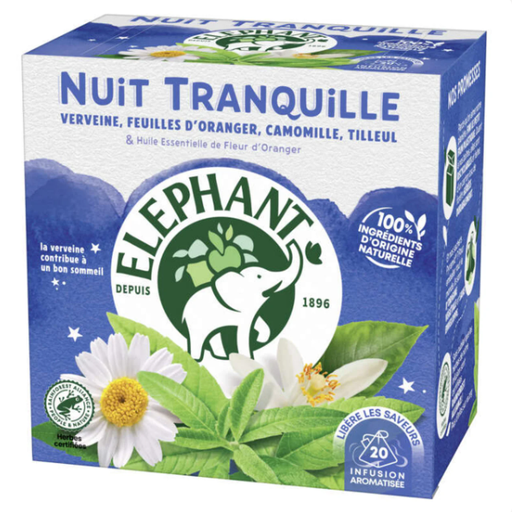 Image unavailable
For anyone who prefers a blended infusion to a cup centred on chamomile: chamomile makes up just 8% of this recipe. If the presence of honey or the absence of caffeine matters to you, check these details on the packaging rather than relying on the product name.
No. “100% German chamomile” means it contains just one plant, while a blend may also include fruit, other plants, spices or flavourings. Compare the ingredients lists if you want a cup with no added flavours alongside your coffee.
Follow the instructions for the product you’ve bought, as they vary by blend. Auchan Bio recommends 3 to 5 minutes in 200 ml of water, while Twinings France recommends 5 minutes in 250 ml of water at 100 °C for Bonne Nuit.
Don’t assume it’s caffeine-free based on the name alone: check the ingredients and the information for the specific product you choose. Clipper Keep Calm’s product listing describes that particular product as naturally caffeine-free; this doesn’t apply to every chamomile blend.
Read the warning on the packaging, particularly if you’re planning to drink it regularly. Anses warns against consuming large amounts of liquorice repeatedly and notes that it may interact with some medicines. If you have a relevant medical condition, seek appropriate advice.
Check the ingredients list on the packaging. The Directorate-General for Competition, Consumer Affairs and Fraud Control states that any allergenic ingredients must be highlighted when present.