People avoiding caffeine in the evening
You want a spiced drink without a black tea base. Look for a rooibos recipe or a ‘caffeine-free’ claim on the specific product you plan to serve.


If some people at your meeting would prefer to avoid caffeine, choose a rooibos recipe or one that is explicitly labelled ‘caffeine-free’ on the product you buy. Black tea chai is better suited to those who prefer this traditional base, while decaffeinated chai tea is another option, with different ingredients from rooibos. Tea bags make individual servings easier, but on their own they tell you nothing about the caffeine content.
You want a spiced drink without a black tea base. Look for a rooibos recipe or a ‘caffeine-free’ claim on the specific product you plan to serve.
You prefer the combination of black tea and spices, while accepting that this recipe won’t meet a request for a caffeine-free drink.
You want to hand out individual servings easily. Tea bags are handy for this, as long as you check the ingredients of each option separately.
Choose this if: avoiding caffeine is your priority and the recipe clearly states that it has a rooibos base.
Bear in mind: it’s an infusion, not a black tea-based chai. Check the other ingredients in the recipe too.
Look for this if: you want a tea-based recipe that has been decaffeinated rather than a rooibos infusion.
Check: the name and ingredients of the exact product, and don’t assume that ‘decaffeinated’ means ‘rooibos’.
Choose this if: the black tea base and spices matter more to you than avoiding caffeine.
Plan for: a separate drink for anyone who needs a caffeine-free option.
| Criteria | What to check | Who is it for? |
|---|---|---|
| Caffeine-free | Look for a rooibos base or an explicit ‘caffeine-free’ claim on the exact recipe. | If I’m serving a drink in the evening, avoiding caffeine while still enjoying the spices is my first priority. Around 42% of consumers put this requirement first. |
| Traditional base | Check that the ingredients include black tea and spices, as they do in the Kashmir Tchaï described by Kusmi Tea. | If I’m looking for black tea chai, a rooibos infusion won’t meet the same expectation. This preference comes first for around 25% of consumers. |
| Serving a group | Check the number of tea bags and the brewing instructions, then read the label for each drink on offer. | When I’m serving several people, I prefer easy-to-hand-out portions while keeping the options distinct. For around 33% of consumers, ease of serving comes ahead of other criteria. |
The word ‘chai’ doesn’t tell you what the drink is made from. For example, Kusmi Tea describes its Kashmir Tchaï as a spiced black tea.
If avoiding caffeine is essential, look for a rooibos recipe or an explicit ‘caffeine-free’ claim on the product you choose.
A tea bag makes individual servings easier, but the format tells you nothing about the caffeine content or other ingredients.
Before preparing drinks for your meeting, read the label on each product and clearly identify the caffeine-free option.
The description of a specialist chai can help you check its recipe, but it doesn’t tell you about delivery arrangements in France.
If your meeting is on a specific date, check the delivery terms and the label of the product offered by your chosen seller.
Kusmi Tea describes its Kashmir Tchaï as an organic spiced black tea.
Carrefour lists YOGI Organic Spiced Chai Infusion in a box of 15 tea bags.
Blue Lotus Chai describes its Rooïbos Masala Chaï as an organic rooibos and spice recipe, which the brand says is caffeine-free.
Clipper describes its plain organic rooibos as a naturally caffeine-free alternative to black tea.
This selection features a chai in tea bags for serving individually at a meeting. If caffeine-free or a rooibos base is essential, confirm these details on the product you buy.
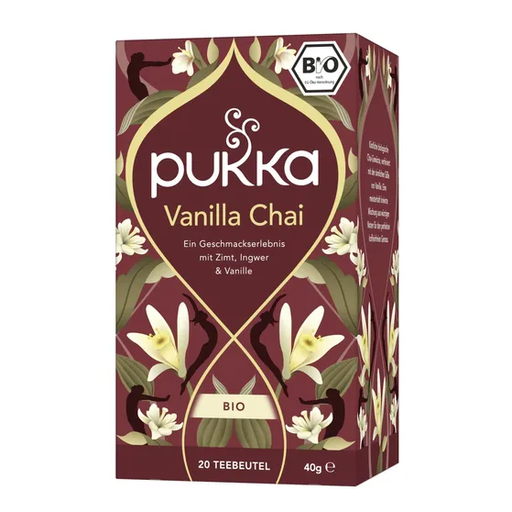 Image unavailable
The tea-bag format is ideal for serving one cup at a time during a meeting.
The product name states that the pack contains 20 tea bags. Check the ingredients list and any caffeine information if these are important to your choice.
No, the word ‘chai’ alone doesn’t mean a drink is caffeine-free. Kusmi Tea describes its Kashmir Tchaï as a spiced black tea, so check the base and the information on the product you’re thinking of buying.
No, they have different bases: rooibos is a naturally caffeine-free infusion, while decaffeinated chai tea is still made with tea that has undergone decaffeination. Check the product name and ingredients on the packaging to see which one you’re choosing.
Offer clearly labelled options according to their caffeine content, such as black tea chai and a recipe explicitly labelled caffeine-free. Tea bags make it easier to serve each option separately, but remember to check the ingredients on every box before the meeting.