Shoppers who want proof of fair trade
For afternoon tea, you want to check the chai’s own certification, which ingredients it covers and what the packaging says, rather than relying on an organic label or the brand alone.


If fair trade is your top priority when choosing a chai for afternoon tea, check the certification of the specific product. Fairtrade/Max Havelaar and the World Fair Trade Organization represent different approaches, while an organic label alone does not prove that a chai is fair trade. Then compare the recipe and format, and check whether it contains black tea, particularly if you’re having it late or are sensitive to caffeine.
For afternoon tea, you want to check the chai’s own certification, which ingredients it covers and what the packaging says, rather than relying on an organic label or the brand alone.
You’re looking for a recipe with clearly identifiable tea and spices, in bags or loose-leaf form to suit the way you prepare afternoon tea.
If you’re having afternoon tea late or serving someone sensitive to caffeine, check whether the chai contains black tea before choosing it.
Choose this if: you’re specifically looking for this label on your chai. Carrefour’s listing for JARDIN BIO ETIC Organic Black Tea Chai mentions Max Havelaar certification.
Check: if it’s a blend, read the packaging details to see which ingredients are covered.
Choose this if: you’re happy with a different fair trade approach. ETHIQUABLE says its Spiced Tchaï Tea is certified by the World Fair Trade Organization.
Bear in mind: this certification is not the same as the Fairtrade/Max Havelaar label.
Consider this if: the recipe or format matters more to you than fair trade certification. Kusmi Tea’s Kashmir Tchaï is an organic spiced black tea available in bags and loose-leaf form.
Check: being organic alone does not prove that a chai carries fair trade certification.
| Criterion | What to check | Who is it for? |
|---|---|---|
| Fair trade certification | The exact label on the product and, for a blend, which ingredients or proportion it covers. Fairtrade/Max Havelaar advises checking the back of the packaging when its label includes an arrow. | I want to know exactly what the fair trade claim covers before serving this chai. Around 45% of consumers are said to prioritise this proof. |
| Recipe and preparation | The list of teas, spices and flavourings, followed by the format (bags or loose leaf) and brewing instructions. | For afternoon tea, I prefer clearly identifiable spices and a format that suits me. The recipe and preparation are said to come first for around 33% of consumers. |
| Caffeine | Whether black tea is listed among the ingredients, especially if you’re serving the drink late in the day. | If I’m having afternoon tea later in the day, I consider how sensitive the person drinking the chai is. Limiting caffeine is said to be the main concern for around 22% of consumers. |
An organic recipe doesn’t necessarily tell you which fair trade approach applies to the chai. With a blend, you may also need to read the packaging carefully to understand what the label covers.
Look for the certification shown for the product you’ve chosen, then check which ingredients it applies to.
A product listing alone doesn’t tell you whether it’s available at your chosen shop or for delivery to your area.
Before making a trip or placing your order, check the product, its format and the information shown for your shop or delivery area.
Tea naturally contains caffeine. Anses says it can delay the onset of sleep and reduce its duration or quality.
If you’re having afternoon tea late or serving someone who is sensitive to caffeine, check whether the recipe contains black tea. If you want to avoid it, look for an infusion without black tea.
Information about a company or a different product doesn’t prove that the chai you’re holding carries the same label.
Match the full product name and recipe to the certification shown on its packaging.
According to ETHIQUABLE, its Spiced Tchaï Tea combines 71% black tea and 29% spices.
Carrefour’s listing for its Organic Black Tea Chai mentions Max Havelaar certification.
Kusmi Tea describes Kashmir Tchaï as an organic spiced black tea, available in bags and loose-leaf form, among other formats.
Lidl provides information about certifications used for products in its range, but that alone doesn’t identify a certified chai.
For afternoon tea, this Joybuy option is a vanilla chai in tea bags. If fair trade certification or caffeine is a deciding factor, check the claims and ingredients for the specific product.
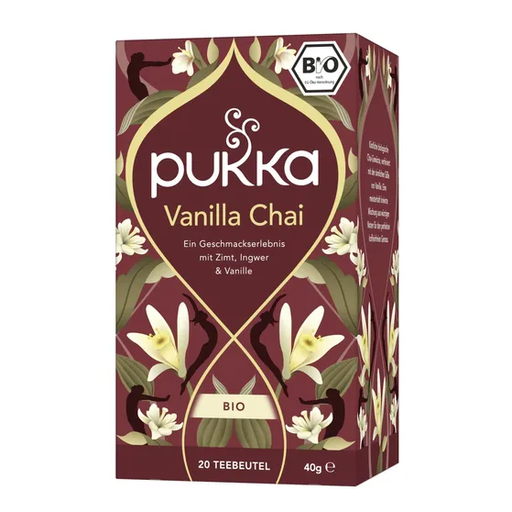 Image unavailable
Worth considering if you’re looking for a vanilla chai in tea bags for afternoon tea. Before choosing it for its fair trade credentials or because of caffeine sensitivity, check the claims and ingredients on the packaging.
No. An organic label doesn’t prove that a chai is fair trade. If this matters to you, look for certification shown on the product and read what it covers.
For a blend, check the details on the back of the packaging rather than assuming that every ingredient is covered. Fairtrade/Max Havelaar France says that its label with an arrow points to information about ingredients and traceability.
First, check whether it contains black tea and consider who will be drinking the chai. Anses reminds us that tea naturally contains caffeine, which can disrupt sleep. If you want to avoid it, an infusion without black tea is another option.
You can look at products available in supermarkets, organic shops or online, then check the certification of the chai you choose. Fairtrade/Max Havelaar France lists these as places to find its products. Before ordering or making a trip, also check the product and its availability at your shop or for delivery to your area.