Households keeping an eye on portions
You want to relate the amount poured into each bowl to the carbohydrates, sugars and fibre listed on the pack, without suggesting that the product has a medical purpose.


When sharing breakfast, start by choosing a recipe and serving size that allow everyone to follow their own dietary guidelines, rather than relying on the pack size or the words “no added sugars” alone. Bjorg muesli comes in 750 g and 1.5 kg packs, but it isn’t crunchy granola. Granola offers a different texture, while oat flakes let you choose your toppings separately. In every case, compare the nutritional values per 100 g, then work them out for the portion you actually serve.
In a household that eats breakfast together, the same cereal may be served in different quantities. The French national health insurance service says that a person’s diet should be tailored to their individual needs if they have diabetes. Choosing a pack doesn’t replace those personal guidelines.
You want to relate the amount poured into each bowl to the carbohydrates, sugars and fibre listed on the pack, without suggesting that the product has a medical purpose.
You’re planning several shared breakfasts and would consider muesli if you like its texture, even if you initially had granola in mind.
You prefer crunchy granola and want to check the ingredients, nutritional values and allergens for the specific product you choose.
First decide whether you want cereal that’s ready to serve or a base you can add to. Then compare the labels per 100 g and the amount you actually plan to serve.
Consider it: if a large pack matters more to you than crunchy clusters; Bjorg describes its 750 g no-added-sugar muesli as a family-size pack.
Bear in mind: muesli doesn’t have the texture of granola, and “no added sugars” doesn’t mean it contains no carbohydrates or sugars.
Consider it: if granola’s texture is what your household wants to serve.
Bear in mind: the Bjorg Chocolate and Auchan Plain granolas described here come in 350 g packs. Check the net weight if you’re looking for a larger size.
Consider them: if you prefer to choose your breakfast toppings separately.
Bear in mind: you’ll need to prepare and portion the toppings yourself; oat flakes aren’t a ready-to-serve alternative to granola.
| What to consider | What to check | Who is it for? |
|---|---|---|
| Nutritional values and portion | Carbohydrates, of which sugars, fibre and fat per 100 g; the amount actually served. | When someone eating with us follows specific dietary guidelines, I want to be able to relate their bowl to the nutritional information on the pack. Around 46% of consumers put checking this information and portion sizes at the top of their list. |
| Pack size for sharing | Net weight, how many breakfasts you have in mind and storage instructions after opening. | For several family breakfasts, I first look for a pack size that matches how much we eat. Around 27% of consumers put pack size and sharing first. |
| Recipe and allergens | Product name, ingredients, allergens and any “may contain” warnings for the specific product. | If crunch or certain ingredients matter to our household, I want to know the recipe before choosing. Around 27% of consumers put ingredients and allergen checks first. |
When comparing packs, start with the values per 100 g, then take the amount you pour into account: information given per 100 g doesn’t tell you everything about what’s in your bowl. The French national health insurance service recommends checking ingredients and sugar information when shopping. The nutrition declaration per 100 g gives you a useful basis for comparing products.
The Bjorg product listings for the 750 g and 1.5 kg mueslis each state that they contain 59 g of carbohydrates and 14 g of sugars per 100 g. Their recipe includes dried fruit, among other ingredients.
Check the carbohydrates, including sugars, the fibre and the ingredients list. Then relate these values to the portion served, in line with the dietary guidelines of the person concerned.
The two large Bjorg packs covered here are mueslis. The Bjorg Chocolate and Auchan Plain granolas mentioned in this article come in 350 g packs.
If you’re looking for crunchy clusters, check the product name and net weight before choosing a large pack.
Ingredients and “may contain” warnings vary from one product to another. So choosing oats alone won’t answer a question about an allergy or intolerance.
For every product you buy, read the ingredients list and allergen information on the pack, especially if someone eating with you has an allergy or intolerance.
These products are useful for comparing specific categories and pack sizes; they’re not a judgement on each brand’s entire range.
Bjorg offers no-added-sugar muesli in 750 g and 1.5 kg packs, as well as 350 g Chocolate granola. The brand also describes the 1.5 kg pack as being for professionals.
The Auchan Plain Granola listing describes a 350 g mix of toasted oat flakes.
As part of E.Leclerc’s Marque Repère range, Grainea offers different breakfast products, including 350 g granola and 1 kg oat flakes listed on the category page.
These two products suit different ways of putting together a shared breakfast: 375 g of muesli and 500 g of oat flakes. Neither should be presented as crunchy granola in a family-size pack. Compare their product types with the amount you plan to serve.
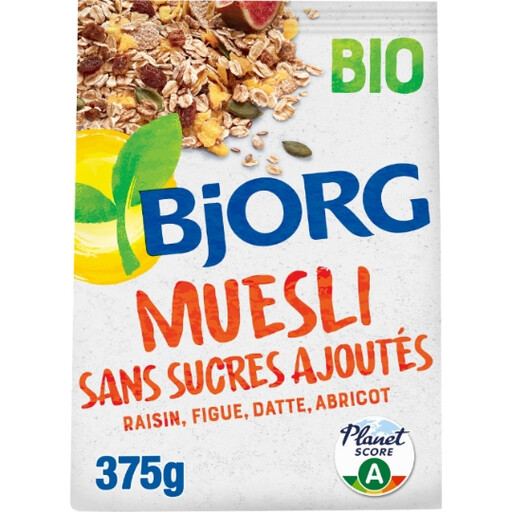 Image unavailable
Worth considering if you’d like to serve muesli rather than crunchy granola. The pack contains 375 g, so check how much you pour into each bowl. For this product, Joybuy recommends resealing the pack after opening and storing it in a dry place.
 Image unavailable
Worth considering if you prefer a base of oat flakes and want to choose your breakfast toppings separately. The pack contains 500 g; this isn’t ready-to-serve granola. Portion the flakes and any toppings to suit each person’s needs.
No. This claim doesn’t replace checking the nutritional values or taking portion size and individual needs into account. The Bjorg listings for the 750 g and 1.5 kg no-added-sugar mueslis state that they contain 59 g of carbohydrates and 14 g of sugars per 100 g. The French national health insurance service says that a diet for someone with diabetes should be tailored to the individual.
Start with the product name, ingredients, allergens, net weight and nutritional values. The French Directorate-General for Competition, Consumer Affairs and Fraud Control says allergens must be highlighted in the ingredients list and nutrition declarations must be given per 100 g or 100 ml. For this type of cereal, use the per-100 g values to compare packs.
Follow the instructions for the product you’ve bought. For its 375 g Bjorg muesli, Joybuy recommends resealing the pack and keeping it in a dry place. The Auchan Plain Granola listing recommends resealing its pack using the zip closure. Also check the best-before date on the packaging.