Who are these criteria useful for?

Parents who pay attention to ingredients

You regularly prepare packed lunches and want to compare sugar, fibre and salt. Nutrition information per 100 g makes it easier to compare products, as the DGCCRF explains. If a Nutri-Score appears on the packaging, it doesn’t replace checking the label.

Multipack shoppers

You want to know how many bars you can pack in your child’s lunches for the week. The formats shown by Carrefour and Auchan highlight why it’s useful to distinguish between the number of bars, their weight and, where relevant, the number of individual sachets.

Households managing allergens

You need to check certain ingredients before choosing a recipe. According to economie.gouv.fr, allergens must be highlighted in the ingredients list. Check the packaging for the exact product, including any ‘may contain’ statements.

What should you check before choosing?

Criteria What to check Who it matters to
Ingredients and sugars Compare the ‘of which sugars’ figures per 100 g and per portion, then check the ingredients list. The DGCCRF presents the per-100 g value as a basis for comparing products. If I prepare packed lunches regularly, I want to know what’s in the bar rather than rely on the name of the cereal. Around 36% of consumers put this check at the top of their list.
Portion to pack Check the weight of each bar and how many bars are in each individual sachet. The number shown on the box doesn’t always tell you what’s inside each sachet. If I want to pop a portion in a bag without having to divide it up, I need to know what’s inside each sachet. This convenience comes first for around 29% of consumers.
Multipack format Count the bars in the pack and compare that number with the packed lunches you plan to prepare. When I’m shopping for several days, I want to know how many packed lunches a pack will cover. Around 21% of consumers prioritise this.
Allergens Read the highlighted allergens in the ingredients list and check the exact packaging for any ‘may contain’ statements. If certain ingredients need to be avoided, I check the specific recipe before putting a bar in a packed lunch. This is the main concern for around 14% of consumers.

Common mix-ups to avoid

  • Assuming ‘wholegrain’ means low in sugar

    The presence of wholegrain oats alone doesn’t tell you how much sugar a product contains. Anses points out that processed foods can contain a range of sweetening ingredients.

    Compare the ‘of which sugars’ figures per 100 g and per portion, then read the ingredients list.

  • Confusing a bar, a sachet and a pack

    A pack containing several bars doesn’t guarantee that each one comes in its own sachet. The inner packaging affects how you prepare a packed lunch.

    Check how many bars are in each sachet and their weight before choosing a format.

  • Relying on a recipe name to identify allergens

    Ingredients vary from one bar to another. The Kellogg’s Caramel & Almond product described by Carrefour contains peanuts and almonds, among other ingredients. The name alone doesn’t tell you everything you need to check.

    Read the allergens and any ‘may contain’ statements on the exact packaging. Also check the school’s guidance if it applies to food brought in from home.

Brands to consider

Kellogg’s

The products shown by Carrefour and Auchan include cereal bars in different formats and recipes, including Special K Milk Chocolate in a pack of six 20 g bars and a wholegrain oat recipe.

  • The six-bar, 20 g format makes it easy to count how many bars to pack.
  • Check the ingredients and allergens for each recipe rather than assuming they’re the same across the brand.

Carrefour

The retailer stocks both its own-brand cereal bars and products from other brands in its cereal bar range.

  • The formats shown make it easy to compare the number of bars in each pack.
  • Check the ingredients and portion size of the product you choose rather than assuming the recipes are similar.

Auchan

Auchan’s range distinguishes between chocolate bars, fruit or honey recipes, and protein bars.

  • This makes it easier to find the type of recipe you’re looking for.
  • A claim in a range name doesn’t replace comparing the nutrition information for the exact product.

Choco BN

The BN product described by Auchan is a chocolate-flavoured filled biscuit, not a cereal bar.

  • You can consider it separately if you’re looking for a biscuit for a snack.
  • Don’t assume its portion size or ingredients match those of a cereal bar.

An option on Joybuy

If you’re counting how many bars to pack in your lunches, this Joybuy selection features a multipack of cereal bars.
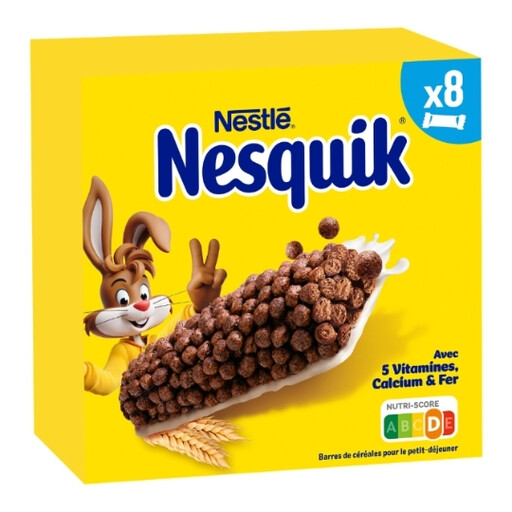
Nesquik cereal bars, pack of 8 × 25 g bars

Nesquik cereal bars, 8 × 25 g

This pack gives you eight 25 g bars to use when preparing packed lunches.

The product information states that it contains 33.4% wholemeal flour, 23.5 g of sugars and 0.38 g of salt per 100 g. The recipe contains wheat and milk and may contain traces of nuts. Check the exact packaging if these ingredients need to be avoided. If you need one individual sachet per bar, check the pack to confirm.

View on Joybuy

Frequently asked questions

Is one cereal bar enough for a secondary school pupil’s snack?

A bar is a convenient portion to take with you, but it isn’t a snack in itself. Manger Bouger offers snack ideas for children and teenagers, including advice to limit foods high in fat and sugar. Choose what works alongside the rest of the meal.

How do you compare two packs of different sizes?

Start with the nutrition information per 100 g, then check the weight of each bar and how many bars are in each sachet. The DGCCRF explains that figures per 100 g make it easier to compare products. The portion size then tells you how much you’ll actually be taking with you.

Is Nutri-Score compulsory on cereal bars in France?

No. According to economie.gouv.fr, displaying the Nutri-Score is voluntary. If it appears on the pack, you can use it alongside the portion weight, nutrition information and allergen details.

Which allergens should you check for a packed lunch?

Check for any allergens relevant to your child on the exact product. The recipes reviewed may contain wheat, milk, soya, peanuts or nuts, among other ingredients. Economie.gouv.fr states that allergens must be highlighted in the ingredients list. Also check for any ‘may contain’ statements.

Does ‘no added sugars’ mean ‘sugar-free’?

No. Anses explains that this claim doesn’t rule out sugars from the ingredients. Check the ‘of which sugars’ line in the nutrition information to see the amount listed.