People keeping an eye on their snack budget
You buy snacks for several days and want to know exactly how much each pack contains.


When choosing cereal bars for work, start by working out how many portions you need and what total weight suits your breaks. Then compare the ingredients in packs that meet your needs. A larger pack won’t tell you everything about the ingredients or allergens, and a cereal bar is a snack—not a lunch in itself.
You buy snacks for several days and want to know exactly how much each pack contains.
You’re looking for enough portions for your planned days at work, in a format that’s easy to take along separately if the packaging allows.
You compare the ingredients and allergens for your chosen flavour, as well as the nutritional information and Nutri-Score, if shown.
Start by counting the breaks you need to cater for. The pack weight and the weight of each bar then help you make sense of the pack size. Check the ingredients on the exact product you’re considering, especially if particular ingredients matter to you.
| What to consider | What to check | Who is it for? |
|---|---|---|
| Pack quantity | Net weight and number of bars. | If I’m buying snacks for several days, I want the pack quantity to match the breaks I’ve planned. Around 42% of consumers prioritise keeping track of what they buy. |
| Portions to take with you | Weight per bar and individual wrapping, if stated. | When planning my breaks at work, I look for portions I can spread across several days. This is the top priority for around 33% of consumers. |
| Ingredients and allergens | Ingredients and allergens for the exact flavour; Nutri-Score, if shown. | If the ingredients or a dietary requirement guide my choice, I need to read the label before settling on a pack size. This is the main consideration for around 25% of consumers. |
According to Santé publique France, when Nutri-Score appears on the packaging, it lets you compare similar products on a per-100 g basis. It doesn’t replace the ingredients list or allergen information.
Two packs may contain bars of different weights, so the number of bars alone doesn’t tell you how much you’ll be taking with you.
Check the net weight and, if stated, the weight of each bar before choosing a pack size for your breaks.
Ingredients vary between products and flavours. For its ECO+ milk chocolate and banana product, E.Leclerc lists oats, wheat, milk and soya; this list doesn’t apply to all ECO+ bars.
Read the label for the exact flavour, especially if you need to avoid an allergen.
A score can help you compare similar products, but it doesn’t tell you about the ingredients or allergens that may affect your choice.
Check the ingredients and nutritional information for the product you choose as well.
A pack with more bars than you need may contain more portions than the number of breaks you’ve planned.
Count the portions you’ll use and check the date on the boxes before buying several packs.
The pack sizes below are examples of specific products. Always check the label of the product you’re considering rather than assuming that an entire range has the same ingredients.
E.Leclerc offers ECO+ products in boxes of 6 bars, weighing 126 g.
Carrefour offers packs of 6 and 8 bars across these ranges.
Auchan’s range includes own-brand bars as well as products from several well-known brands.
Auchan offers, among others, a Kellogg’s oats and honey product in a pack of 4 x 2 bars, weighing 160 g.
These Joybuy products contain several bars in one pack. Choose a quantity that suits your breaks, and check the label for your chosen flavour before buying.
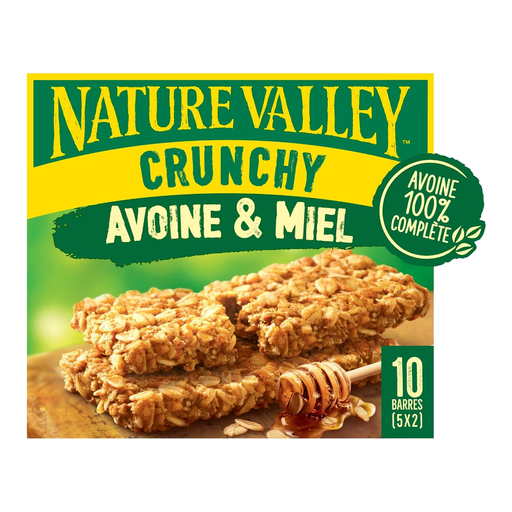 Image unavailable
Worth considering if you like to spread oat and honey bars across several breaks at work. The pack is listed as 210 g and contains 5 bars. Check the packaging for the ingredients and allergens in this product.
 Image unavailable
The pack of eight bars gives you portions for several breaks at work. Each bar is listed as 25 g. If the ingredients matter to your choice, check the ingredients and allergens on the pack.
 Image unavailable
This pack may suit you if you’re planning more breaks and fancy blueberry-flavoured bars. It contains 12 bars, each weighing 68 g. If you need to carry them separately, check how they’re wrapped, as well as the allergens in this product.
Compare the net weight, the number of bars and the weight of each portion, if stated. This will help you choose an amount that suits the breaks you’ve planned, without relying on the number of bars alone.
No. As the DGCCRF explains, displaying it is voluntary. If it is shown, Santé publique France recommends using it to compare similar products. It is calculated per 100 g and doesn’t replace checking the ingredients and allergens.
Read the ingredients list and check which allergens are highlighted on the packaging for the exact flavour. The DGCCRF says that allergenic ingredients must be identified on the labels of prepacked foods. Don’t assume that the ingredients in one recipe are the same as in another.
A bar’s format alone doesn’t make it a lunch. If you’re taking one for your lunch break, check its ingredients and nutritional information, and consider it alongside the rest of your meal.