To choose a cereal bar to take with you while revising, and prioritise a lower fat content, compare the amount per 100 g across products intended for the same purpose, then check the portion you’ll eat. Also check the sugars, ingredients and allergens: a claim such as ‘less sugar’, ‘organic’ or ‘protein’ doesn’t tell you how much fat a bar contains.
Who is this guide for?
People who are keeping an eye on fat
You want to take a bar with you while revising and compare its fat content with that of other bars. The amount per 100 g gives you a like-for-like basis for comparison; the portion figure then tells you how much is in the bar you’ll eat.
People who check several nutritional values
You want to look at sugars, fibre, protein and salt too, rather than choosing based on a single claim on the front of the pack. If a Nutri-Score is shown, it can help you compare similar products.
People who need to check the ingredients
If certain ingredients or allergens affect your choice, start with the list on the packaging of the exact variant. The French Directorate-General for Competition Policy, Consumer Affairs and Fraud Control says that allergenic ingredients must be highlighted.
Which criteria should you check first?
When choosing a bar to take with you while revising, start with anything that could rule a product out, such as an ingredient you need to avoid. Then compare the nutritional values of the remaining options. The French Directorate-General for Competition Policy, Consumer Affairs and Fraud Control notes that nutrition information per 100 g makes it easier to compare products.
| Criterion | What to check | Who this matters to |
|---|
| Fat |
The amount per 100 g across comparable bars, then the amount in the portion you’ll eat. |
If I’m looking first for a lower-fat bar for my revision breaks, I want to compare recipes on the same basis before looking at the size of the bars. Around 31% of consumers put fat content at the top of their list of criteria. |
| Other nutritional values |
Sugars, fibre, protein and salt per 100 g; the Nutri-Score as an additional guide, if it’s shown on the pack. |
A ‘less sugar’ or ‘protein’ claim might catch my eye, but I want to check the other values before choosing my snack. Looking at the overall nutritional profile is the main priority for around 31% of consumers. |
| Ingredients and allergens |
The ingredients list and allergen information for the exact variant, including any warnings about possible traces. |
If I need to avoid an ingredient, a fat content that suits me doesn’t necessarily make the bar suitable. For around 23% of consumers, ingredient suitability comes before other criteria. |
| Portion size |
The total weight, number of bars and, if shown on the packaging, the weight of an individual bar. |
If I’m planning several revision breaks, I want to know how many bars are in the box and how much each one weighs. Around 15% of consumers prioritise portion size above all else. |
Common misconceptions to avoid
-
Assuming ‘organic’, seeds or almonds mean ‘lower fat’
Carrefour France’s product listing for Carrefour Bio Seed and Almond bars states that they contain 39 g of fat per 100 g. So you can’t assume from the recipe name that they’ll meet your needs if you’re looking for a lower-fat bar.
Compare the amount per 100 g, then check the ingredients and allergens for the product you’re considering.
-
Confusing sugars, protein or fibre with fat
A range focused on another nutrient doesn’t tell you the fat content of each recipe just from its name.
Read the ‘fat’ and ‘sugars’ rows separately in the nutrition table.
-
Checking only the nutrition table when you need to avoid an allergen
Nutritional values don’t replace the ingredients list or any warnings about possible traces. The French Directorate-General for Competition Policy, Consumer Affairs and Fraud Control says that allergenic ingredients must be highlighted.
Check the packaging of the exact variant before comparing the products that meet your requirements.
Brands to compare
Carrefour
Carrefour France offers cereal bars across several own-brand ranges.
- The range includes different recipes and formats, giving you several labels to compare.
- Carrefour Bio Seed and Almond bars contain 39 g of fat per 100 g, according to the product listing: ‘organic’ doesn’t mean ‘lower fat’.
Auchan
The Auchan range includes bars labelled ‘LESS SUGAR’.
- This label helps you spot products focused on sugars.
- It doesn’t tell you their fat content, so check the nutrition table for each product.
Kellogg's
The Auchan range reviewed includes Special K and Frosties bars.
- These products give you some options to consider in the cereal bar aisle.
- If you’re looking for a lower fat content, compare the values for the specific recipe.
Nature Valley
The ranges reviewed include Crunchy, Protein, Sweet & Salty and +Fibre recipes.
- The range names help you tell the different recipes apart.
- These names don’t prove that a recipe contains less fat.
Grany
The Auchan range includes the brand’s cereal bars in several recipes.
- Its different variants can be included in a comparison of cereal bars.
- Focus on the exact recipe and its nutritional information rather than making assumptions about the whole brand.
Two Joybuy products to consider
These two products show different options for a snack to take with you: a box of blueberry energy bars and apple cereal bars. Before choosing based on fat content, compare the values shown on the packaging of each product.
 Image unavailable
CLIF BAR Blueberry Energy Bar, 12 × 68 g
Worth considering if you’re looking for an energy bar to take with you, rather than a classic cereal bar. The box contains 12 bars of 68 g each. If fat and sugar content are important to you, compare the figures on the packaging and check the ingredients if you need to avoid anything.
View on Joybuy
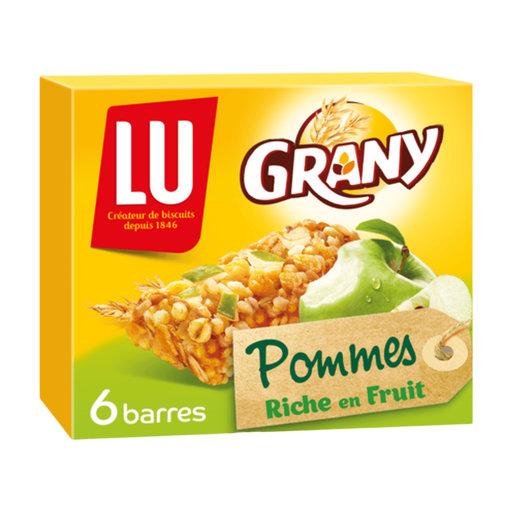 Image unavailable
LU Grany apple cereal bars, 125 g
Worth considering if you’re looking for an apple cereal bar for your revision breaks. The pack weighs 125 g. Check how many bars it contains and the weight of each one to work out the portion, as well as the nutrition table and ingredients for the exact variant.
View on Joybuy
Frequently asked questions
How do I compare the fat content of two bars?
Check the ‘fat’ row per 100 g in the nutrition tables for comparable bars. As the French Directorate-General for Competition Policy, Consumer Affairs and Fraud Control explains, presenting values per 100 g makes comparisons easier. Then check how much fat is in the portion you plan to eat.
Does a ‘less sugar’ bar necessarily contain less fat?
No. The claim refers to sugars and doesn’t tell you anything about the fat content. For the recipe you’re interested in, check both rows in the nutrition table.
Is the Nutri-Score enough to choose a bar for revision?
No. If shown, the Nutri-Score can be an additional guide when comparing similar products, as Manger Bouger suggests. It doesn’t replace checking the fat, sugars and ingredients that matter to you.
Where can I check the allergens in a cereal bar?
Check the ingredients list and allergen information on the packaging of the exact variant. The French Directorate-General for Competition Policy, Consumer Affairs and Fraud Control says that allergenic ingredients must be highlighted; also read any warnings about possible traces.


