People who take small snacks with them
If you regularly pop a bar in your bag, the number of portions and their individual weight can help you choose a pack that suits your travels.


To choose cereal bars to take with you, compare the number of portions and the weight of each bar, then check the ingredients and nutritional information. Smaller portions are handy for a quick snack. For a longer break, look at the weight per portion rather than assuming a heavier bar will necessarily keep you fuller.
If you regularly pop a bar in your bag, the number of portions and their individual weight can help you choose a pack that suits your travels.
Oat-based options and 35 to 40 g bars listed by Auchan and Carrefour let you compare larger portions with smaller individually wrapped bars.
If certain ingredients or allergens matter to you, read the label on the product you’re buying rather than relying on the range name alone.
Start by distinguishing the total contents of the pack from the portion you’ll actually take with you.
| Criteria | What to check | Who is it for? |
|---|---|---|
| Pack contents | Compare the number of bars and their individual weight, not just the total weight. | If you’re planning several short breaks, you’ll want to know how many portions the pack actually contains. Around 40% of consumers would put this first. |
| Portion for on the go | Check whether each portion contains one bar or several. | When you’re packing your bag, it’s helpful to take a portion that matches the break you have planned. Around 30% of consumers would consider ease of carrying the main factor. |
| Ingredients | Read the ingredients and allergen information; compare nutritional values on the same basis, particularly per 100 g. | If you need to avoid an ingredient, the exact recipe matters more than the name on the front of the pack. Around 20% of consumers would make ingredients their top priority. |
| Portion size | Check the weight per bar and the nutritional information per portion. | For a longer break, you’ll want a larger portion than a small snack. Around 10% of consumers would put this need first. |
Ingredients vary from recipe to recipe. A range name or image isn’t enough to tell you which allergens are present in the bar you’ve chosen.
Check the ingredients list and allergen information on the packaging of the product you’re buying.
A label such as “Less Sugar” or “Protein” doesn’t tell you everything about the ingredients or nutritional values. Anses points out that sweetening ingredients can appear under a variety of names.
Compare the ingredients and nutritional information for the recipes you’re interested in on the same basis.
Carrefour lists several Classic' cereal bar recipes in packs of six small portions.
The Auchan catalogue features Crousty cereal bars and products labelled “Less Sugar”.
The Carrefour and Auchan catalogues list several Kellogg's formats, including Special K, oat bars and a High Protein product.
These two packs show some of the formats you can compare when choosing cereal bars to take with you: a 210 g pack of Nature Valley bars and a pack of eight 25 g Nesquik bars. Check the pack details and ingredients for the product you choose.
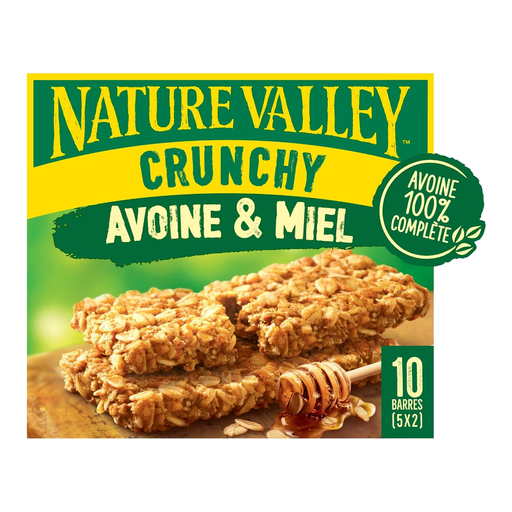 Image unavailable
Worth a look if you’re after oat and honey cereal bars to take with you. The pack is marked x5 and states a total weight of 210 g. Check the packaging to see how many bars are in each unit, and read the label if you have an allergy.
 Image unavailable
This pack size gives you eight small 25 g portions for breaks on the go. If these details matter to your choice, check the packaging and ingredients.
It’s a small portion, but the weight alone can’t tell you whether it’ll suit you. Depending on the break you have in mind, compare the weight per bar with the 35 to 40 g formats listed by Carrefour and Auchan.
Read the ingredients and allergen information on the packaging of the product you’re buying, even if you already know its name. The DGCCRF points out that prepacked food labelling includes an ingredients list.
No. Compare the ingredients list and nutritional information for each recipe on the same basis. Anses notes that sweetening ingredients can appear under a variety of names.
Read the exact wording of the date and follow the storage instructions on the packaging. The DGCCRF distinguishes between a use-by date, which must be observed, and a best-before date, usually worded “best before”.