For a small late-night snack
You want an individual bar whose weight and kcal are easy to check. Compare the sugars per bar too, and don’t confuse a small portion with a low-sugar one.


For a small late-night snack, start by comparing the kcal in the whole bar, then check the sugars and fibre in that same portion. The figures per 100 g alone won’t tell you how much you’ll be eating. If you’re looking for a more substantial portion or a specific amount of protein, check the bar’s weight and ingredients rather than assuming it will be lower in calories. If you have an allergy, check the ingredients and any ‘may contain’ warnings on the packaging of the specific product you choose.
You want an individual bar whose weight and kcal are easy to check. Compare the sugars per bar too, and don’t confuse a small portion with a low-sugar one.
A very small bar may not always satisfy your hunger. The portion weight, fibre and ingredients can help you compare different formats. Manger Bouger says that fibre can help you feel fuller for longer between meals.
If you need to avoid an ingredient, check the exact recipe and any ‘may contain’ warnings. Wheat, milk, soya, peanuts and tree nuts are among the ingredients or allergens listed for some of the products featured here, but not necessarily all of them.
Start with the portion you plan to eat, then compare products based on what matters most to you.
| What to compare | What to check | Who is it for? |
|---|---|---|
| Portion and energy | The weight and kcal of the whole bar; figures per 100 g are useful for comparing different formats. | If I eat late and don’t want to open a second bar, I look for a portion whose energy content I can keep track of. Around 42% of consumers prioritise portion control and kcal. |
| Fibre and sugars | The fibre and sugars per portion, taking the bar’s weight into account. | If a small bar doesn’t satisfy my hunger, I want to check its ingredients before choosing a larger format. This is the main priority for around 33% of consumers. |
| Specific ingredients | The protein per portion if that’s what guides your choice; the ingredients list and allergens if you need to avoid anything. | I’m looking for a specific amount of protein or need to avoid an ingredient, so the ingredients matter more than the kcal figure alone. Around 25% of consumers prioritise this check. |
A 21.5 g bar and a 40 g bar won’t provide the same amount of energy if you eat one whole bar, even though the per-100 g figures let you compare their composition.
Start by checking the kcal in the portion you’ll actually eat, then use the per-100 g figures to compare products of the same weight.
Carrefour says its Carrefour Sensation Seeds and Chocolate recipe contains 577 kcal per 100 g. So a recipe made with seeds or a protein bar doesn’t tell you how many kcal are in a portion just from its name.
Check the bar’s weight, kcal and sugars per portion, then look at the fibre or protein if these matter to your choice.
Ingredients and ‘may contain’ warnings vary between recipes. The DGCCRF states that allergens must be clearly highlighted on the labels of relevant food products.
If you have an allergy or need to avoid an ingredient strictly, read the packaging of the exact product you’re buying, including any ‘may contain’ warnings.
Two Special K formats show how much a small cereal bar can differ from a Protein version.
The Seeds and Chocolate recipe lets you compare a bar made mainly with seeds against a small cereal bar.
The Matin Hazelnut and Cocoa bar is a useful comparison if the fibre per portion matters to you.
The crispy caramel and milk chocolate bar is aimed at those looking for protein, rather than a small cereal bar.
Supermarket own-brand products offer other formats and ingredients to check bar by bar.
These two products let you compare a 25 g Nesquik cereal bar with a 28 g Granola Extra biscuit bar. If you’re specifically looking for a cereal bar, bear in mind that these belong to different categories.
 Image unavailable
This format is a good choice if you want to compare the nutritional content of an individual 25 g bar. The figures for this product work out at around 97 kcal and 5.9 g of sugars per bar, so even a small bar is worth checking for its sugar content. The recipe includes wheat and milk and may contain tree nuts. Check the packaging if you have an allergy.
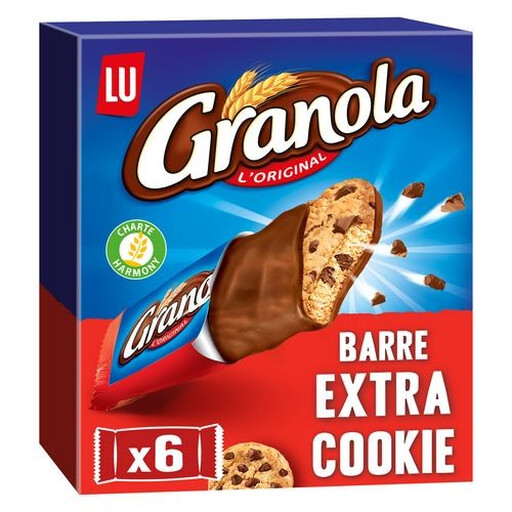 Image unavailable
This biscuit bar is a useful comparison if you’re also considering a format other than a cereal bar. A 28 g bar contains around 136 kcal, while the product lists 39 g of sugars per 100 g. The recipe includes wheat, milk and soya and may contain eggs. Check the packaging if you need to avoid any of these ingredients.
No. This description alone isn’t enough to compare bars of different weights. Check the kcal in the bar you’ll eat, then look at the figures per 100 g. For example, Kellogg’s says its 21.5 g Special K dark chocolate bar contains 85 kcal.
Compare the fibre per portion with the weight, kcal and sugars in that same portion. Manger Bouger says that fibre can help you feel fuller for longer between meals, but that figure alone can’t tell you which bar to choose.
Not necessarily if your priority is a small portion. Kellogg’s says its 28 g Special K Protein bar contains 116 kcal and 5.9 g of protein. The Auchan listing for an Inshape Nutrition bar gives 162 kcal and 15 g of protein per 45 g bar. Compare the ingredients and allergens in each recipe too.
Read the ingredients list and any ‘may contain’ warnings on the packaging of the exact product. The DGCCRF notes that allergens must be clearly highlighted on the labels of relevant food products. The name of a range is no substitute for checking the packaging.