Parents preparing several lunchboxes
If you’re preparing snacks for several days or for more than one child, count how many bars you need and check their weight. A large number on the pack doesn’t, by itself, tell you how the portions are packaged.


When preparing several lunchboxes, compare the number of bars, portion sizes and ingredients rather than simply choosing the biggest pack or relying on the word ‘cereal’. For snacks, Manger Bouger recommends offering a variety of foods and limiting those that are high in fat or sugar. If your child has an allergy, check the label on the product you buy and follow any relevant instructions from their school.
If you’re preparing snacks for several days or for more than one child, count how many bars you need and check their weight. A large number on the pack doesn’t, by itself, tell you how the portions are packaged.
Cereal bar recipes vary. When choosing something for a snack, compare the ingredients and nutritional information per portion and per 100 g, particularly the sugar, fat, salt and fibre. Manger Bouger recommends varying snacks and limiting foods that are high in fat or sugar.
The DGCCRF reminds shoppers that allergenic ingredients must be highlighted on the labels of prepacked foods. For a child with specific needs at school, the French Ministry of National Education explains that an individual care plan, or PAI, can set out dietary adjustments.
First, check that the pack contains enough portions for the number of lunchboxes you’re preparing. Then look at the recipe and any instructions that apply to your child.
| What to compare | What to check | Who is it for? |
|---|---|---|
| Number and size of portions | Count how many bars you need, then check the weight of each bar and how they’re packaged. | If you’re preparing several lunchboxes and don’t want to split up a loose pack, the number of portions comes first; around 33% of consumers prioritise this. |
| Ingredients | Compare the ingredients and nutritional values per portion and per 100 g, particularly the sugar, fat, salt and fibre. | If the recipe needs to fit into a varied snack, its ingredients matter more than the pack size; around 25% of consumers give this top priority. |
| Allergens and school requirements | Check the allergens in the product you’re buying and, if necessary, the PAI and school instructions. | If your child needs to avoid certain ingredients or follow dietary instructions at school, product suitability comes first; around 25% of consumers prioritise this above all else. |
| Taste, texture and variety | Before buying a large pack, check that your child likes the recipe and can open the packaging. | A snack your child doesn’t enjoy could come home uneaten; around 17% of consumers prioritise whether their child will accept it. |
Six bars don’t always weigh the same: Carrefour, for example, offers a 6 x 18 g pack, while E.Leclerc lists a pack of six bars with a total weight of 126 g.
Work out how many portions you need, then compare the net weight, weight per bar and packaging.
The product name doesn’t tell you everything about the recipe. For example, Kellogg’s lists 6.2 g of sugar per 24 g portion in its Corn Flakes Cacao bars.
Read the ingredients and nutritional information for the portion you’re planning to serve, then consider the bar as part of a varied snack.
Allergens vary between products. The DGCCRF reminds shoppers that allergenic ingredients must be highlighted in the ingredients list on prepacked foods.
Check the label on the product you’re buying and follow any instructions that apply to your child, including those in a PAI, if they have one.
The 48-biscuit Choco BN pack shown by Auchan is neither a cereal bar nor a pack of individually wrapped portions.
If you need portions that are already separated, check the packaging rather than relying on the number of items in the pack.
The products reviewed include Corn Flakes Cacao and Croustille Avoine Miel bars, which have different recipes and portion sizes.
The retailer offers several cereal bar recipes in packs of six, with weights varying between products.
E.Leclerc offers Marque Repère cereal bars in a range of recipes, including packs of six.
This is a filled biscuit, so it belongs to a different snack category rather than being a cereal bar.
These two cereal bar products let you compare a 210 g pack of five with a pack of eight 25 g bars when preparing several lunchboxes. Before choosing, check the portion packaging and exact recipe on the pack.
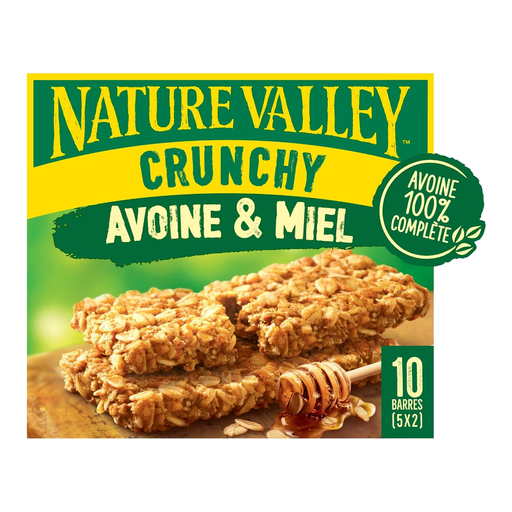 Image unavailable
A format to consider if you want five bars for your lunchboxes. The net weight is 210 g; check the pack to see how the bars are grouped, how much you plan to serve and which allergens the recipe contains.
 Image unavailable
This pack could suit you if you need eight bars to share between several lunchboxes. Each bar is listed as 25 g; check the recipe label for allergens and the nutritional values for the portion you plan to serve.
Don’t choose a snack based solely on whether it includes a cereal bar. Manger Bouger recommends offering children a variety of foods and limiting those that are high in fat or sugar. Consider the recipe and what else makes up the snack.
Compare the number of bars, net weight, weight per bar and how they’re actually packaged. Also read the ingredients, allergen information and nutritional values: two packs with the same number of bars may contain bars with different weights and recipes.
Read the label on the product you’re buying rather than relying on the range name or a previous purchase. The DGCCRF states that allergenic ingredients must be highlighted on prepacked foods. If your child needs adjustments at school, also check the instructions in their PAI, if they have one.
The Anses says it’s not advisable to add eating occasions outside structured meals. If you’re preparing a lunchbox for a snack, check when it will be eaten and what instructions apply at the school.