People keeping a close eye on fat
To have with your coffee, you’re looking for a bar whose fat content you can compare with other recipes on the same per-100 g basis.


To choose a lower-fat cereal bar to enjoy with your coffee, compare the fat content per 100 g of products intended for the same purpose, then check the sugars and serving size. A recipe containing nuts, or a ‘organic’ or ‘gluten-free’ claim, does not tell you how much fat it contains on its own. Check the ingredients and allergens in the bar you choose too.
To have with your coffee, you’re looking for a bar whose fat content you can compare with other recipes on the same per-100 g basis.
You prefer nuts, seeds or chocolate for their flavour and texture, while checking whether the fat content meets your purchasing criteria.
If you’re looking for a ‘gluten-free’ or ‘vegan’ claim, or need to check for allergens, examine the exact variant. Its name and appearance alone can’t tell you what it contains.
The DGCCRF says that nutrition information per 100 g makes it easier to compare products. For your coffee break, start with your main priority, then check what that means for the portion you’ll eat.
| What matters to you | What to check | Who is it for? |
|---|---|---|
| Fat | Compare the fat and saturated fat content per 100 g of bars intended for the same purpose. If a reduction is claimed, read the wording on the product carefully. | I want a lower-fat bar with my coffee, rather than relying on the word ‘cereal’ alone. Around 36% of consumers prioritise this comparison. |
| Sugars and serving size | Check the sugars per 100 g and per serving. If shown on the products, Nutri-Score can help you compare bars eaten on the same occasion. | A lower fat content isn’t enough to sway me if the recipe is very sugary; around 29% of consumers put this balance first. |
| Flavour and texture | Check which ingredients are highlighted and the bar’s weight, then compare these with the fat content on the label. | For my break, the crunch of seeds or nuts matters more than a strict reduction in fat. This is the priority for around 21% of consumers. |
| Suitable ingredients | Check for the claim you’re looking for, highlighted allergens and any ‘may contain’ warnings on the exact pack. | I first need to find a recipe that meets my dietary requirement; around 14% of consumers put this check ahead of other criteria. |
Recipes can vary considerably: Kellogg’s lists 31 g of fat per 100 g for its Honey Almond & Peanut bar.
Compare values per 100 g for bars intended for the same purpose, then check the amount in one bar.
This figure alone doesn’t tell you about the sugars or the portion you’ll eat. A Nutri-Score label, if shown, doesn’t replace checking the nutrition information either.
Look at fat, sugars, serving size and the ingredients list together before choosing between two recipes.
A fruit bar may contain gluten-containing cereals or carry warnings about traces of other ingredients. The ingredients can vary by product.
Check the highlighted allergens and any ‘may contain’ warnings on the pack of the variant you plan to buy.
The brand offers bars combining oats and nuts, among other recipes.
The retailer offers a range of cereal bar recipes and sizes, including a Bio Fraise (Organic Strawberry) variety.
The Eco+ and Marque Repère ranges include a variety of cereal bar recipes, including fruit and chocolate options.
The retailer features an Eat Natural date and hazelnut bar labelled ‘gluten-free’ and ‘vegan’, among other products.
The brand offers a range of bar recipes, including cereal and nut varieties.
For a single-serving coffee break, these two products offer different recipes and bar sizes. Compare their labels according to your priorities; their inclusion here doesn’t mean the whole bar is claimed to be ‘reduced fat’.
 Image unavailable
If you’d like a blueberry bar for your break, this pack gives you 68 g portions. Compare the fat and sugars per 100 g, then check the ingredients on the pack if you need to avoid an allergen.
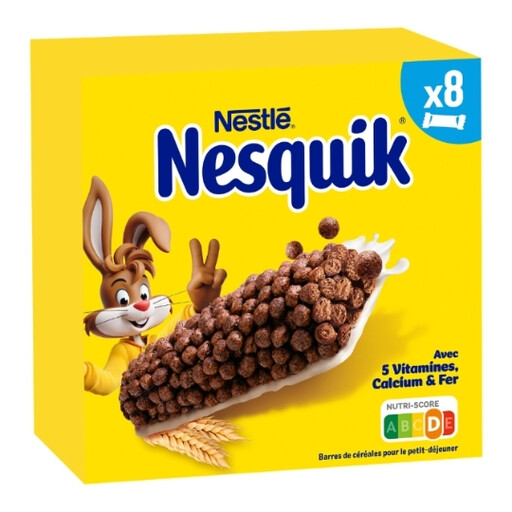 Image unavailable
For a 25 g bar with your coffee, compare the values per 100 g with those for the serving. The claim that the cocoa powder has a reduced fat content refers to that ingredient, not necessarily the whole bar. Check the allergens on the pack too.
No. This type of claim relates to fat, not the overall composition. The DGCCRF notes that nutrition claims are regulated. Check the sugars, serving size, ingredients and allergens in the product too.
Start with the values per 100 g to compare bars of different sizes. According to the DGCCRF, this is the standard basis for presenting nutrition information. Then check the value per serving for your coffee break.
No, these claims describe other characteristics. For example, Auchan’s product details for the Eat Natural date and hazelnut bar, labelled gluten-free and vegan, list 24 g of fat per 100 g. Check the fat content of each recipe separately.
Read the ingredients list and check for any ‘may contain’ warnings on the pack of the exact variant. For prepacked foods, the DGCCRF says allergenic ingredients must be highlighted in the list.
No. Santé publique France says that displaying it is voluntary. If it’s shown, use it to compare products in the same aisle or eaten on the same occasion, but don’t use it instead of checking the nutrition information and ingredients.