
Livraison le jour même ou le lendemain

Qualité garantie

Débloquez vos offres de bienvenue: Livraison GRATUITE | Jusqu'à -80 % | 30 jours d'essai gratuits à JoyPlus
Téléchargez l'application
With soaring energy prices, heating a single room without turning on the central heating has become a clever move. The ceramic space heater, with its rapid heat-up time and versatility, has emerged as a go-to solution. But be warned: the market is saturated with often misleading marketing claims.
As a product expert at Joybuy, I'm here to help you cut through the noise. Let's break down the 3 most common pitfalls together so you can make a smart, long-lasting choice.
To avoid making a mistake, forget the marketing jargon and focus on the technical specifications that truly make a difference. These are the ultimate benchmarks of performance and efficiency for a low-energy electric heater.
Most modern space heaters use PTC (Positive Temperature Coefficient) ceramic technology. In practice, the ceramic element is self-regulating: it heats up very quickly, then reduces its power to maintain the temperature, thus preventing overheating and wasted energy. It's this intelligent regulation, far more than the raw wattage listed, that defines the heater's true efficiency. For a 15 to 20 m? room, a power output of 1500 to 2000W is generally an excellent balance for rapid heating.
A heater with a thermostat and remote is not a gimmick; it's an essential ally for both your comfort and your wallet. The thermostat allows you to set a precise target temperature. Once reached, the device goes into standby mode. Some models go even further with an ECO mode that automatically adjusts the power based on the ambient temperature. This is THE key feature for optimising consumption without even thinking about it.
In a bedroom or office, quiet operation is a top priority. A quiet heater for bedrooms worthy of the name should stay below the 45 dB mark on its low setting. Look for this information in the technical specifications. Finally, always verify the presence of these essential safety features:
To put theory into practice, here are a few models that perfectly illustrate these criteria and meet specific needs, all while avoiding the common pitfalls.
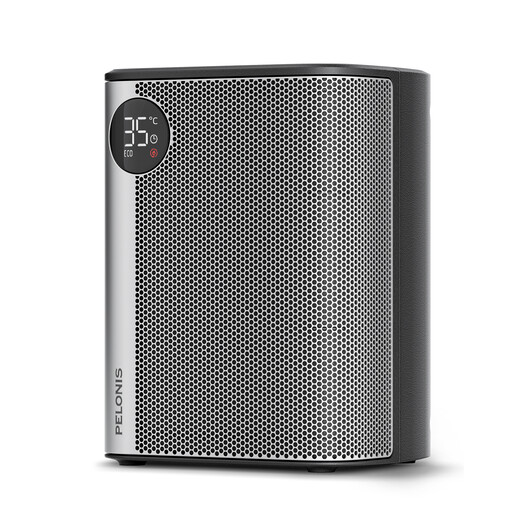
Perfect for juggling multiple rooms (living room, office, guest room). Its 2000W power ensures rapid heat-up, while its various modes allow it to adapt to any situation.
Its smart ECO mode and adjustable thermostat avoid the overconsumption trap by adjusting power to the ambient temperature, which is more efficient than continuous low-power operation.
ECO mode for energy efficiency; 24h timer for scheduled use; Comprehensive safety features (overheat, tip-over).
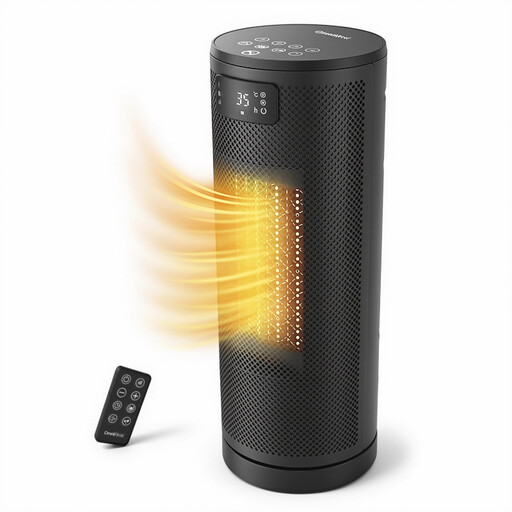
Perfect for a bedroom, nursery, or office where silence is golden. This model focuses entirely on ultra-low noise operation so as not to disturb sleep or concentration.
It counters the vague "silence" trap by specifying low noise levels (down to 38 dB)—an objective figure that guarantees a quiet environment, unlike unquantified marketing promises.
Ultra-quiet operation (38/45/50 dB); Precise thermostat (5–35 °C); Remote control and oscillation for optimal comfort.
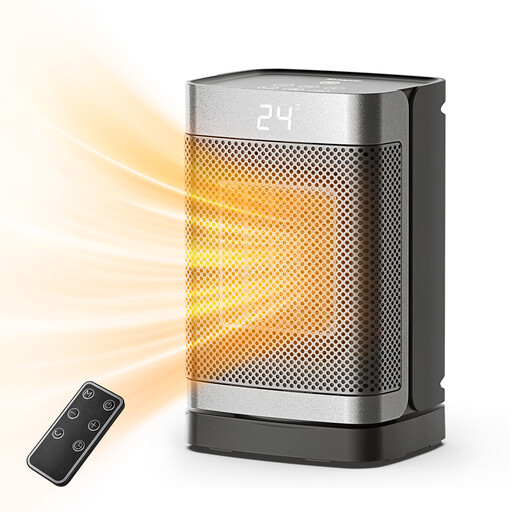
The perfect companion for heating a personal space, like a home office or a reading nook. This small space heater is moved and stored in a flash, while delivering fast, targeted warmth.
It doesn't sacrifice safety for size. Despite its small footprint, it includes tip-over and overheat protection, avoiding the pitfall of entry-level devices with questionable safety features.
Compact and lightweight design; Remote control included for convenient operation; 12h timer and wide-angle oscillation.
Beyond an efficient space heater, intelligently managing your central heating is a major lever for controlling your energy bill. Discover our selection of smart thermostats, compliant with European efficiency and safety standards.
Consumption depends on three factors: the device's power (in kilowatts, kW), the duration of use (in hours), and the price of your electricity per kWh. The calculation is simple: Consumption (in kWh) = Power (in kW) x Time (in h). A 2000W (or 2 kW) device running for one hour will consume 2 kWh. The whole point of a model with a good thermostat and an ECO mode is that it doesn't run at full power constantly. This reduces its actual operating time and, ultimately, your bill.
The word "silent" is often overused. Since they include a fan to distribute heat, some background noise is unavoidable. For use in a bedroom, it's recommended to choose a model with a noise level below 45 decibels (dB) on its low power setting. This quantified data, when a manufacturer is transparent enough to provide it, is a much more reliable mark of trustworthiness than a simple "silent" claim.
As a general rule, it's estimated that you need about 100W per square metre (m?) for a well-insulated room with a standard 2.50 m ceiling height. For example, for a 15 m? room, a 1500W unit is a good starting point. Remember that a space heater is meant to supplement your main heating system, not replace it. Its heat-up speed and the presence of a thermostat are therefore just as crucial as its raw power.