
Livraison le jour même ou le lendemain

Qualité garantie

Débloquez vos offres de bienvenue: Livraison GRATUITE | Jusqu'à -80 % | 30 jours d'essai gratuits à JoyPlus
Téléchargez l'application
Choosing a new pan? It can be a real headache. Between promises of healthy cooking and marketing slogans, it's hard to separate fact from fiction. The ceramic pan is often presented as the ideal alternative, but not all models are created equal. Before you make a purchase, it's essential to know the most common pitfalls to avoid buyer's remorse.
As the head of product selection at Joybuy, I'm here to demystify the market for you. Let's break down the red flags and the criteria that truly matter for choosing a high-performance, durable, and safe pan.
The cookware aisle is a jungle of marketing claims. To avoid falling for the hype, here are the three most common mistakes to steer clear of.
To make the right choice, rely on technical specifications, not marketing slogans.
The winning combination: a forged aluminium or multi-ply steel body for fast, even heat distribution, paired with a quality ceramic coating. Aluminium provides lightness and thermal conductivity, while the coating ensures non-stick performance and safety. Insist on a PFAS-free certification for absolute peace of mind. Some coatings are also reinforced with titanium or diamond particles for better scratch resistance.
Be careful, not all pans are compatible with all hobs. For an induction hob, the base of the pan must be ferromagnetic. Look for the coil symbol or the phrase "all hobs compatible". Oven compatibility is a real bonus for finishing a dish with a gratin or perfecting a bake. However, pay attention to the maximum supported temperature, which depends on the pan and its handle (bakelite or wood handles generally can't go in the oven, unlike stainless steel ones).
The size of the pan should suit your household and cooking habits. A 20-24 cm diameter is perfect for one or two people, while a 28 cm model or larger is necessary for a family. If you need to replace all your cookware, a ceramic pan set can be a smart, cost-effective, and practical choice. It offers multiple diameters to suit all types of recipes while ensuring a consistent look and function in your cupboards.
Rather than an endless list, we've matched user profiles with products that check all the boxes on our strict criteria list.
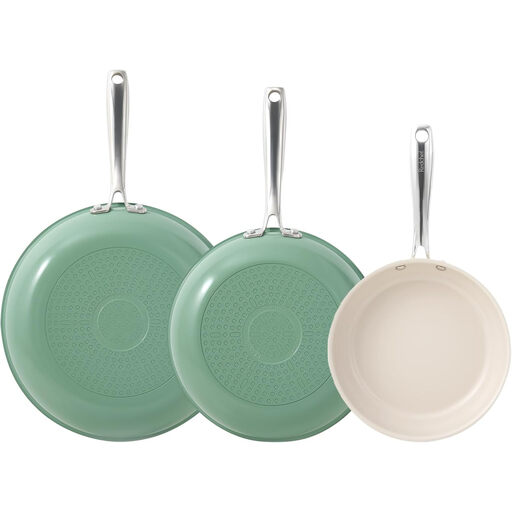
Why we love it: This set covers all of a family's needs with its three sizes (20, 24, and 28 cm). It can handle everything from a fried egg to a vegetable stir-fry for four, offering a complete and cohesive solution.
No false "100% ceramic" promises. The spec sheet is transparent: a forged aluminium body for even heat and a triple-layer ceramic coating. It's honest and effective.
Absolute versatility: one purchase for three essential diameters. Compatible with all hobs (including induction) and oven-safe up to 230°C.
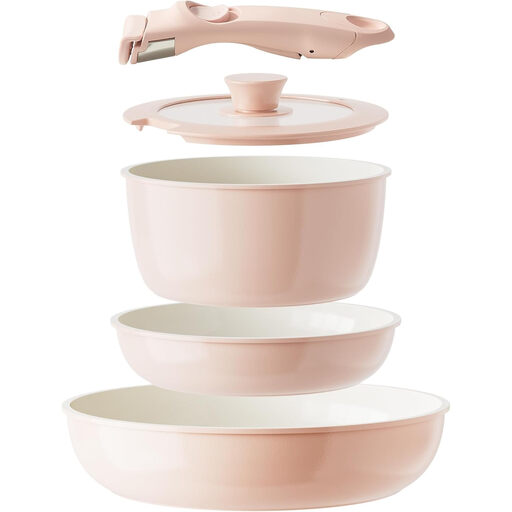
Why we love it: The removable handle is a game-changer for those short on space. The pans and saucepan stack perfectly, freeing up precious cupboard space.
It embodies versatility at its best. The same pan goes from the hob to the oven, serves as a dish at the table, and goes into the fridge with its lid. The ultimate anti-gadget.
Space-saving and modular: the removable handle system allows for ultra-compact storage. The set is, of course, certified PFAS, PTFE, and PFOA-free and compatible with all hobs.
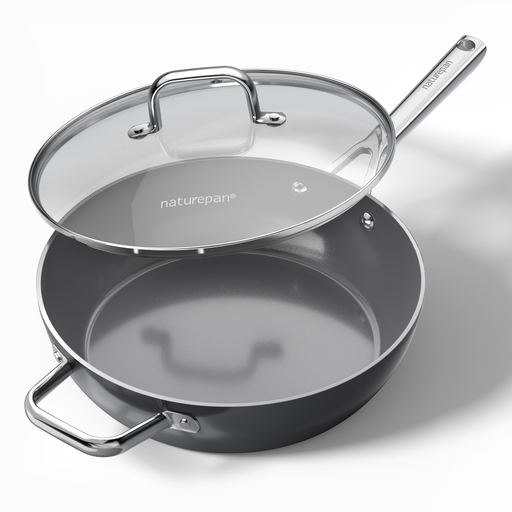
Why we love it: With its high sides and lid, it transforms into a sauté pan or a small Dutch oven. Perfect for saucy dishes, risottos, or simmered meats. It's much more than just a frying pan.
It doesn't just promise basic non-stick performance. Its coating is reinforced with diamond and titanium particles, ensuring superior durability for more demanding cooking than a simple fried egg.
Ultra-versatile sauté pan design: its high sides reduce splatters and allow for cooking larger quantities. Compatible with all hobs and oven-safe up to 260°C.
We have curated a complete selection of products that meet our demanding specifications for performance and safety.
The lifespan of a ceramic non-stick pan depends primarily on its care. With proper maintenance, a quality model can remain effective for several years. To make it last, follow a few golden rules:
Absolutely. The ceramic coating allows you to cook most foods without fat: eggs, pancakes, fish... However, a drizzle of oil or a knob of butter can help with caramelisation (the famous Maillard effect), develop flavours, and, in the long run, preserve the coating.