
Livraison le jour même ou le lendemain

Qualité garantie

Débloquez vos offres de bienvenue: Livraison GRATUITE | Jusqu'à -80 % | 30 jours d'essai gratuits à JoyPlus
Téléchargez l'application
The ceramic pan has taken our kitchens by storm, driven by the promise of healthy cooking. Lured by a non-stick coating free of controversial compounds, many buyers jump in... only to be disappointed. Coatings that wear out in record time, questionable induction compatibility, and marketing promises that evaporate with use: disappointments are common.
To avoid regretting your purchase after just a few months, here’s how to sidestep the most common pitfalls.
To make the right choice, ignore the marketing hype and focus on the technical features that directly impact your daily cooking.
The crucial element of a ceramic pan is its coating. Its main selling point? The absence of controversial chemical substances.
Above all, a good pan must adapt to your kitchen and your habits.
In a well-organised kitchen, every centimetre counts.
Rather than an endless catalogue, we've selected models that meet specific needs. There's an ideal pan for every profile.
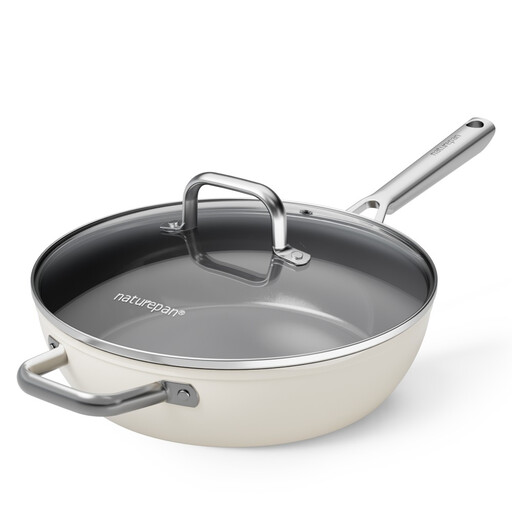
Why it's a match: Its large 28 cm diameter, high sides, and lid make it the perfect partner for slow-cooked meals, risottos, and other saucy recipes for the whole family. You can cook in large quantities without any splatter.
Its ceramic coating, reinforced with diamond and titanium particles, directly tackles the weak point of classic models: durability. It is, of course, guaranteed PFAS/PFOA-free.
Maximum versatility. It serves as a sauté pan, frying pan, and oven dish (up to 260 °C). Compatible with all hobs, including induction, it ensures perfectly even cooking.
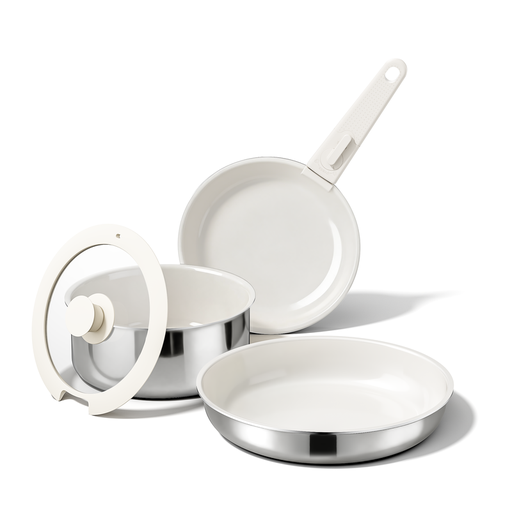
Why it's a match: This is THE solution for anyone short on space. Thanks to the detachable handle, the pans and saucepan stack perfectly, freeing up an incredible amount of cupboard space.
This set tackles the problem of clutter, which is often underestimated at the time of purchase. Its robust locking mechanism puts an end to the stress of wobbly detachable handles, ensuring a stable and secure grip.
Spectacular space-saving (up to 70 % according to the brand) and absolute versatility: it goes from the hob to the oven (up to 250 °C), then to the table, and even into the fridge.
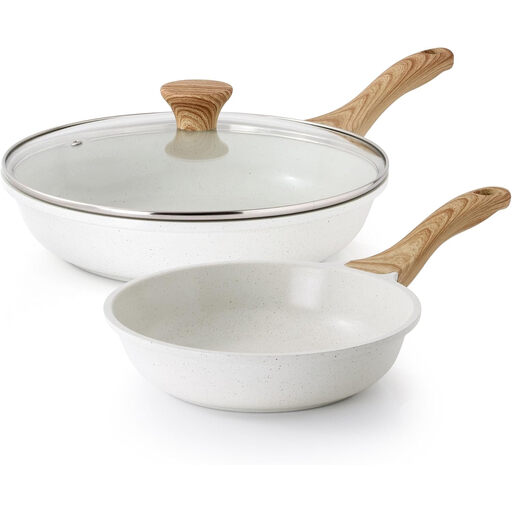
Why it's a match: This complementary duo of sizes covers 90 % of everyday needs: from a fried egg in the morning to sautéed vegetables for two in the evening. A simple and effective team.
It sidesteps the classic pitfall of disappointing "induction compatibility." Its high magnetic conductivity stainless steel base is designed for fast, even heating on all hobs, including induction.
The perfect pair of sizes for everyday use. Its ceramic coating is guaranteed free of PFAS, PFOA, lead, and cadmium. You can cook healthily with complete peace of mind.
Discover our full selection of products that meet our quality criteria and the latest safety standards.
The lifespan of a ceramic pan depends above all on its care. With the right habits, a quality model will retain its non-stick properties for several years. The coating's sworn enemies? Metal utensils, prolonged high-heat cooking, cooking sprays, and thermal shock (running a hot pan under cold water).
To extend the life of your pan, here are the three golden rules:
Absolutely. Its major health advantage is that it's made without PTFE (the component in Teflon) and without PFOA/PFAS (persistent chemical substances). In practical terms, this means that even in the event of accidental overheating, the coating will not release any toxic fumes. This is what makes it a top choice for healthy cooking every day.