
Livraison le jour même ou le lendemain

Qualité garantie

Débloquez vos offres de bienvenue: Livraison GRATUITE | Jusqu'à -80 % | 30 jours d'essai gratuits à JoyPlus
Téléchargez l'application
Choosing a new frying pan can quickly become a headache. Between promises of perfect cooking without a drop of oil and doubts about material composition, it's hard to know where to start. You're considering a ceramic pan for its non-stick coating and healthy image, but you're wary of the common disappointments: a coating that loses its non-stick properties after a few months, disappointing induction performance in practice, or materials with an opaque composition.
Our mission: to help you make an informed decision. This guide is designed to give you the keys to choosing a pan that truly meets your expectations for performance, durability, and food safety.
Cookware marketing is full of appealing claims that can sometimes hide deal-breaking flaws. Here are the essential points to watch out for.
To avoid these disappointments, focus on objective technical specifications. They are what guarantee the quality and longevity of your pan.
The secret to a good healthy non-stick pan lies in the quality of its coating. The highest-performing models don't just settle for a single layer of ceramic.
An all-hob, induction-compatible pan worthy of the name must have a specific base. Look for a thick, encapsulated base, often made of stainless steel. It ensures perfect contact with the induction hob for fast, uniform heating. This is the key to avoiding "hot spots" that burn food in the centre while leaving the edges undercooked.
Think about all your cooking habits. An oven-safe pan expands your cooking options, allowing you to finish cooking a piece of meat or gratinate a dish. For this, the handle must be made of stainless steel or cast iron, not Bakelite or plastic, which do not withstand high temperatures. Dishwasher compatibility is a plus, although hand washing remains the best way to preserve the coating in the long run.
To help you visualise these criteria, here are a few models that stand out for their design and suitability for specific uses.
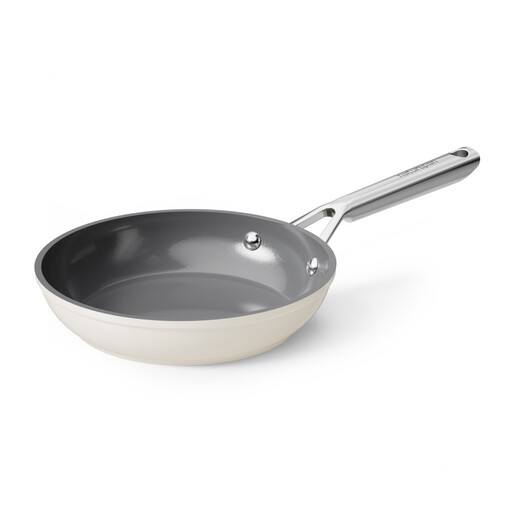
Why this model? With its 24cm diameter, it's the quintessential versatile size, perfect for meals for 2 to 3 people. It's equally at home searing meat, sautéing vegetables, or cooking an omelette.
Its ceramic coating, reinforced with titanium and diamond particles, avoids the pitfall of short-lived non-stick performance. It offers far superior resistance to everyday wear and tear.
Oven-safe up to 230°C thanks to its stainless steel handle. Its thick base ensures quick, even heating on all hobs, including induction.
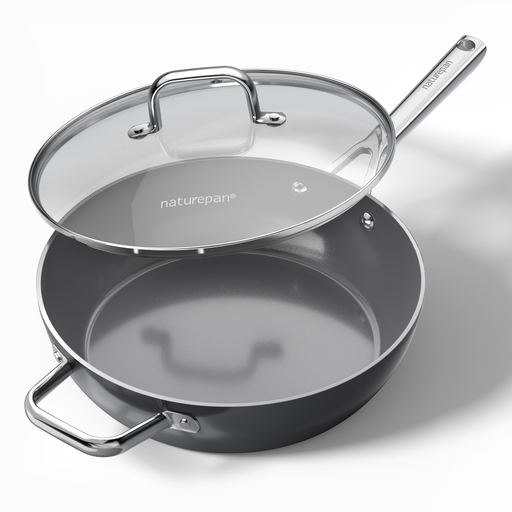
Why this model? Its high sides and lid make it an ultra-versatile tool, a hybrid between a frying pan and a sauté pan. Ideal for saucy dishes, braised meats, or large portions of sautéed vegetables, all without splatters.
It tackles the problem of inefficient "all-hob" pans on induction cooktops. Its thick base ensures perfectly even heat distribution, which is essential for slow cooking and large volumes.
Large capacity and versatility. Its stainless steel handle allows it to go in the oven up to 260°C, transforming it into a family-sized gratin dish. Guaranteed PFAS/PFOA-free coating.
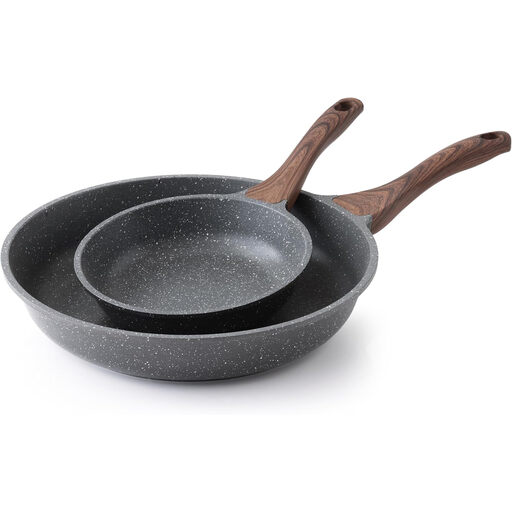
Why this model? This set of two pans (20cm for fried eggs and small portions, 32cm for family meals) is a complete and economical solution for outfitting your kitchen. The cast aluminium body ensures good durability.
It clears up any doubts about material composition. The coating is made without PFOA, PFOS, lead, or cadmium, a point clearly guaranteed by the manufacturer.
Excellent value for money. The stainless steel base ensures compatibility with all hobs, including induction. The Bakelite handle stays cool to the touch during cooking.
We've curated a full selection of pans that meet our standards for quality, durability, and safety.
How long does a ceramic pan last? It all depends on the quality of the coating and how you care for it! A good model with a reinforced coating can last for several years while maintaining its performance. To maximise its lifespan: never overheat it while empty, use wooden or silicone utensils, and clean it by hand with a soft sponge once it has cooled down.
Can a ceramic pan really go in the oven? Yes, but it all depends on the handle. A stainless steel or cast iron handle allows for high-temperature oven use (often up to 260°C). Conversely, a Bakelite or plastic handle will limit the temperature (usually to around 150-180°C) or prohibit oven use altogether. Always remember to check the manufacturer's recommendations.
How do I care for a non-stick pan to prevent scratches? The golden rule: never use metal utensils (forks, knives, stainless steel spatulas). Opt for silicone, wood, or nylon. Also, avoid abrasive sponges and scouring powders. A simple wipe with a soft sponge, hot water, and washing-up liquid is more than enough in most cases.