
Same-day & Next-day Delivery

Quality Guaranteed

Unlock Your Welcome Offers: FREE Delivery | Up to 80% OFF | Free 30-day JoyPlus trial
Download the APP
Navigating the jungle of kitchen utensils can sometimes feel like an obstacle course. The ceramic pan, in particular, is often touted as the ultimate healthy, high-performance alternative. But beware: behind the marketing hype lie realities that often lead to disappointment. As a product expert at Joybuy, my mission is to help you separate fact from fiction to make an informed choice that truly fits your daily cooking routine.
Before you take the plunge, here are the three pitfalls to avoid at all costs?:
To avoid getting duped, focus on a few objective technical specifications. These are the true guarantors of the quality and lifespan of your future healthy cookware.
People often turn to ceramic for health reasons. It is therefore essential to verify that the coating is guaranteed PFOA-free and, more broadly, PFAS-free. These "forever chemicals," found in some older coatings, are at the centre of major health and environmental concerns. A manufacturer that is transparent about its composition is already a good sign. New-generation coatings, reinforced with titanium or diamond particles, also promise better longevity.
All cooking performance rests on the base of the pan.
Think about how you will use it. Will you need an oven-safe pan to finish cooking or brown a dish? If so, check two things: the maximum temperature it can withstand and the handle material. A stainless steel or cast iron handle is ideal for the oven, unlike a Bakelite or plastic handle that could melt.
Finally, an easy-to-clean pan will save you precious time every day. Even if dishwasher compatibility is a plus, a good coating can be cleaned in a flash with a simple wipe of a sponge. In fact, this is the preferred method to make it last longer.
Rather than an endless list, here are a few models that tick all the boxes for specific needs.
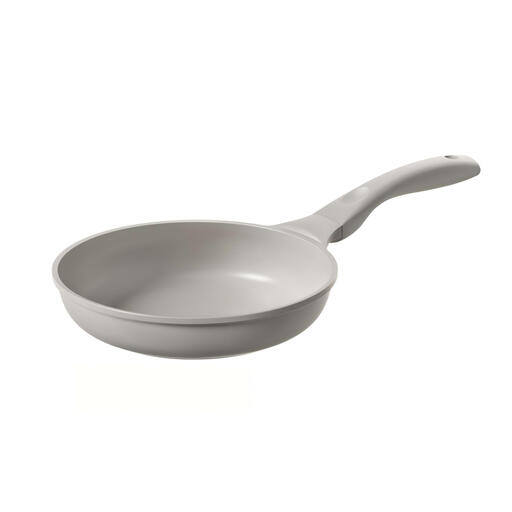
Why we love it : Perfect for everyday meals, from morning fried eggs to evening stir-fried vegetables. Its 24 cm diameter is ideal for one or two people. Its design is straightforward: healthy cooking and lightning-fast cleanup.
Its coating is clearly advertised as PTFE/PFOA/PFAS-free. Its base is designed for fast and even heating on all hobs, including induction, which prevents hot spots.
Its ergonomic Bakelite handle stays cool to the touch, a real safety bonus. Dishwasher safe for those lazy days.
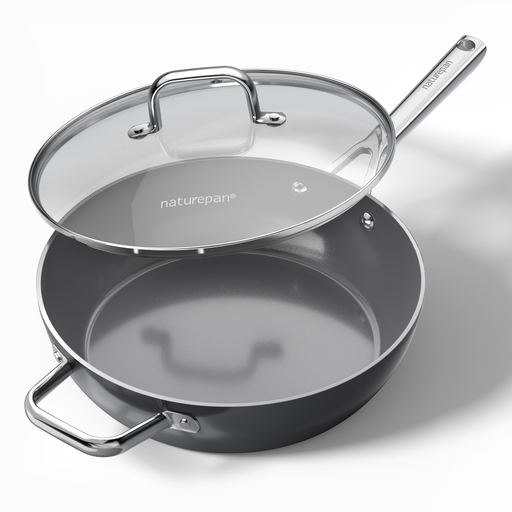
Why we love it : Perfect for family meals, stews, or sauce-based dishes. Its high sides and lid make it an ultra-versatile ceramic sauté pan. Its large 28 cm diameter is ideal for 3 to 4 people.
Its titanium and diamond-reinforced coating is guaranteed PFAS/PFOA-free. Its stainless steel handle allows it to go in the oven up to 260 °C (500 °F), giving it impressive versatility.
Oven-safe at very high temperatures, a rare feature for a non-stick pan. Delivered with its lid, it's perfect for simmering and braising.
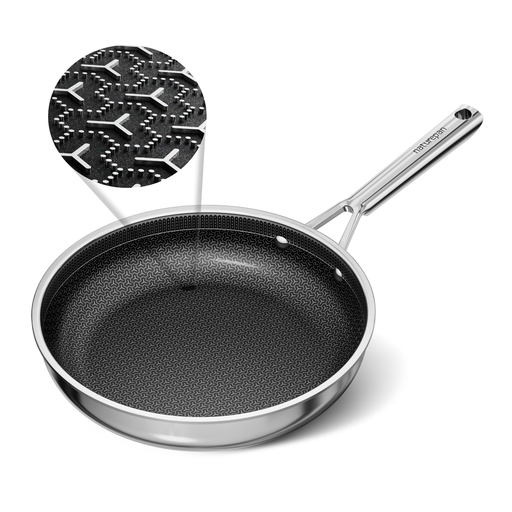
Why we love it : For those who want the best of both worlds: the perfect sear of stainless steel and the non-stick convenience of ceramic. Its unique design is engineered for performance and longevity.
Its raised honeycomb pattern protects the ceramic coating nestled in the grooves, dramatically increasing its scratch resistance. The tri-ply construction ensures optimal thermal conductivity on induction.
Hybrid technology to sear meats to perfection without sticking. 5-ply construction and oven-safe up to 260 °C (500 °F) for unbeatable durability and versatility.
We have curated a complete range of products that meet our strict selection criteria and current safety standards.
The lifespan of a ceramic-coated pan depends heavily on its manufacturing quality and how you care for it. An entry-level model used daily can lose its non-stick properties in less than a year. Conversely, a well-made pan with a reinforced coating that is properly maintained (no overheating, no metal utensils, hand-washed) can remain effective for several years.
To maximise its lifespan, a few simple steps are all it takes:
The main health benefit of modern ceramic coatings is that they are made without PFAS (including PFOA and PTFE). In practical terms, this means they don't risk releasing toxic compounds, even in case of accidental overheating. It is therefore a wise precautionary choice for those who want to eliminate these substances from their kitchen.