
Livraison le jour même ou le lendemain

Qualité garantie

Débloquez vos offres de bienvenue: Livraison GRATUITE | Jusqu'à -80 % | 30 jours d'essai gratuits à JoyPlus
Téléchargez l'application
A ceramic non-stick frying pan can make everyday meals easier, particularly when cooking eggs, vegetables, fish or pancakes with little fat. However, marketing claims alone are not enough to help you make the right choice. Between coatings described as ‘natural’, sometimes vague ‘all hob’ claims and models advertised as easy to clean, certain details can quickly become frustrating in everyday use.
Here are the points to check before buying, along with a selection of models suited to different French households.
In most current models, the body of the pan is made from aluminium, stainless steel or a multi-layer alloy, and then covered with a ceramic coating. This design often allows the pan to heat up quickly, but it does not mean that the pan is made entirely from ceramic.
The technical specifications should therefore state:
Claims such as PFAS-free, free from PTFE and PFOA or ‘non-toxic’ should be considered characteristics declared for a specific product, rather than a medical guarantee. PFOA and PTFE do not cover all PFAS. Detailed product information is therefore preferable to a vague slogan.
When choosing a PFAS-free frying pan, check the manufacturer’s exact wording and the documentation available. The ceramic models featured here state that they are free from PTFE, PFOA or PFAS, according to their respective product specifications. This does not remove the need to follow the usage instructions or replace a pan whose coating is badly damaged.
An all-hob non-stick frying pan must have a base suitable for your cooking setup. On an induction hob, the base must be magnetic and sufficiently flat. A pan compatible with gas and electric hobs is not automatically an induction-compatible frying pan.
Before ordering, check the list of compatible appliances: induction, gas, electric hob, ceramic hob or smooth surface. For halogen or infrared hobs, you may need to ask the manufacturer for confirmation.
The stated diameter generally refers to the top edge, and not always to the area that is actually heated. For one person or a couple, a 20 to 24 cm frying pan is suitable for eggs, individual portions and side dishes. A 26 to 28 cm model provides more room for cooking for a family, searing a piece of meat or preparing a vegetable stir-fry.
A large frying pan may, however, be less manageable on a small hob. Also compare the diameter of the base with that of your induction zone or gas burner.
Aluminium is valued for being lightweight and conducting heat quickly. A thickened or multi-layer base can help distribute heat more evenly and reduce hot spots. Stainless steel provides a more robust structure, but can also make the pan heavier.
Aluminium frying pans with a ceramic coating are often practical for everyday use. However, they should be preheated gradually and not left empty over high heat for too long.
An easy-to-clean frying pan is not necessarily designed to withstand every type of treatment. Some products are advertised as dishwasher-safe, while others require hand washing. In both cases, a soft sponge, mild detergent and thorough drying help preserve the coating.
Choose wooden, silicone or nylon utensils. Metal objects, abrasive scourers and thermal shock can accelerate wear. The non-stick properties of a ceramic coating may also diminish over time, particularly after repeated overheating.
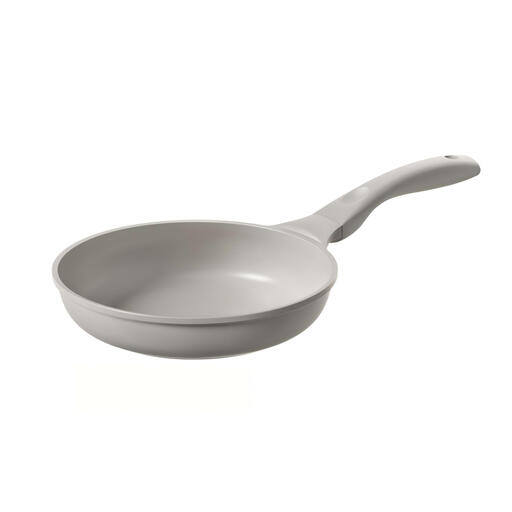
Why this choice suits this group : Its 24 cm size is suitable for everyday meals without taking up too much space in a small kitchen. The product specifications mention an aluminium base, a ceramic coating free from PTFE, PFOA and PFAS, as well as compatibility with induction, gas and electric hobs.
Compatibility with several types of hob is clearly stated, reducing the risk of ending up with an unusable pan after moving house or changing your hob.
A versatile 24 cm size, a Bakelite handle and dishwasher-safe cleaning, as stated in the product specifications.
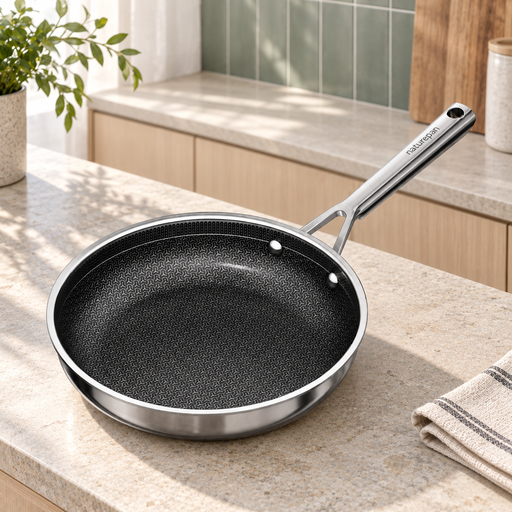
Why this choice suits this group : Its multi-layer stainless steel construction, with an aluminium conducting core and textured surface, is aimed at users looking for a more sophisticated design for searing and frying food.
The product specifications clearly distinguish between the materials, hob types and maximum oven temperature, stated as up to 230 °C without the lid.
Multi-layer stainless steel, an aluminium core and compatibility with induction, gas, electric and ceramic hobs.
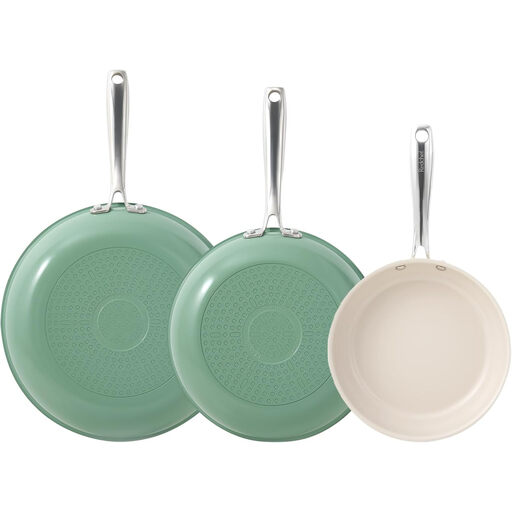
Why this choice suits this group : The 20, 24 and 28 cm diameters cover a wide range of uses, from individual portions to generous family-sized stir-fries. The product specifications mention compatibility with induction, gas and electric hobs, as well as oven use.
The set means you do not have to use one large frying pan for every preparation. However, the instructions recommend hand washing to preserve the coating.
Three sizes, stainless steel handles and a maximum oven temperature stated as 450 °C according to the product specifications.
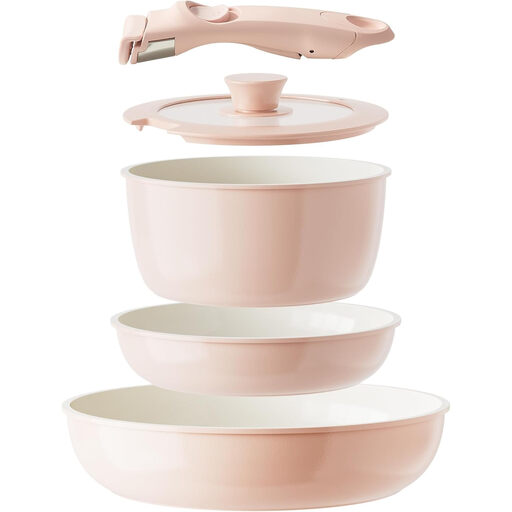
Why this choice suits this group : The removable handles and stackable pieces fit easily into small cupboards. The set includes a 20 cm saucepan, two frying pans measuring 20 and 26 cm, a lid and a removable handle.
Compatibility with all hob types, including induction, is clearly stated. However, you must lock the handle securely before lifting a hot piece.
Storage designed to save space, a lid included and a coating presented as free from PFAS, PTFE and PFOA.
We have brought together a complete selection, updated in real time, of products meeting these demanding criteria while also taking European safety regulations into account.
The cost of using a pan depends less on the simple mention of ‘ceramic’ than on how it is cared for, how often you cook and whether it eventually needs replacing. Hand washing takes a little more time, but it is often recommended to extend the coating’s lifespan.
Yes, some models are designed for induction thanks to a magnetic base, but this is not always the case. Always check the list of compatible hobs in the product specifications. A pan designed only for gas, electric or ceramic hobs will not necessarily work on an induction hob.
Its lifespan depends on the temperature used, the utensils, cleaning and how often it is used. Repeated overheating, scratches and abrasive products can accelerate the loss of non-stick properties. When the surface is badly damaged, warped or no longer allows food to cook evenly, it is better to replace the pan.
Wait until it has cooled, then use warm water, mild detergent and a non-abrasive sponge. Even when a model is advertised as dishwasher-safe, hand washing is often still recommended to preserve the surface. Check the recommendations for each product before using it for the first time.