
Livraison le jour même ou le lendemain

Qualité garantie

Débloquez vos offres de bienvenue: Livraison GRATUITE | Jusqu'à -80 % | 30 jours d'essai gratuits à JoyPlus
Téléchargez l'application
Choosing a new pan might seem simple, but the market is saturated with marketing promises that rarely stand the test of time. A ceramic induction pan that loses its non-stick properties after a few months, vague "healthy cooking" claims, or disappointing induction compatibility are all-too-common frustrations. This guide is here to help you decode the spec sheets, identify the essential criteria for a durable and satisfying purchase, and avoid the most common pitfalls.
Before you commit, watch out for these three points that separate a quality utensil from a costly disappointment.
To be sure of your future pan's performance and longevity, focus on these three fundamental parameters.
The core of a good PFOA-free non-stick pan is its coating. Basic ceramic options are a good start, but for enhanced durability, look for a reinforced ceramic coating. The addition of particles like diamond or titanium, for example, significantly increases resistance to scratches and abrasion. This technology helps maintain non-stick properties for much longer, even with heavy use.
Performance on an induction hob depends entirely on the pan's base. It must contain a layer of ferromagnetic stainless steel. For optimal efficiency, check that:
Beyond just cooking, think about overall usability. A pan with high sides can double as an excellent ceramic sauté pan with a lid, ideal for saucy dishes or simmering vegetables. Also, check the handle material: a stainless steel or Bakelite handle that stays cool on the hob is a key safety feature. Finally, being able to put the pan in the oven significantly increases its versatility.
To help you see these criteria in action, here are a few models that meet different needs and use cases.
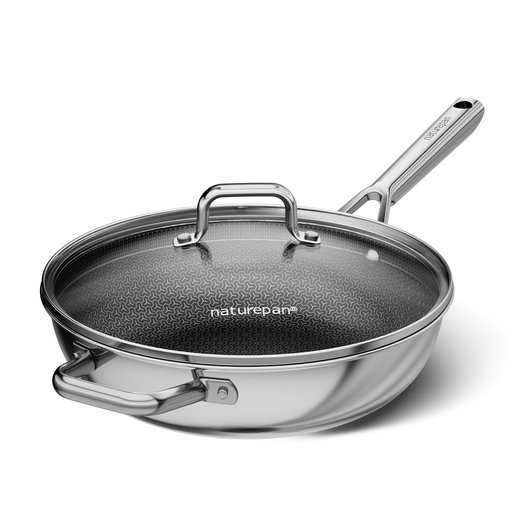
Why this model? Ideal for those who love cooking a variety of dishes, from seared meats to simmered meals. Its high sides and included lid transform it into a very practical sauté pan, perfect for families or batch cooking.
Its ceramic coating is reinforced with diamond and titanium particles, offering far superior wear resistance compared to standard coatings. Its optimised base ensures fast, even heating on induction hobs.
Versatility: Can be used as both a frying pan and a sauté pan. Oven safe: Oven-safe up to 260°C (500°F) to finish cooking or keep food warm. Guaranteed PTFE/PFAS/PFOA-free.
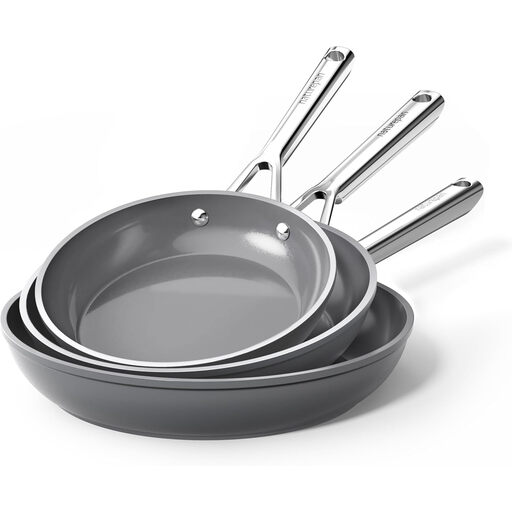
Why this set? This induction pan set covers all daily needs, from a fried egg in the morning to a family dinner. It's a practical starter investment to completely refresh your cookware.
All three pans feature the same diamond-titanium reinforced ceramic coating and an encapsulated base, guaranteeing consistent and durable performance across the entire set. The PFOA/PFAS-free certification applies to every piece.
Complete solution: Three sizes for all types of cooking. Easy maintenance: The ultra-smooth surface wipes clean with a sponge, and the entire set is dishwasher safe.
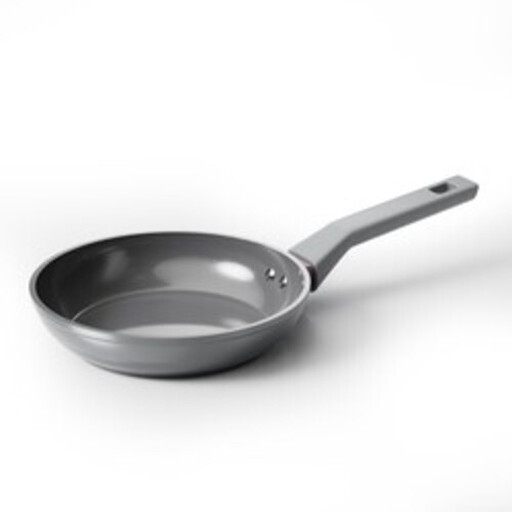
Why this model? Perfect for a single person, a couple, or for small jobs like an omelette or side vegetables. Its compact size makes it easy to handle and store.
Despite its small size, this pan features a durable diamond-titanium ceramic coating and a multi-ply base for fast, even heating on induction. It is explicitly guaranteed to be free of PFAS, PFOA, lead, and cadmium.
Non-stick performance: Ideal for cooking with very little oil. Handling: The wood-effect Bakelite handle stays cool to the touch for safe handling.
Discover our complete, up-to-date selection of products that meet these strict selection criteria and current safety regulations.
The longevity of a ceramic pan depends on the quality of its coating and how it's maintained. A model with a reinforced ceramic coating can last for several years. To maximise its lifespan, it's best to cook over medium heat, avoid thermal shock (don't run a hot pan under cold water), and use wooden, silicone, or plastic utensils.
Using metal utensils (forks, knives, stainless steel spatulas) on a ceramic coating is strongly discouraged, even if it's reinforced. They can cause micro-scratches that will degrade the non-stick properties over time. Always opt for soft utensils.
Although many pans are dishwasher-safe, hand washing is preferable to preserve the coating in the long run. Use a soft sponge with warm, soapy water. Most of the time, thanks to the non-stick surface, a simple wipe is all it takes. Absolutely avoid scouring pads and harsh detergents.