
Livraison le jour même ou le lendemain

Qualité garantie

Débloquez vos offres de bienvenue: Livraison GRATUITE | Jusqu'à -80 % | 30 jours d'essai gratuits à JoyPlus
Téléchargez l'application
Choosing the right cookware can quickly become overwhelming. If you're considering a ceramic induction pan, you're likely drawn to its promise of healthier cooking and easier cleanup. The problem is, the market is saturated with marketing claims that often confuse more than they clarify. Our mission is to help you cut through the noise and make an informed decision that truly fits your daily routine.
Before we get to our top picks, let's break down the most common pitfalls that lead to a disappointing purchase.
To avoid these traps, focus on a few objective technical specifications. These are the true indicators of your future pan's quality and longevity.
For a PFOA-free non-stick pan, the coating is everything. For healthy, PFAS-free cooking, demand that the product sheet explicitly states it is free of these substances (per- and polyfluoroalkyl substances), as well as PTFE, lead, and cadmium. Modern ceramic coatings often integrate particles (like titanium or diamond) to boost their scratch resistance and durability.
For maximum efficiency on induction, the pan must have a thick, perfectly flat ferromagnetic base. This base, sometimes called an "encapsulated bottom," ensures full contact with the cooktop for rapid heat-up and even heat distribution. This is a non-negotiable feature to prevent hot spots and guarantee uniform cooking.
This criterion depends entirely on your cooking habits. If you like to finish dishes in the oven, an oven-safe pan is a must-have. Check two crucial points:
Instead of searching for a one-size-fits-all pan (which doesn't exist), it's better to choose one that perfectly matches your needs. Here are our suggestions, profile by profile.
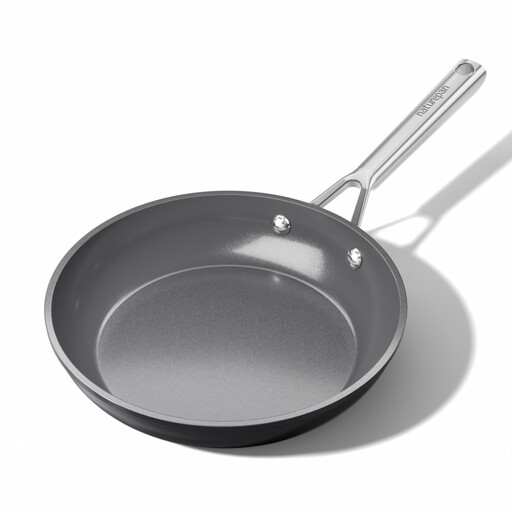
Why we chose it: Perfect for daily use (fried eggs, sautéed vegetables, fish fillets). Its 24 cm size is ideal for 2-3 people, and its coating, explicitly formulated without PTFE/PFOA/PFAS, is a true guarantee of healthy cooking.
Its encapsulated base is optimised for rapid, even heat distribution on induction, avoiding the "misleading compatibility" trap.
The titanium and diamond-reinforced ceramic coating promises enhanced durability. It's also oven-safe up to 260°C and dishwasher-safe.
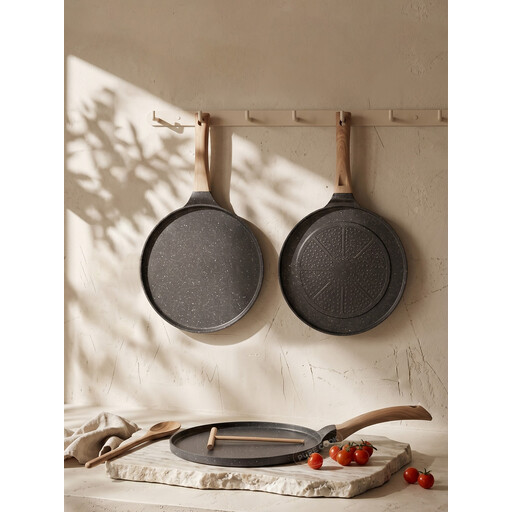
Why we chose it: For those who want to combine style and function. Its stone-effect coating and wooden handle add a touch of elegance to the kitchen, while its light weight makes it very easy to handle for everyday cooking.
No empty promises: the description emphasizes careful maintenance (hand washing, no metal utensils) to preserve the coating. An honest and transparent approach.
Its light weight, thanks to its aluminium alloy body, makes it incredibly easy to handle. The wooden handle stays cool to the touch during stovetop cooking.
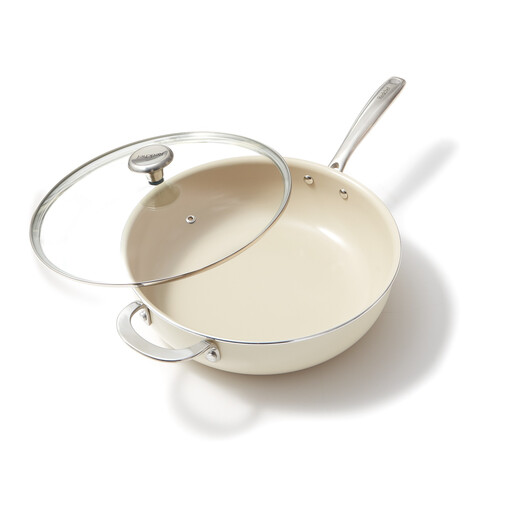
Why we chose it: Perfect for large meals, this 28 cm ceramic-coated sauté pan with a lid is designed for family cooking. Its large capacity and high sides are ideal for sautéing, simmering, or braising.
Full transparency: the coating's composition (free of PFAS, PFOA, lead, cadmium) is clearly stated, without hiding behind the vague term "ceramic."
Ultimate versatility: it works on all stovetops (including induction) and is oven-safe up to 450°C. Its riveted stainless steel handle ensures a solid, durable grip.
Explore our full selection of products that meet our quality standards and the latest safety regulations.
To wrap up, let's answer the final questions you might have.
With proper care, a good quality ceramic coating will maintain its non-stick properties for 1 to 3 years of regular use. Beyond that, it may start to stick, although it remains perfectly usable for cooking with a little oil or butter.
A few simple habits can significantly extend your pan's lifespan:
Not necessarily. The term "stone-effect" (or marble, granite) most often refers to the visual appearance of the non-stick coating. This coating can be ceramic-based, but it can also be made of reinforced PTFE or other compounds. The important thing is to always check the exact composition of the coating (look for phrases like "PFAS-free ceramic coating," for example) and not to rely solely on its appearance.