
Livraison le jour même ou le lendemain

Qualité garantie

Débloquez vos offres de bienvenue: Livraison GRATUITE | Jusqu'à -80 % | 30 jours d'essai gratuits à JoyPlus
Téléchargez l'application
Finding the perfect pan can often feel like an uphill battle. Between promises of healthy cooking, coatings that wear out in a few months, and unreliable compatibility, it's easy to make a poor investment. Our mission at Joybuy: to help you see clearly, cut through the marketing noise, and make an informed, long-lasting choice.
But before we get to our top picks, let's break down the 3 pitfalls you must avoid when buying a ceramic pan:
To avoid these traps, rely on objective technical criteria. They are the true guarantors of your future pan's quality and longevity.
The main advantage of ceramic is its coating, which promises healthy cooking without toxic chemicals. To make the right choice, check these points:
On an induction cooktop, the pan's base is the most strategic component. It must be perfectly flat and contain a ferromagnetic disc.
The best pan is the one that adapts to your everyday cooking needs.
After analysing dozens of models based on these criteria, here is our selection, designed for different needs and budgets.
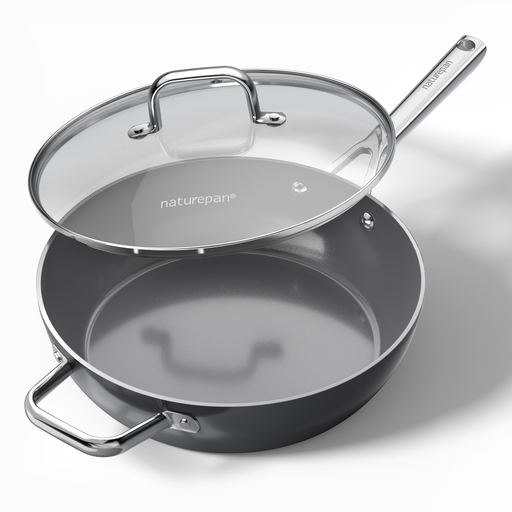
Why it's a match: Its large 28 cm size, high sides, and included lid make it an ideal sauté pan for family meals. Its oven-safe compatibility up to 260°C (500°F) offers maximum versatility, allowing you to go from stovetop to oven, and then straight to the table.
Its titanium and diamond-reinforced ceramic coating checks the box for durability. Its thick, optimised base guarantees excellent performance on induction, without the risk of uneven heating.
Versatility and durability: moves from stovetop to oven without constraints, with a coating designed for intensive use and guaranteed free of PTFE/PFOA/PFAS.
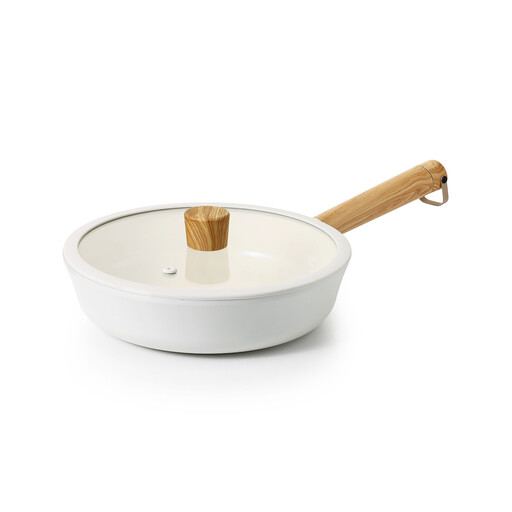
Why it's a match: With its 24 cm diameter, it's perfect for couples or small kitchens. It offers the benefits of a sauté pan (high sides, lid) in a compact and affordable format.
It is clearly guaranteed free of PTFE, PFAS, lead, and cadmium, meeting the requirement for healthy cooking. Its magnetic stainless steel base ensures effective induction compatibility, without the nasty surprises of a low-quality base.
Excellent value for money: a healthy and practical solution for everyday cooking, compatible with all stovetops, including induction.
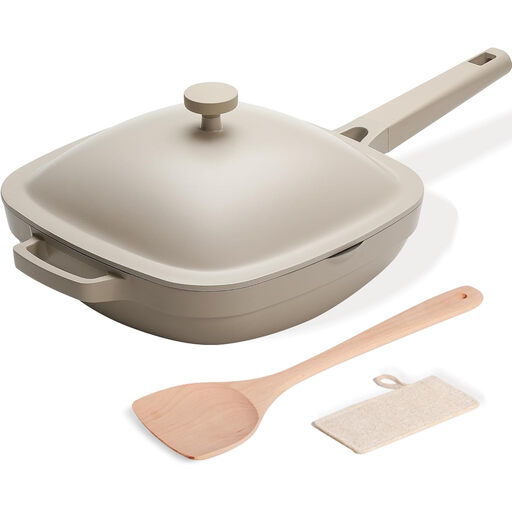
Why it's a match: Its patented design, a hybrid between a square and a circle, offers a larger cooking surface than a round pan of the same diameter. Lightweight and delivered with useful accessories, it's designed for everyday practicality.
Its die-cast aluminium body ensures even heat distribution, sidestepping the trap of poor compatibility. The Ti-Ceramic coating is guaranteed non-toxic and PFAS-free for 100% healthy cooking.
Optimised cooking surface: its unique shape and dual pouring spouts make it highly functional for a variety of preparations, from sautéing to cooking sauces.
We have compiled a complete selection of products that meet our strict selection criteria and current safety standards.
The lifespan of a ceramic coating depends on two factors: its manufacturing quality and its maintenance. An entry-level model can lose its non-stick properties in less than a year. Conversely, a quality pan with a reinforced coating, used and cleaned with care, will retain its properties for 2 to 5 years.
A few simple steps are all it takes to extend your pan's life:
PFOA is just one of many compounds in the vast family of PFAS (per- and polyfluoroalkyl substances), nicknamed "forever chemicals." A pan certified as PFOA-free is a good start, but a PFAS-free certification offers a much broader guarantee. By their nature, ceramic coatings do not typically use these fluorinated compounds, making them a top choice for healthy, non-toxic cooking.