
Livraison le jour même ou le lendemain

Qualité garantie

Débloquez vos offres de bienvenue: Livraison GRATUITE | Jusqu'à -80 % | 30 jours d'essai gratuits à JoyPlus
Téléchargez l'application
Choosing kitchen utensils can be a real challenge, especially when you're looking for a product that ticks all the boxes: effective, healthy, and built to last. The ceramic induction pan has become a staple in many kitchens, but be warned—not all are created equal. Between brand promises and opaque compositions, it's hard to know what to choose.
This guide is here to give you clear, concrete benchmarks. Our mission: to help you decode the labels and identify the criteria that truly matter to find the perfect pan for your daily life, cutting through the marketing jargon.
Before you jump on the first model you see, let's review the features that really make a difference. Here are the three essential points to check to avoid making a mistake.
The number one advantage of ceramic is, of course, the absence of controversial substances. A PFAS-free non-stick pan (including per- and polyfluoroalkyl substances and PFOA) is the foundation of healthy cooking. But be careful, the durability of the coating is just as crucial. Early generations of ceramic wore out visibly fast. Fortunately, technologies have evolved. A diamond- or titanium-reinforced coating, for example, means that mineral particles have been added to boost resistance to scratches and wear. The result? A non-toxic piece of cookware that truly goes the distance.
If you cook on an induction hob, a pan for all hobs, including induction is non-negotiable. Its base must be ferromagnetic, perfectly flat, and thick enough to distribute heat evenly without warping over time. The other game-changing criterion is versatility. An oven-safe pan opens up a world of possibilities: start cooking on the hob and finish in the oven for a perfect gratin or slow-cooked dish. Just remember to check the maximum temperature supported by the pan and its handle.
A pan's durability isn't just about its coating. Its structure is just as fundamental. A body made of forged aluminium or multi-ply stainless steel ensures rapid and even heating. The handle must provide a secure grip and stay cool on the hob. Whether it's fixed or removable, its attachment must be flawless for total safety. Finally, don't underestimate the height of the sides: the higher they are, the closer your pan gets to a ceramic sauté pan, perfect for saucy dishes and generous volumes.
Based on these criteria, here are the models that caught our attention for their design, versatility, and value for money.
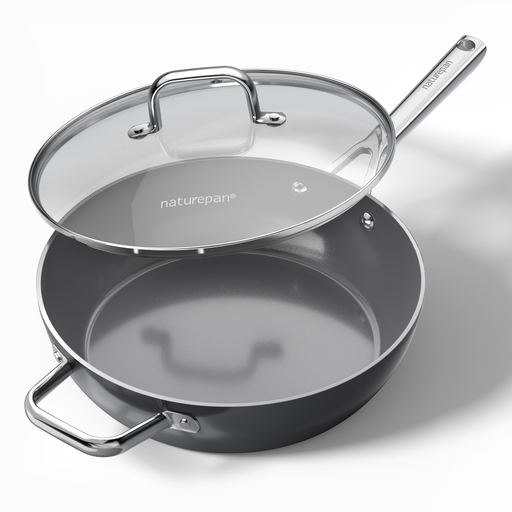
What sets it apart: With its high sides and included lid, this 28 cm model plays in the same league as sauté pans and small Dutch ovens. Its ceramic coating, reinforced with diamond and titanium particles, is designed to last and allow for healthy cooking with minimal oil.
Key features:
Who is it for? For families and anyone who loves to cook generous one-pan meals. Its versatility makes it a smart investment that can replace several other utensils.
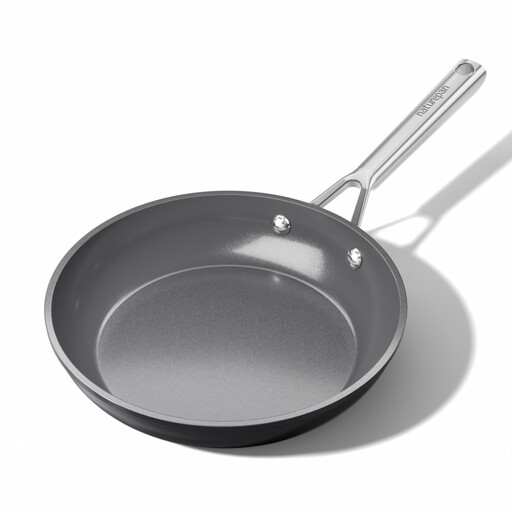
What sets it apart: The 24 cm diameter is the ultimate all-purpose size, ideal for everyday use. It benefits from the same reinforced ceramic coating as its counterparts, ensuring effective non-stick performance and true robustness. A universal format for most recipes.
Key features:
Who is it for? Ideal for couples and small families (2-3 people). It's the do-it-all pan: sear meat, pan-fry fish, or sauté vegetables.
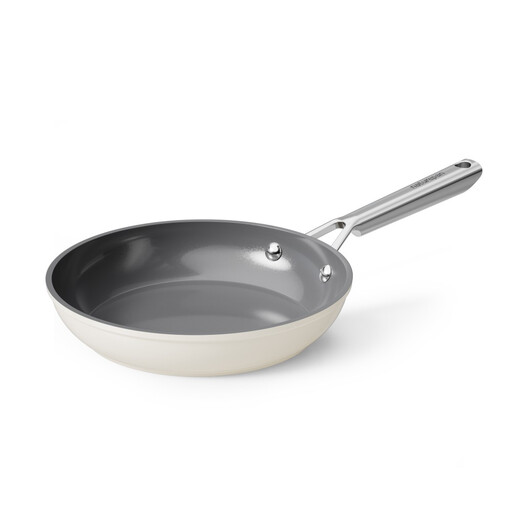
What sets it apart: With its compact 20 cm size, this is the perfect partner for small appetites and quick meals. Perfect for a fried egg, a solo omelette, or toasting a handful of almonds. Its cream-white finish adds a touch of discreet elegance to the kitchen.
Key features:
Who is it for? A must-have for students, people living alone, or as a secondary pan for sauces and side dishes.
A well-designed home is often a matter of details. Beyond the kitchen, other accessories can simplify your life. For your fastening or small DIY projects, take a look at our selection of adhesive sticks.
Yes, provided you choose it wisely. A quality ceramic coating is made without PFAS, PFOA, or PTFE. It is therefore a non-toxic piece of cookware, as long as you follow the golden rules: don't overheat it while empty and use non-metallic utensils. Bonus: it requires very little oil, a real plus for light, everyday cooking.
To keep your pan non-stick for as long as possible, a few simple habits are all it takes. Only use wooden, silicone, or nylon utensils. Avoid overheating it while empty and prevent thermal shock (don't run it under cold water when it's still hot). Even if it's dishwasher-safe, washing by hand with a soft sponge is still the best way to preserve its coating in the long run.
No, and this is a crucial point to watch out for. Induction compatibility doesn't depend on the coating, but on the base of the pan. To work, the base must be ferromagnetic. Before any purchase, look for the coil-shaped symbol or the explicit "induction compatible" mention on the packaging or product sheet.