
Livraison le jour même ou le lendemain

Qualité garantie

Débloquez vos offres de bienvenue: Livraison GRATUITE | Jusqu'à -80 % | 30 jours d'essai gratuits à JoyPlus
Téléchargez l'application
Finding the right ceramic induction pan can quickly become a challenge. Between promises of healthy cooking and marketing claims, it's easy to get lost and end up with a pan whose non-stick coating wears out after just a few months. If you're looking for a durable, high-performance alternative to traditional pans, this guide is for you. We'll break down the common pitfalls to help you make a truly informed decision.
The market is flooded with options, but they are far from equal. Here are the key points to watch for that make all the difference between a good investment and a future disappointment.
The term 'ceramic' is an often-misused marketing buzzword. Many entry-level pans have a thin layer of coating that visibly degrades, losing its non-stick properties in record time. A quality coating, on the other hand, is always reinforced. A titanium ceramic coating or one enriched with diamond particles, for example, offers unparalleled resistance and longevity.
A pan can proudly display the 'induction compatible' logo and still deliver poor performance. If the base of the pan is too thin or its ferromagnetic disk is of subpar quality, the heat will be very poorly distributed. The result? Hot spots that burn food and painfully uneven cooking. A good pan for all hobs, including induction, is recognisable by its thick base, designed for fast and uniform heat diffusion.
Some models boast about their versatility, but a few design details can make them frustrating in daily use. A Bakelite or plastic handle, for instance, prevents you from putting your oven-safe pan in the oven to finish cooking or brown a dish. Likewise, a pan with low sides will limit its use for saucy dishes, leading to messy splatters.
To avoid these pitfalls, here are the three technical specifications to scrutinise before you check out.
The quality of the non-stick coating is the number one criterion. Favour models that clearly specify the nature of their coating. Formulas reinforced with titanium or diamond particles are an excellent guarantee of durability. Also, ensure the pan is certified PFAS-free, PFOA-free, and free of other unwanted compounds to guarantee a healthy non-stick pan.
To shine on an induction hob, it all comes down to the pan's base. Look for models with a thick, encapsulated bottom that incorporates a ferromagnetic steel plate. This architecture not only ensures rapid heating but also even heat distribution, preventing hot spots and the risk of warping over the long term.
If you love recipes that go from the hob to the oven, the handle is a non-negotiable criterion. A stainless steel or cast iron handle is generally an excellent indicator of high-temperature compatibility (often up to 260?°C). Just be sure to check the maximum supported temperature, as it can vary from one model to another.
To help you see these criteria in action, here are a few options that meet specific needs.
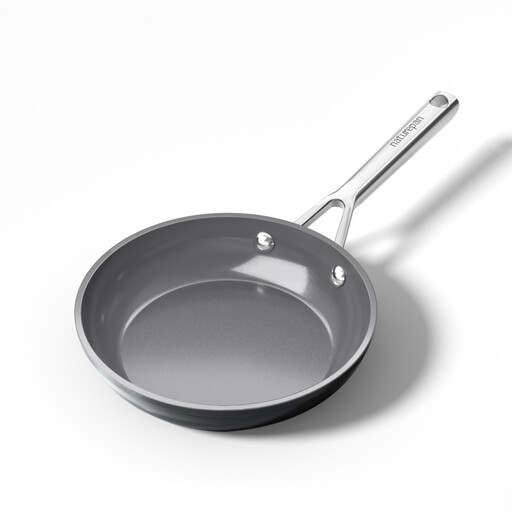
Why we chose it: Ideal for a single person or a couple, this compact pan is perfect for morning eggs or cooking small portions. Its versatility makes it highly practical in kitchens where every square inch counts.
Its stainless steel handle allows it to go in the oven up to 260 °C, avoiding the frustration of a pan that's limited to the stovetop.
The titanium and diamond-reinforced ceramic coating promises excellent durability and healthy, PFAS-free cooking. Its optimised base ensures fast, even heating on induction hobs.
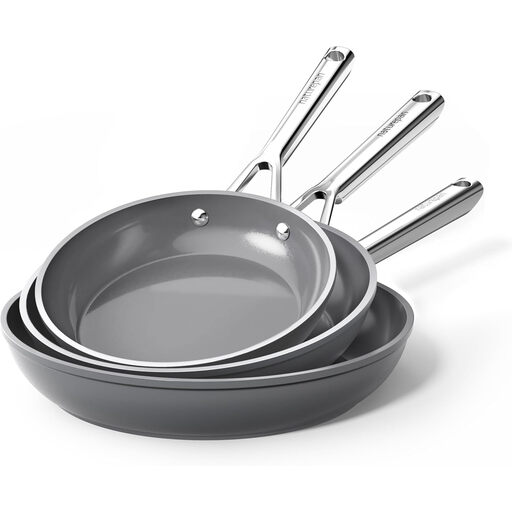
Why we chose it: This ceramic pan set covers all the needs of a family, from a small omelette to a large vegetable stir-fry. It's a complete solution to get fully equipped in one go with consistent, high-performance cookware.
Each pan in the set has an induction-optimised base, ensuring consistent heating performance regardless of size, unlike mismatched sets.
All three pans share the same reinforced coating and oven compatibility (up to 260 °C), offering great versatility for preparing multiple dishes at once.
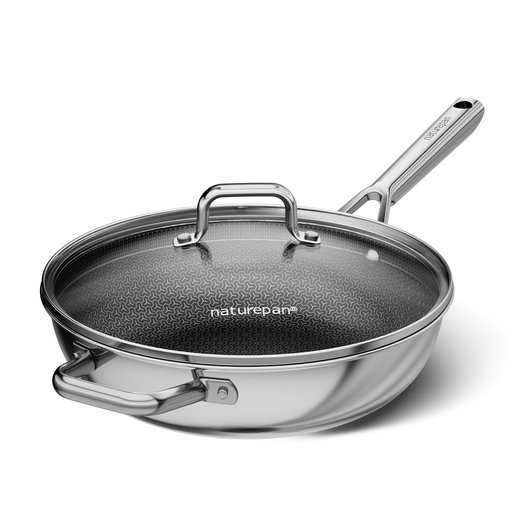
Why we chose it: With its high sides and lid, this ceramic induction sauté pan is the ultimate tool for saucy dishes, braised meats, or simmered vegetables. Its large 28 cm capacity is perfect for large families or entertaining guests.
It avoids the "false versatility" trap by offering high sides and a lid, transforming it into a truly multifunctional tool for searing, simmering, and braising without splatters.
Its 5-layer construction with a laser-etched honeycomb texture and its diamond-titanium coating are designed for heavy-duty durability, even with intensive use.
We have selected other products for you that meet our demanding specifications for performance and safety.
The lifespan of a ceramic pan depends primarily on the quality of its coating and how you care for it. An entry-level model will see its performance decline in less than a year. Conversely, a well-maintained pan with a reinforced coating (titanium, diamond) will remain your kitchen ally for several years.
To maximise your pan's lifespan, a few simple steps are all it takes:
Yes, quality ceramic pans are an excellent option for a healthy non-stick pan. Their coating is made without the use of per- and polyfluoroalkyl substances (PFAS), such as PFOA or PTFE, which are found in some traditional non-stick coatings. In practical terms, this means no potentially harmful fumes are released, even in cases of accidental overheating. It is therefore a wise precautionary choice for anyone wishing to limit their exposure to these substances.