
Livraison le jour même ou le lendemain

Qualité garantie

Débloquez vos offres de bienvenue: Livraison GRATUITE | Jusqu'à -80 % | 30 jours d'essai gratuits à JoyPlus
Téléchargez l'application
Choosing a new cookware set can often be a headache. Drowning in marketing promises, it's hard to know what to expect from daily use. Ceramic-coated utensils, in particular, are appealing for their non-stick promise and "healthy cooking" image. But are they all created equal, especially when cooking on an induction hob?
As the Head of Home & Kitchen Equipment at Joybuy, my role is to separate fact from fiction and give you clear, practical advice. Before you commit, let's review the 3 most common pitfalls that can turn a promising purchase into a costly disappointment.
To avoid falling into these traps, simply focus on a few technical specifications. Here are the points to examine closely before you check out.
The term "ceramic" can mean very different things. Entry-level versions often prove to be fragile. More premium options integrate reinforcements to significantly boost durability and non-stick performance.
For maximum efficiency on an induction hob, the quality of the base is paramount.
A good cookware set should adapt to your kitchen and your habits.
Rather than a long, random list, here are a few configurations that meet specific needs, based on the performance and practicality criteria we've just outlined.
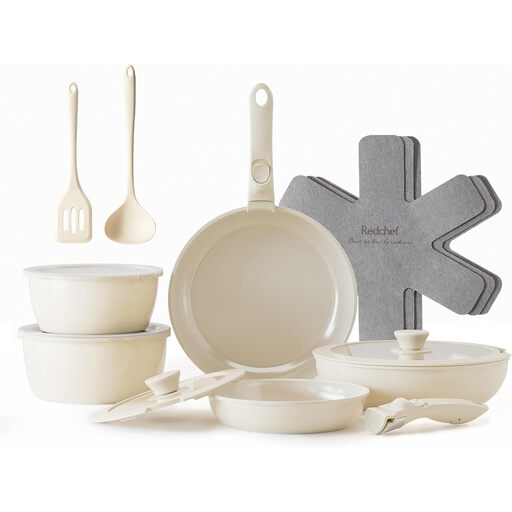
Why we chose it : Ideal for compact kitchens, studio apartments, or camper vans where every square inch counts. The single handle for all items is the core of this ingenious system.
It directly tackles the lack of space with a system of stackable pots and a detachable handle that, according to the manufacturer, saves up to 75% of cupboard space.
Maximum versatility: the pieces go from the hob to the oven (up to 230°C / 450°F, without the handle), then to the table as a serving dish or into the fridge with the storage lids.
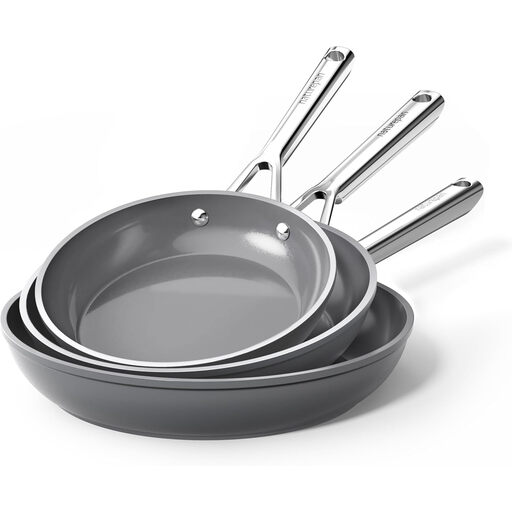
Why we chose it : Perfect for those who cook daily and want pans that will go the distance, from a simple fried egg to a steak seared and then finished in the oven.
It bypasses the pitfall of fragile coatings with its ceramic composition reinforced with diamond and titanium particles, designed to better withstand everyday wear and tear.
High heat resistance (oven-safe up to 260°C) and a thick base ensuring even heat distribution, which is essential for perfectly searing food.
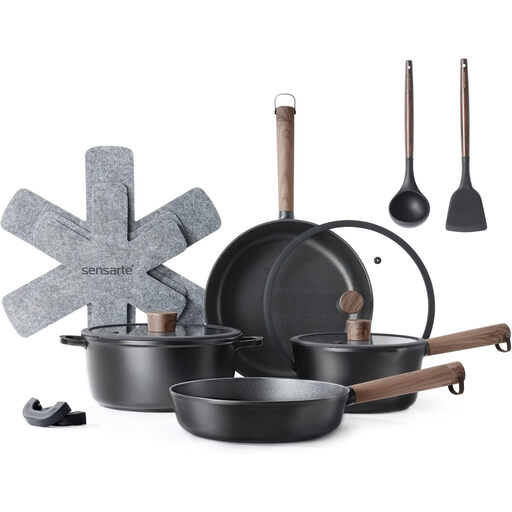
Why we chose it : Designed for families or those who like to cook in large batches, this complete pots and pans set prepares you for any situation, from simmering sauces to large Sunday stir-fries.
It avoids the trap of incomplete "all-in-one" sets by offering an arsenal of 13 pieces, including a stockpot, saucepan, pans of different sizes with their lids, and even utensils and protective felt pads.
A complete set for all everyday needs. Its design allows for surprisingly compact storage for a set of this size, and the coating makes cleaning up after family meals much easier.
We have compiled a complete selection of products that meet our selection criteria and current safety standards.
The lifespan of a ceramic coating depends heavily on its base quality and how it's maintained. An entry-level model might start to stick after a year of daily use, while a titanium or diamond-reinforced coating can retain its properties for several years. To make it last, use wooden or silicone utensils, cook over medium heat, and, most importantly, avoid thermal shock (never run a hot pan under cold water).
Although many models are advertised as dishwasher-safe, hand washing with a soft sponge and soapy water is still the best way to preserve the coating. Always let your pots and pans cool to room temperature before cleaning them. Avoid abrasive sponges and scouring powders, which will permanently damage the non-stick surface.
Yes. PFAS, PFOA, and PTFE-free cookware is made without using these chemical compounds during its production. Opting for products with these labels provides peace of mind for consumers who want to limit their exposure to potentially harmful substances. It's a cornerstone of the healthy cooking approach, which involves choosing materials that are inert when in contact with food, even at high temperatures.