
Livraison le jour même ou le lendemain

Qualité garantie

Débloquez vos offres de bienvenue: Livraison GRATUITE | Jusqu'à -80 % | 30 jours d'essai gratuits à JoyPlus
Téléchargez l'application
Choosing a new hob can quickly feel overwhelming. Between marketing promises and complex technical sheets, it's easy to get lost. An impressive power rating can sometimes hide unresponsive cooking zones, and an "easy-to-clean" surface might get scratched after the first use. As a product expert at Joybuy, my role is to help you cut through the noise. I'll guide you in identifying the criteria that truly matter so you can make a choice that fits both your kitchen and your daily life.
Before you start comparing models, it's best to know the most common traps. Keeping them in mind will save you a lot of disappointment.
To make the right choice, focus on the features that genuinely meet your needs.
The first step is to measure the space you have available. The 60 cm ceramic hob is the standard size. It fits into most worktops and typically offers 4 cooking zones, a versatile configuration ideal for families.
For a studio, kitchenette, or as a secondary hob, a 2-zone hob (about 30 cm wide) is an excellent option. It frees up counter space while still being sufficient for everyday cooking. Always check the cut-out dimensions (the width and depth of the opening) and ensure they match your installation.
Power, measured in watts (W), determines how fast the hob heats up. A high-performance ceramic hob will offer zones with varied power levels, for example, from 1200 W for simmering to 2200 W or more for searing meat.
Some models feature expandable or dual-circuit cooking zones. These zones adapt to the diameter of your pans or allow you to activate a larger area for big cookware like fish kettles or stockpots. This is a real bonus for added flexibility.
These features are not just gimmicks. They ensure safe and convenient use on a daily basis.
To help you get a clearer picture, here are some models that meet different needs, selected based on their performance and safety.
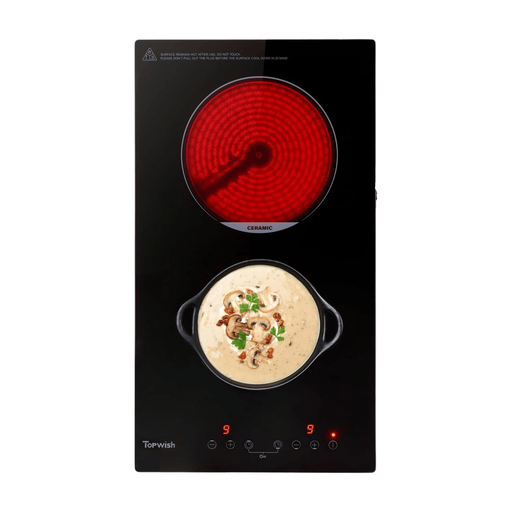
Why it's a great fit: Ideal for studios, small kitchens, or as a secondary hob, this 2-zone hob model optimises space without compromising on the essentials. Its two zones of 1200 W and 1800 W are sufficient for everyday cooking.
It sidesteps the "diluted power" trap. With 3000 W distributed over just two zones, each area has more than enough power for efficient and independent cooking.
It includes essential safety features (child lock, heat indicator) and a timer, functions often missing from entry-level compact models.
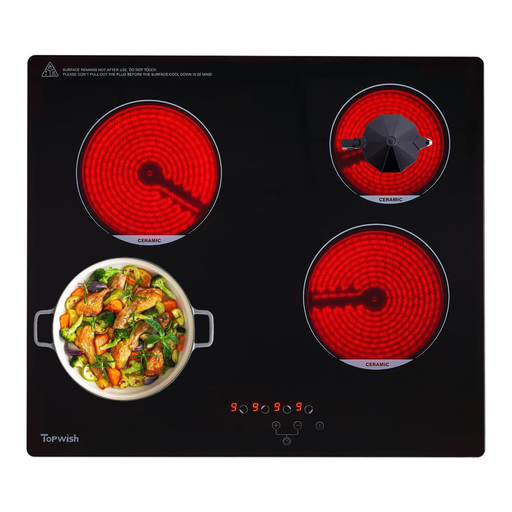
Why it's a great fit: This 4-zone, 60 cm hob is the quintessential family solution. Its 6600 W total power and two dual-circuit zones offer great flexibility for cooking multiple dishes simultaneously with various pot sizes.
It bypasses the trap of poor ergonomics. Its touch control panel is clear and responsive, and the expandable zones are simple to activate, making it genuinely practical to use large cookware.
The inclusion of two dual-circuit zones offers a versatility that's rare at this price point, adapting to small saucepans and large stockpots alike.
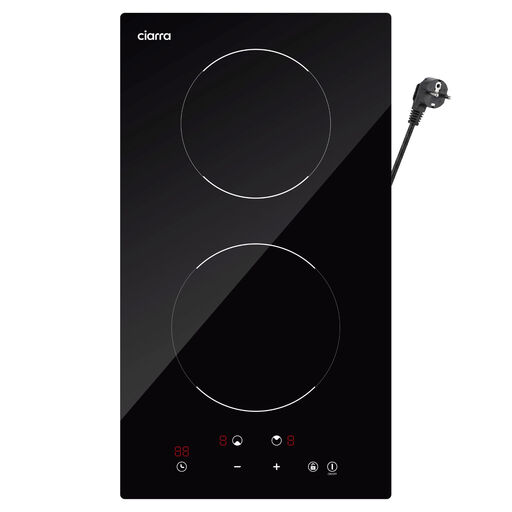
Why it's a great fit: For those considering an induction hob, this compact model is an excellent entry point. It offers the speed and precision of induction, heating the cookware directly for a near-instantaneous heat-up time.
It directly addresses the main criticism of ceramic hobs: their thermal inertia. Induction offers immediate responsiveness to temperature changes, preventing boil-overs and allowing for finer cooking control.
Enhanced safety (the surface doesn't get as hot) and simplified cleaning (spills don't bake onto the surface). Note that it requires compatible (magnetic) cookware.
We have put together a complete selection of products that meet our quality criteria and current safety standards.
The choice depends on your priorities.
A good quality ceramic hob, correctly installed and maintained, has an average lifespan of 10 to 15 years. Maintenance is simple: use a non-abrasive sponge and a specialised cleaner for ceramic glass. For stubborn stains, a suitable scraper is recommended.
Installing a built-in electric hob involves connecting it to the electrical system, which must comply with strict safety standards (like the NF C 15-100 standard in France). For high-power models (over 3000 W), a direct connection to the electrical panel on a dedicated circuit is often required. To ensure a safe and compliant installation, it is essential to hire a qualified electrician.