
Livraison le jour même ou le lendemain

Qualité garantie

Débloquez vos offres de bienvenue: Livraison GRATUITE | Jusqu'à -80 % | 30 jours d'essai gratuits à JoyPlus
Téléchargez l'application
A ceramic fan heater can quickly warm up a bedroom, office or living room without the need for a fixed installation. Product listings often highlight power, ECO mode or quiet operation, but they don't always specify the real-world conditions of use. To avoid buying the wrong model, it's best to check the area you need to heat, the available controls and the safety features.
A 2,000 W fan heater generally gives out more heat than a 1,000 or 1,500 W appliance. That doesn't mean it will suit every room. In a small, well-insulated office, this power can be used occasionally on a lower setting. In a larger or poorly insulated room, it will speed up the warm-up time without necessarily replacing a main heating system.
So you need to weigh up the power against the stated heating area, the insulation, the ceiling height and the temperature you want.
An appliance marketed as a low-energy heater doesn't make electricity consumption disappear. A 2,000 W model running at full power for one hour theoretically uses 2 kWh. ECO mode, the thermostat and the different heat settings can reduce running time, but the result depends on your settings and your electricity tariff.
Also be wary of the percentage savings claimed by brands. These are based on their own comparison conditions and don't represent guaranteed savings in your home.
A fan heater is still audible, even when it uses a PTC ceramic element. The decibel level stated can vary depending on the mode selected and the measurement distance. For a bedroom, look for a precise figure, such as a range of 34 to 42 dB, rather than a vague "quiet" claim.
Overheat protection and a tip-over switch are essential safety precautions, but they don't replace good usage rules: keep the appliance clear, on a stable surface, away from fabrics, and unplug it after use.
PTC ceramic heating uses an element whose electrical resistance changes with temperature. In a fan heater, it's combined with a fan that blows warm air into the room. This technology provides fast heat-up and allows a compact design, but it doesn't automatically make the appliance quiet or economical.
Check the number of modes available: a low setting lets you reduce the power when the room is already warm. Some models offer steps of 900 W, 1,300 W and 1,500 W, while others are limited to just two levels.
A heater with an adjustable thermostat lets you select a target temperature, often between 5 °C and 35 °C depending on the model. This feature is more practical than a simple "warm" button for maintaining a steady temperature.
A 12 or 24-hour timer can schedule the appliance to turn off or on during certain periods. It's handy for a work session or occasional use, but always make sure the area around the appliance is clear before leaving it running unattended.
An oscillating heater distributes warm air over a wider angle. A 70° oscillation can therefore cover a room better than a fixed flow, without increasing the nominal power.
Look for at least overheat protection and a safety cut-off switch in case of tipping. The CE mark, instructions in French, identification of the manufacturer or the responsible party established in the European Union, and usage guidelines should all be verifiable on the product page.
In the UK, plug a high-power appliance directly into a suitable wall socket. Avoid multi-way adaptors and extension leads that aren't designed for such a load. Never place the heater in a bathroom, near a water source, under a power socket or against curtains. Keep about one metre between the air outlet and flammable materials, following the manufacturer's instructions.
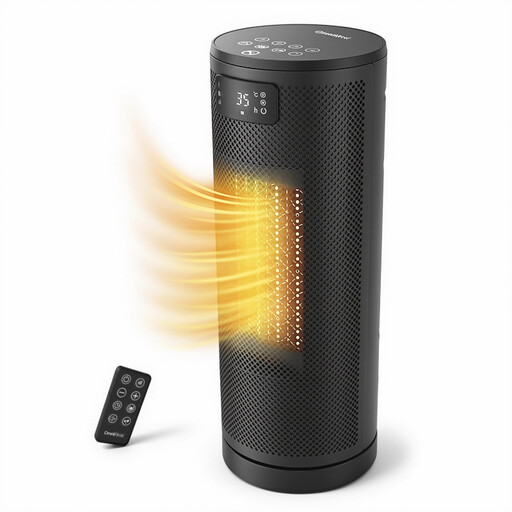
Why this choice suits this profile: Its four modes, adjustable thermostat from 5 to 35 °C and compact design make it ideal for first-time use in a bedroom, office or small living room.
The listing states the noise levels, from 38 to 50 dB depending on the mode, rather than just a general promise of quietness.
ECO mode, oscillation, remote control, 24-hour timer and overheat and tip-over protection.
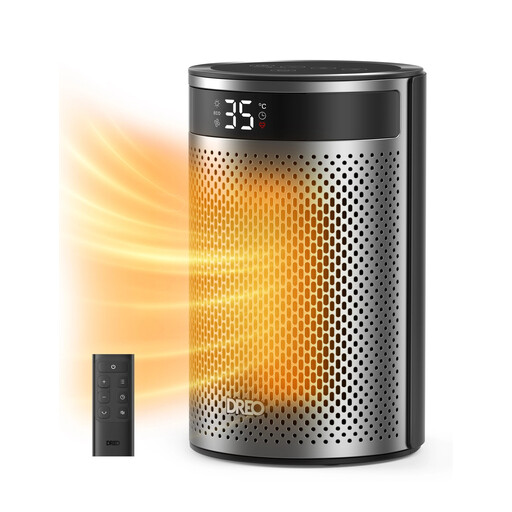
Why this choice suits this profile: Its stated noise level between 25 and 42 dB, remote control and adjustable thermostat from 5 to 35 °C meet the expectations of a bedroom or quiet workspace.
The data shows three power levels, at 900, 1,300 and 1,500 W, which avoids running at full power all the time.
Dimensions of 15.8 × 15.4 × 25 cm, multi-layer protection and CE and CB certifications as per the product listing.
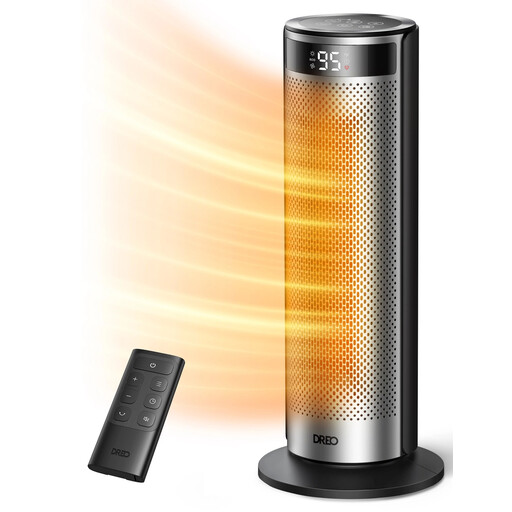
Why this choice suits this profile: Its stated coverage of 15 to 25 m², 70° oscillation and precise settings make it suitable for medium to large rooms.
The listing clearly distinguishes the 2,000 W power, the PTC surface of 250 × 44 mm and the stated noise range of 25 to 42 dB.
Adjustable thermostat from 5 to 35 °C, 12-hour timer, child lock and eight levels of protection as stated.
We've put together a comprehensive, real-time updated list of products that fully meet these strict selection criteria and European safety regulations.
The cost depends on the appliance's power and how long it's used. At full power, a 1,500 W model uses 1.5 kWh per hour, compared to 2 kWh for a 2,000 W appliance. Use the thermostat, lower settings and the timer to avoid unnecessary heating periods.
Follow the instructions in the manual strictly. Choose an appliance with overheat protection, a tip-over cut-off switch and a timer, then place it on a hard, flat, clear surface. Never cover it and keep bedding, curtains and clothing away. Unattended operation should remain the exception and be prepared with care.
For a small bedroom or office, a 1,500 to 1,800 W model with multiple levels will offer more flexibility. For a room of 15 to 25 m², a 2,000 W appliance can be considered if the listing states a corresponding coverage and your home's insulation allows it.