
Livraison le jour même ou le lendemain

Qualité garantie

Débloquez vos offres de bienvenue: Livraison GRATUITE | Jusqu'à -80 % | 30 jours d'essai gratuits à JoyPlus
Téléchargez l'application
Navigating the jungle of kitchen utensils can be a daunting task. Between promises of healthy cooking and marketing claims, it's hard to separate fact from fiction. On paper, a ceramic cookware set has it all: it's attractive, healthy, and high-performing. However, a few common pitfalls can quickly turn what seemed like a good deal into a purchase you'll regret. Let's review the key points to avoid any unpleasant surprises.
The two most common purchasing mistakes are:
For a long-lasting investment, three technical criteria demand your full attention. They are the guarantee of a set of pots and pans that is safe, practical, and versatile.
The true advantage of a ceramic cookware set is its coating. A genuine ceramic coating is derived from a "sol-gel" process, which uses sand derivatives (silica) to create a glassy, hard, and thermally stable surface.
Its main health benefit is the absence of perfluorinated compounds. Always check that the product is certified PFOA, PFAS, lead, and cadmium-free. This guarantees a non-toxic cooking surface that won't release controversial substances, even in case of accidental overheating. Avoid vague packaging and favour brands that are transparent about their coating's composition.
In small kitchens, modularity isn't a luxury, it's a necessity. A system of stackable cookware can free up to 70% of your cupboard space. The cornerstone of this modularity is the removable handle.
Before buying, pay close attention to:
Today, a good cookware set must be a true Swiss Army knife. Two types of compatibility are fundamental:
Rather than an endless list, we've selected products that meet specific needs while respecting our criteria for safety and practicality.
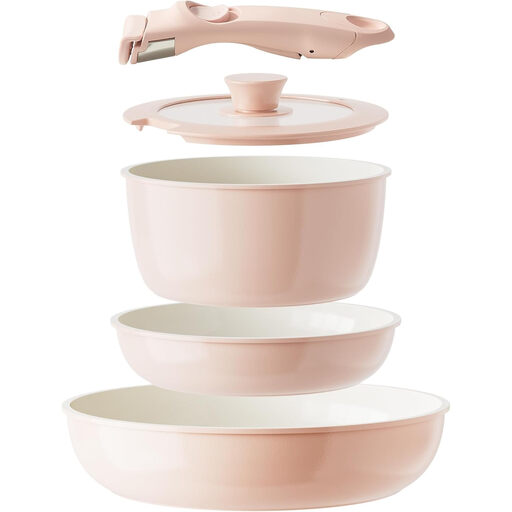
Why we chose it: Ideal for small kitchens, studio apartments, or anyone looking to optimise their cupboard space. The stackable system and single handle allow the entire set to be stored in one large drawer.
This Redchef set uses a genuine natural ceramic coating, guaranteed free of PFAS, PTFE, and PFOA. This is not a mere "ceramic effect." Its removable handle is designed for stable and safe handling, from the hob to the oven, and then to the table.
Up to 75% space saving and total versatility: compatible with all hobs (including induction), oven-safe up to 450°C (without handle or lid), and dishwasher-safe.
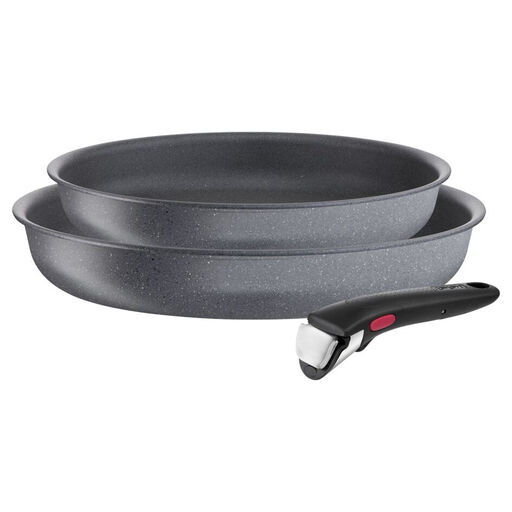
Why we chose it: For those who prefer to rely on a system that has stood the test of time and are looking for a reliable everyday solution. The Ingenio range is the undisputed benchmark for removable handles.
This set eliminates the risk of a flimsy handle thanks to Tefal's patented and ultra-robust system. The non-stick coating is guaranteed PFOA-free, and the Thermo-Fusion base ensures even heat distribution and perfect induction compatibility.
The Thermo-Signal technology, which indicates when the pan has reached the ideal temperature for a perfect sear, and a removable handle system that remains the most reliable on the market.
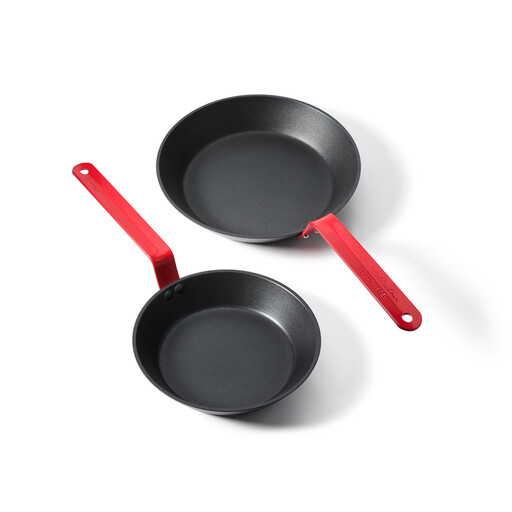
Why we chose it: Perfect for those who prioritise healthy cooking and want a high-performance non-stick surface for quick cooking (eggs, pancakes, fish) with minimal oil.
This set stands out from low-end coatings by incorporating a Swiss non-stick technology (ILAG), guaranteed PFOA and PFOS-free. It also ticks the versatility box with all-hob and oven compatibility.
Its non-stick performance, claimed to be very durable by the manufacturer, and its oven-safe compatibility up to 232°C give it a highly appreciated flexibility for a simple duo of pans.
Explore our full selection of products that meet our quality criteria and current safety standards.
The longevity of a ceramic coating heavily depends on its care. With proper use, it can last from 2 to 5 years. To preserve it, follow a few golden rules: use wooden or silicone utensils, avoid thermal shock (never run a hot pan under cold water), do not overheat it while empty, and prefer hand washing with a soft sponge.
Its main health advantage is that it is made PFOA and PFAS-free. These chemicals (the infamous "forever chemicals") are used in many traditional non-stick coatings and are now highly controversial. A ceramic coating, on the other hand, offers a stable and inert cooking surface, provided you adhere to the usage temperatures recommended by the brand.
It's very simple. Look for the induction symbol (a coil-shaped icon) on the packaging or engraved directly on the bottom of the pot/pan. The other foolproof test: hold a magnet to the base of the utensil. If it sticks firmly, your cookware is induction-compatible.