
Livraison le jour même ou le lendemain

Qualité garantie

Débloquez vos offres de bienvenue: Livraison GRATUITE | Jusqu'à -80 % | 30 jours d'essai gratuits à JoyPlus
Téléchargez l'application
Navigating the jungle of cookware options can be a daunting task. Ceramic cookware is all the rage, touted as a healthy and high-performance solution. But be warned: not all promises hold up. Before you pull out your credit card, it's crucial to see through the marketing hype and understand what truly makes a difference. As the Head of Product Recommendations at Joybuy, my job is to arm you with the right information for a smart, long-lasting purchase.
Marketing is full of tempting promises. However, a few common misconceptions can quickly lead to disappointment. Here are the three most frequent pitfalls.
To ensure you make the right choice and a lasting investment, here are the three technical points you absolutely must check.
The material of the pan's body (what's underneath the coating) is crucial for cooking performance.
A word of caution: always check for compatibility with your cooktop. If you have an induction stove, the 'induction compatible' or 'all cooktops, including induction' label is non-negotiable. The base of the pan must contain a ferromagnetic disk to work.
Not all ceramic coatings are created equal. Technologies have evolved significantly to make them more durable. Some are now reinforced with titanium or diamond particles for far greater durability and scratch resistance. These innovations significantly extend the life of the non-stick surface.
Versatility is another major advantage. A pan that is oven-safe opens up new possibilities: start a dish on the stovetop and finish it in the oven to get a perfect gratin top or for slow, low-temperature cooking. Always check the maximum supported temperature, including the handle!
Practical details make all the difference in daily use. Cool-touch handles, tight-fitting lids, and pouring spouts... these little extras change everything. For small kitchens, RVs, or simply to save space, a cookware set with a detachable handle is a remarkably effective solution. These sets allow pans and pots to be stacked perfectly, freeing up precious cabinet space.
Instead of an endless list, here are a few products that check all the boxes and meet specific needs, based on the criteria we've just discussed.
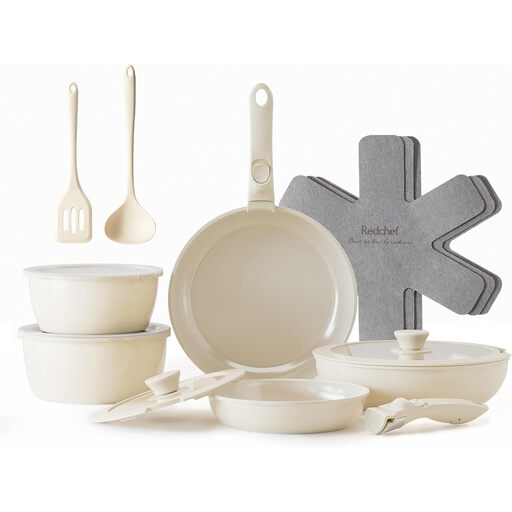
Why it's a great choice: Perfect for kitchens where every square inch counts. This comprehensive set of pots and pans covers all everyday needs, from slow-cooked stews to seared meats, with maximum space-saving thanks to its stackable design and single handle.
The promise isn't indestructible durability, but unbeatable convenience. The main selling point is modularity and space-saving: a tangible benefit that solves a real problem, going far beyond just the non-stick surface.
The detachable handle lets you move from the stovetop to the oven, then serve directly at the table or store in the fridge. The set is compatible with all cooktops (including induction) and is dishwasher-safe.
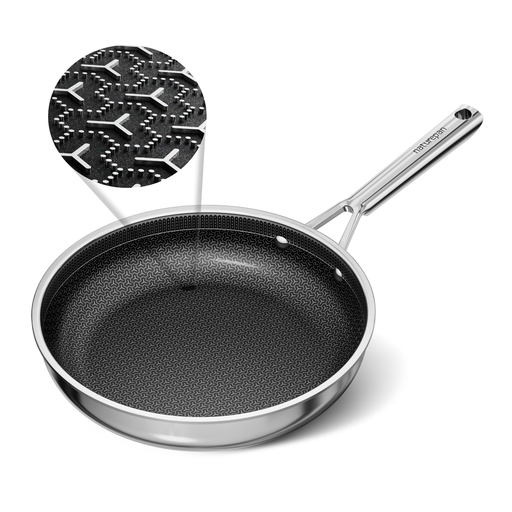
Why it's a great choice: For those who want to sear meat to perfection without giving up the convenience of non-stick. This hybrid pan combines the best of both worlds: the durability of stainless steel for searing and the practicality of ceramic to prevent sticking. The result: controlled, professional-grade cooking.
This model tackles the fragility problem head-on. Its laser-etched honeycomb pattern protects the ceramic coating (located in the 'valleys') while allowing the raised stainless steel to ensure a perfect sear. A true technical innovation.
Its 5-ply hybrid construction and diamond-titanium reinforced coating. This oven-safe pan (up to 260°C / 500°F) offers versatility and durability that are head and shoulders above the rest.
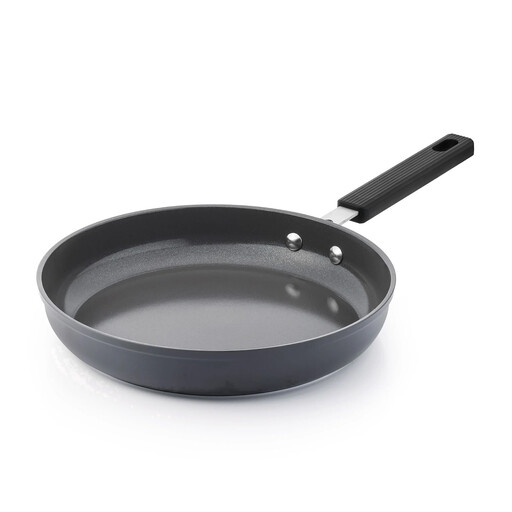
Why it's a great choice: For healthy everyday cooking, without the hassle. Ideal for fried eggs, omelettes, or sautéed vegetables, it focuses on the safety of its materials and its ease of cleaning—two top priorities for daily kitchen use.
It perfectly addresses the pitfall of vague 'healthy' claims. The brand guarantees in black and white that the coating is free of all PFAS, lead, and cadmium. This is transparency that provides peace of mind and makes a real difference.
A healthy pan with clear, verifiable guarantees. Compatible with all cooktops (including induction) and equipped with an ergonomic, cool-touch handle, it's the perfect partner for frequent, worry-free use.
Discover our complete, up-to-date selection of products that meet our strict selection criteria and current safety standards.
The lifespan of a ceramic pan depends heavily on its use and care. With proper maintenance (no overheating, hand washing, using wood or silicone utensils), a quality coating can remain effective for 2 to 3 years. Reinforced models (titanium, diamond) can naturally last longer.
This is a very bad idea. Using metal utensils (forks, knives, stainless steel spatulas) should be avoided at all costs. They can scratch and irreversibly damage the non-stick ceramic coating, destroying its properties. Always opt for wood, bamboo, silicone, or nylon utensils.