
Livraison le jour même ou le lendemain

Qualité garantie

Débloquez vos offres de bienvenue: Livraison GRATUITE | Jusqu'à -80 % | 30 jours d'essai gratuits à JoyPlus
Téléchargez l'application
Choosing a new ceramic cookware set might seem straightforward. On paper, the promise is appealing: healthier cooking, effortless cleaning, and an ultra-high-performance non-stick surface. Yet, disappointment is often just around the corner, sometimes only a few months after purchase. As the Head of Product Curation at Joybuy, my mission is to help you decode the marketing jargon to make a truly informed decision.
Before you take the plunge, watch out for these 3 common pitfalls?:
To ensure you invest in a set of pots and pans that lives up to your expectations, a few technical checks are essential.
The body of your pot or pan is its engine. There are two main types:
The term "ceramic" most often refers to a non-stick coating derived from a so-called "sol-gel" process, based on sand derivatives (silica). Its main advantage? It's formulated without PFOA or PFAS, controversial substances sometimes found in older PTFE (Teflon) coatings. When choosing your PFOA-free cookware, make sure the manufacturer guarantees the absence of these compounds. This composition makes it a prime choice for a healthy cookware set.
In a modern kitchen, every square inch counts. A cookware set with a detachable handle revolutionises storage. Stackable pots nest inside one another, freeing up precious cupboard space. This clever system also allows you to move a single dish from the hob to the oven, and then directly to the table.
Rather than an endless list, here are configurations designed for specific needs, all of which sidestep the pitfalls we've just discussed.
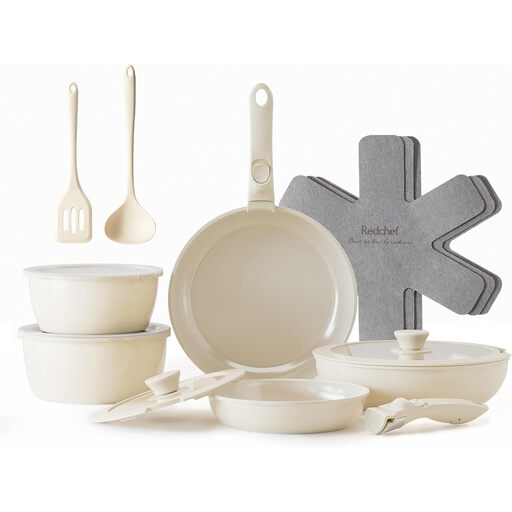
Why we chose it: Perfect for optimising space, whether in a small flat, a studio, or even a camper van. The 100% stackable concept and the single handle that fits every piece are game-changers for storage.
The detachable handle prevents accidental overheating of the handle and makes it easy to move to the oven, preserving the coating's longevity. The stackable design directly solves the storage headache.
Absolute versatility: Goes from the induction hob to the oven, then to the fridge and the table. Its ceramic coating is guaranteed free of PFAS, PTFE, PFOA, lead, and cadmium.
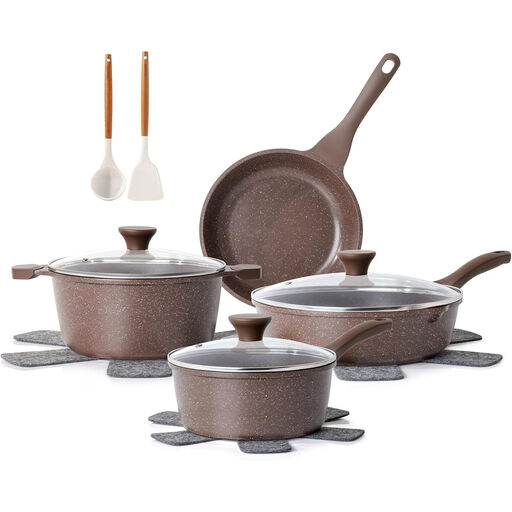
Why we chose it: For those who cook daily for the whole family and prioritise the composition of materials. This comprehensive set covers all needs, from frying pans to stockpots with their lids.
It directly addresses the concern for healthy cooking: the brand guarantees a non-stick coating free of PFOA, PFOS, lead, and cadmium. There's no room for ambiguity.
Healthy composition and versatility: The aluminium body ensures rapid heating, and the base is compatible with all hobs, including induction. Cleaning is a breeze thanks to the rivet-free interior.
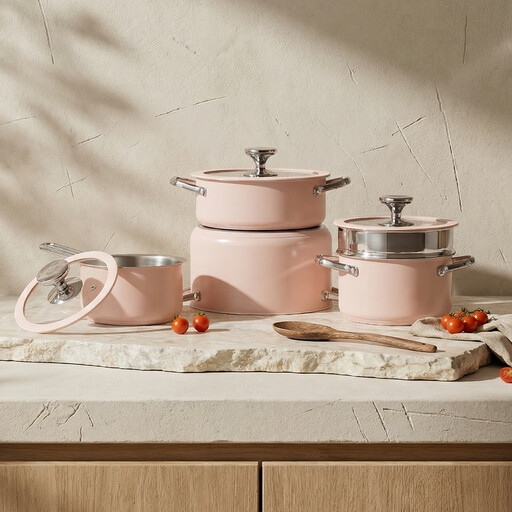
Why we chose it: For those who want the robustness of stainless steel on the inside and the elegance of a coloured ceramic coating on the outside. An original approach that focuses on durability and design.
This set sidesteps the wear-and-tear pitfall: it doesn't rely on a non-stick cooking surface, but on the longevity of 304 stainless steel. The ceramic is on the exterior for style and easy cleaning, with no risk of wear from contact with food.
Ultra-robust design: The 304 stainless steel interior can withstand very high temperatures (up to 870 °C) and remains perfectly neutral, even with acidic foods. The exterior coating is resistant to both corrosion and stains.
We have put together a complete selection of products that meet our selection criteria and current safety standards.
The lifespan of a ceramic non-stick coating primarily depends on its care. On average, with proper maintenance (cooking over medium heat, using wooden or silicone utensils, hand washing), you can expect it to retain its properties for 1 to 3 years. Repeated overheating is its number one enemy.
This is strongly discouraged. Although it appears hard, a ceramic coating is susceptible to scratches. The slightest micro-scratch can impair its non-stick properties and accelerate wear. Always opt for spatulas, spoons, and whisks made of silicone, wood, or nylon.
Yes, provided its base is designed for it. For cookware for induction to work, its base must include a ferromagnetic material. Look for the coil-shaped pictogram or the clear "induction compatible" mention on the product sheet. A thick, perfectly flat base will ensure better contact and more efficient heating.