
Livraison le jour même ou le lendemain

Qualité garantie

Débloquez vos offres de bienvenue: Livraison GRATUITE | Jusqu'à -80 % | 30 jours d'essai gratuits à JoyPlus
Téléchargez l'application
At first glance, choosing a new ceramic cookware set seems straightforward. The promise of a healthy, non-stick surface that cleans with a simple wipe is certainly appealing. Yet, disappointment often follows: pans that start sticking after just a few weeks, or pots that struggle to heat up on an induction hob...
As a Product Expert at Joybuy, my role is to help you decode the marketing claims to make a truly informed choice. Let's break down the 3 most common pitfalls and the criteria that really matter, ensuring a purchase you won't regret.
The market is saturated with options, but not all are created equal. Here are the key things to watch out for that make all the difference between a good investment and a disappointment.
For healthy and sustainable cooking, looks aren't everything. Far from it. Here are the three technical parameters that determine the quality and longevity of your future cookware set.
The term "ceramic" most often refers to a coating. For enhanced durability, look for coatings reinforced with titanium or diamond particles. Also, ensure it is explicitly labelled as PFOA, PFAS, lead, and cadmium-free. The body of the cookware is just as important: forged aluminium or multi-ply stainless steel provide excellent conductivity and even heat distribution, preventing the hot spots that degrade the coating.
For high-performance induction cookware, the base must be thick and perfectly flat. It should incorporate a quality ferromagnetic disk that covers almost its entire diameter. This feature ensures maximum contact with the hob, rapid heat transfer, and uniform cooking. The result of a poor-quality base? Unpleasant whistling sounds and wasted energy.
A good non-stick pots and pans set should adapt to your daily routine. A sturdy and easy-to-use detachable handle transforms your cookware: it goes from the hob to the oven, then directly to the table as a serving dish, and finally into the fridge. Check the maximum temperature rating for the oven-safe ceramic pan (with and without the handle). Flat, stackable lids are also a major plus for optimising space.
To illustrate these criteria, here are a few products that stand out for specific uses.
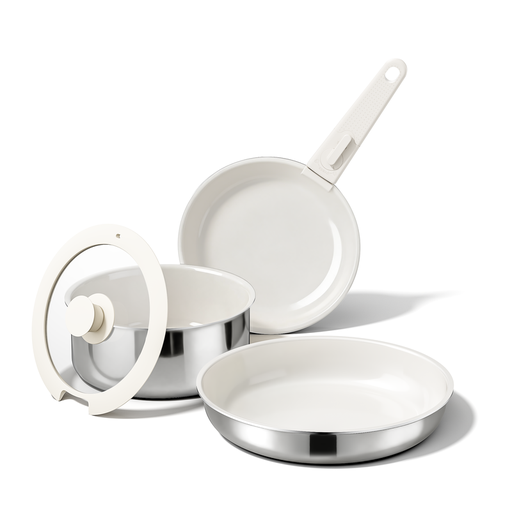
WHY IT'S A GREAT CHOICE: Perfect for small kitchens, studio apartments, or even outfitting a van or camper. This set directly addresses the need for versatility and compact storage without sacrificing cooking quality.
The detachable handle system is designed to be sturdy and secure. The stackable design is engineered so that the bases don't rub directly against the coatings, thus preserving their integrity.
Up to 70% space-saving thanks to stacking and the single handle. Total versatility: compatible with all hobs including induction, oven (up to 250°C), fridge, and dishwasher.
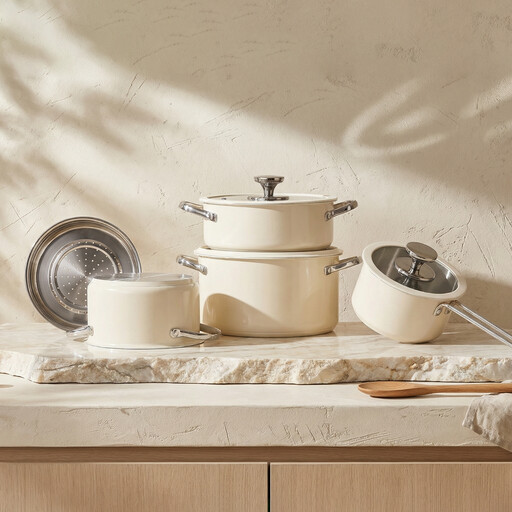
WHY IT'S A GREAT CHOICE: Designed for those who prepare varied meals daily. This set offers different sizes of stockpots and saucepans for simmering, steaming, or boiling larger volumes.
This set combines a 304 stainless steel interior, known for its durability and food-grade safety, with an exterior ceramic coating that makes cleaning easy. This hybrid approach prioritises interior durability.
Complete and versatile set: includes a milk pot, a stockpot with a steamer basket, a fondue pot, and a large stockpot. Robust materials: the 304 stainless steel can withstand very high temperatures (up to 870°C).
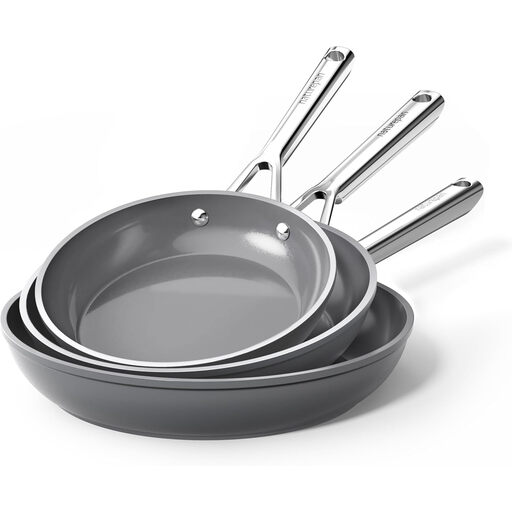
WHY IT'S A GREAT CHOICE: Perfect for those looking to replace their worn-out pans with high-performance cookware for daily tasks: frying eggs, searing meat, sautéing vegetables...
The ceramic coating is reinforced with diamond and titanium particles, making it more resistant to abrasion and extending its non-stick effectiveness compared to a basic ceramic coating.
Coating durability: the reinforcement technology offers better longevity. Versatility: the pans are oven-safe up to 260°C, allowing you to finish a dish or keep it warm.
We've curated a selection of products that meet our demanding quality criteria and current safety standards.
1. What is the real-world lifespan of a ceramic coating? The lifespan depends on the initial quality and how it's maintained. A high-quality coating, used over medium heat with wooden or silicone utensils and hand-washed with a soft sponge, can retain its non-stick properties for several years. Using a dishwasher, while often possible, can accelerate wear and tear.
2. How do I care for my ceramic cookware to preserve the non-stick surface?
3. Can a ceramic pan really go in the oven? Yes, many models are designed for it. This is a crucial feature to verify before buying. The temperature limit (usually between 200°C and 260°C) must be specified by the manufacturer. Be aware that if the handle is not metal or is not detachable, the pan is likely not oven-safe. The key takeaway: always check the product manual.