
Livraison le jour même ou le lendemain

Qualité garantie

Débloquez vos offres de bienvenue: Livraison GRATUITE | Jusqu'à -80 % | 30 jours d'essai gratuits à JoyPlus
Téléchargez l'application
Ceramic bowls fit just as easily into everyday meals as they do on a beautifully set table. However, a rushed purchase can lead to a few disappointments: awkward dimensions, impractical storage, or limited compatibility with your kitchen appliances. Before choosing a set, it’s worth focusing on the details that really matter, rather than just the colour or the marketing promises.
A bowl that’s 20 or 22 cm in diameter might look spacious, but how much it can actually hold depends largely on its depth and the shape of its sides. Wide, shallow pasta bowls are ideal for saucy dishes. Soup or cereal bowls generally need to be deeper to prevent spills.
So, be sure to check the full dimensions, the capacity stated in millilitres or ounces, and whether there’s a wide rim.
Depending on the model, ceramic can be compatible with the dishwasher, microwave, oven or freezer. However, this versatility isn’t automatic. A decorative finish, a plastic lid, or a sudden change in temperature can affect how the bowl can be used.
Always check the product page and follow the manufacturer’s recommendations. Even a container that’s oven-safe shouldn’t go straight from the freezer into a hot oven without care – thermal shock could cause it to crack.
Stackable bowls save space in a cupboard, but not all shapes nest together properly. External ridges, wide bases, or very different sizes can make the stack unstable.
In a small kitchen or a busy family home, the shape, weight and consistency of the dimensions matter just as much as the look.
Choose ceramic that’s designed for food contact, with a smooth, glazed surface that’s easy to clean. Some product pages also mention whether it’s lead-free or resistant to scratches. However, these details should be checked for each individual item and can’t automatically be applied to an entire range.
Thick ceramic often feels reassuring, but it can also be heavier to use every day. When you receive your bowls, inspect each one and stop using it at the first sign of a chip or crack.
Here are some useful guidelines:
The stated capacity is still a rough guide: the amount you serve will vary depending on how full you fill the bowl and its internal shape.
Look for separate indications for the dishwasher, microwave, oven and freezer. Compatibility stated for the bowl doesn’t necessarily apply to its lid. Plastic lids often need to be removed before going in the oven and may require hand washing.
To keep your bowls in good condition for longer, avoid knocking them against the sink, sudden temperature changes and abrasive cleaning products. Let a hot bowl cool down before rinsing it with cold water.
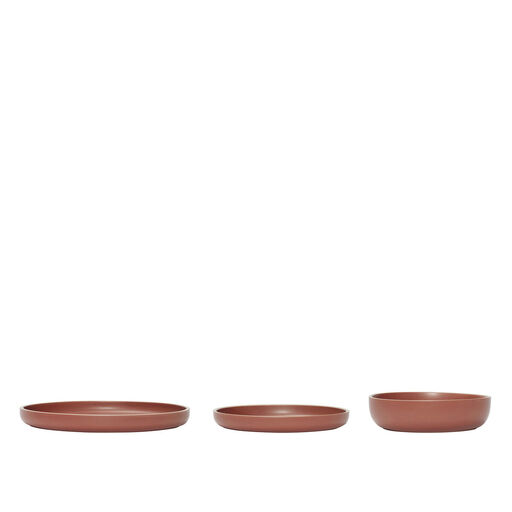
Why this choice suits this profile: With three different sizes, this set lets you build a versatile collection of tableware without buying lots of separate pieces. The bowls work well for cereals, salads, side dishes and snacks.
The dimensions and capacities are listed separately: 960 ml, 500 ml and 1,000 ml. The product page also states compatibility with the dishwasher and microwave, but not the oven.
A set of 3 red ceramic bowls, compatible with the dishwasher and microwave reheating according to the product page.
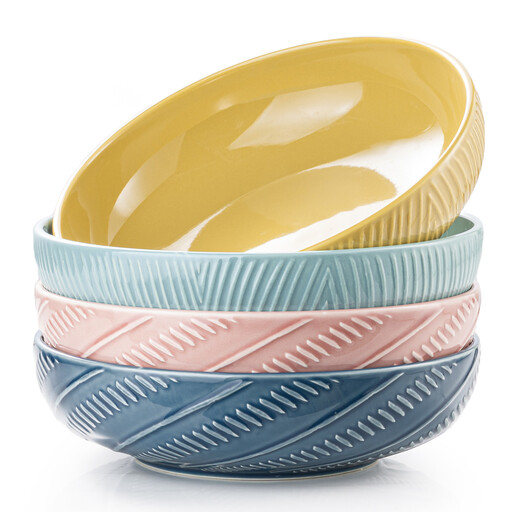
Why this choice suits this profile: The textured finish and deep colours add real character to family meals and dinner parties alike.
The product page mentions lead-free ceramic, a size of 21.6 cm by 6.1 cm, and a stackable design. Stated compatibilities cover the microwave, fridge, dishwasher and oven.
A set of 4 wide 36 oz bowls, with a decorative textured finish, stackable storage and stated uses for pasta, soups, salads and stews.
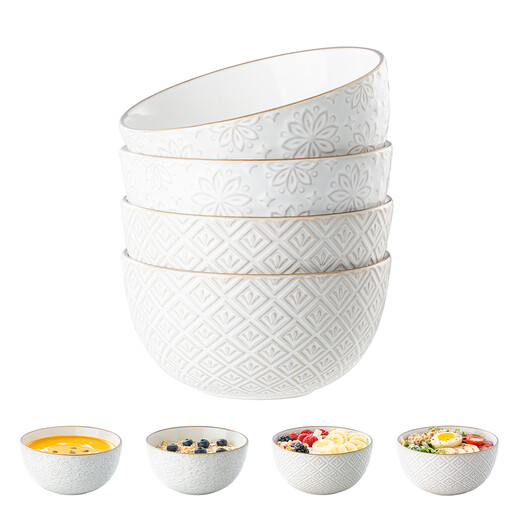
Why this choice suits this profile: With a 26 oz capacity, these bowls are suitable for soups, noodles, ramen, fruit and salads. Their volume leaves plenty of room for generous portions.
The product page details the capacity of each bowl, their stackable design and compatibility with the microwave, oven, freezer and dishwasher. Sudden temperature changes should still be avoided.
Different embossed patterns on each bowl, a glazed surface and dimensions suited to both liquid dishes and hearty meals.
We’ve put together a full, real-time selection of products that meet these exacting criteria, as well as European safety regulations.
Ceramic ramekins are the perfect complement to a set of bowls for serving sauces, desserts and individual dishes. An 8 oz model (around 237 ml) is particularly good for creams, mousses, quiches and baking portions. If you regularly make desserts, also check whether lids are included and what their maximum temperature rating is.
For a buffet, large serving bowls are very practical, but they don’t replace individual bowls. A well-thought-out collection of tableware can bring together soup bowls, cereal bowls, pasta bowls and a few small dishes.
No. Only the product page can confirm this. Also check that there are no metal parts, and remove any lids that aren’t designed for reheating. After use, handle the bowl with care: the ceramic can be very hot even if the sides only feel warm.
For everyday use, a medium capacity works well for cereals, fruit and classic soups. For ramen, noodles or generous portions, a size of around 700 to 800 ml offers more comfort. The depth and shape of the rim also affect how easy it is to use.
Avoid knocks, very hard utensils and rapid temperature changes. Don’t put a bowl straight from the freezer into a hot oven unless the manufacturer explicitly allows it. Regularly inspect the glaze and set aside any piece that has a crack or chip.