
当日/次日达

品质保障

开启新人专享福利: 全场免邮 | 低至 2 折 | 免费试用 30 天 JoyPlus 会员
下载 Joybuy
A stuffy bedroom, a living room that’s hard to cool down, or an office where the air barely moves can quickly make your days feel stifling. Yet choosing a ceiling fan or pedestal fan isn’t just about comparing the stated power. The type of installation, noise level, battery life and controls all play a part in everyday comfort.
Before you place your order, here are the main pitfalls to avoid and the criteria to check so you can find the right model for a bedroom, living room, office, kitchen or covered outdoor space.
A large diameter doesn’t automatically mean a fan will suit every room. A 132 cm ceiling fan can cover a large area, while a 38 or 40 cm model will be easier to move and install in a smaller space.
To make the right choice, consider the floor area, ceiling height and furniture layout. In a small bedroom, an overly large unit can feel visually overwhelming. Conversely, in a spacious living room, a compact model may leave certain areas out of the airflow.
The promise of a quiet fan should always be taken in context. The noise you hear varies depending on the speed, blade balance, motor and quality of the mounting. A fan with a DC motor can be quieter at low speed, but it’s still essential to check the stated specifications and installation conditions.
In a bedroom, look for a night mode, multiple speed settings and a timer. These features let you gradually reduce the airflow or switch the fan off automatically once you’re asleep.
A ceiling fan must be fixed to a suitable support, with enough clearance between the blades and the people below. Models fitted with a suspension rod – also called a downrod – require you to check the ceiling type and available space carefully.
Maintenance also deserves your attention. Dust building up on the blades can reduce comfort and upset the balance. Always unplug an electrical appliance before cleaning it, and follow the manufacturer’s instructions.
The blade diameter is a good starting point:
The number and material of the blades also affect the style, noise level and maintenance. Wooden blades give a warm finish, while ABS blades are generally easy to clean. Don’t choose a model just for its looks: also check that it matches the room dimensions and the type of installation you have in mind.
A 5-speed fan gives you more precise airflow adjustment than a model limited to two or three levels. Automatic oscillation is handy for spreading the airflow in several directions, especially in a living room or workspace.
A remote control lets you change the settings from the sofa or bed. A timer can limit operation during the night or when you’re out for a short time. For a rechargeable pedestal model, check the stated battery capacity, charging time and storage conditions.
A ceiling fan without a light suits rooms that already have their own independent lighting. Conversely, a ceiling fan with an LED light can combine two functions in one place. Some models offer several colour temperatures and adjustable brightness: check these details on the product page.
To compare energy consumption, look at the wattage and the expected hours of use. A 35 W appliance running for several hours a day won’t have the same running cost as a more powerful model. The amount will also depend on the rate set by your electricity supplier.
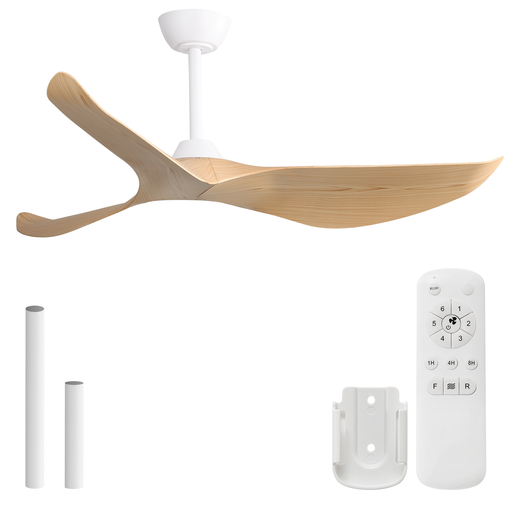
Why this choice suits this profile: its 38-inch size and natural ABS blades make it ideal for anyone looking for a ceiling fan without a light, with a discreet design.
Its diameter stops you choosing an oversized appliance for a modest room. The lack of a light fitting also suits homes that already have a ceiling light.
38-inch size, ABS blades and downrod installation.
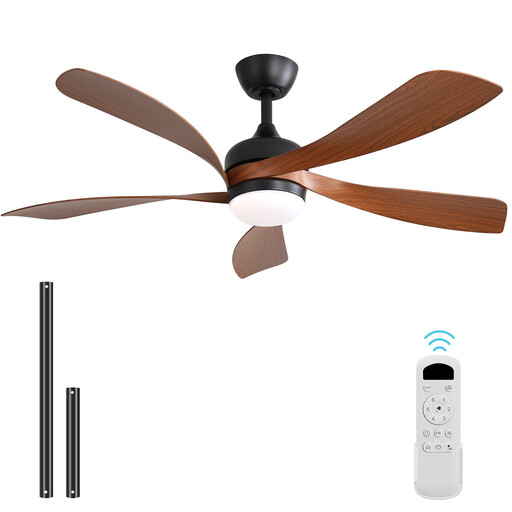
Why this choice suits this profile: this ceiling fan with LED light combines adjustable lighting, a remote control and a large diameter for a spacious living room or bedroom.
The product page states a diameter of 132 cm, a recommended coverage of up to 6.1 m × 6.1 m, and downrods of 12.5 or 25 cm. This information lets you check compatibility with your ceiling before buying.
Six speeds, timer of 1, 4 or 8 hours, reversible rotation and adjustable colour temperature from 3000 K to 6000 K according to the product page.
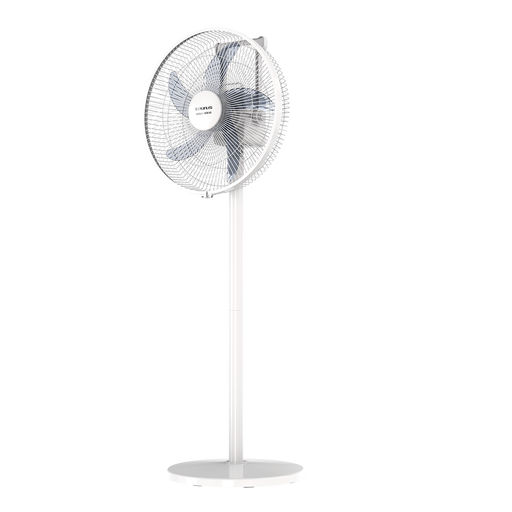
Why this choice suits this profile: this rechargeable pedestal fan can also be used as a desk fan, wall-mounted fan or tower fan, depending on the configuration you want.
With a stated battery life of up to 8 hours and four possible configurations, it reduces your reliance on a fixed power socket. However, always follow the charging and safety instructions for the battery.
40 cm diameter, five speeds, automatic oscillation, remote control and timer up to 8 hours.
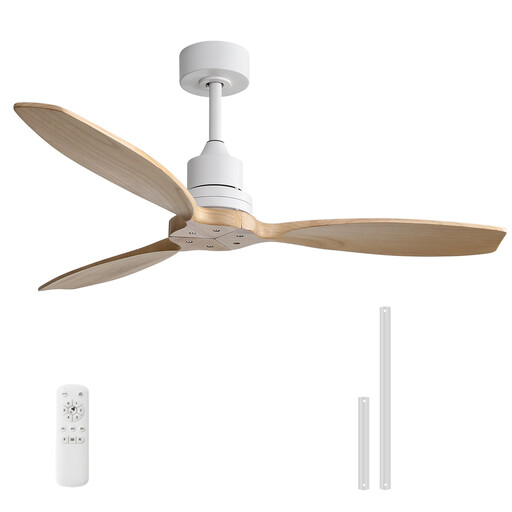
Why this choice suits this profile: its 52-inch diameter and wooden blades naturally suit a spacious living room that wants a decorative presence without built-in lighting.
The product page clearly identifies the version without a light. This means you avoid paying for a feature you don’t need if the room already has its own lighting.
52-inch diameter, white finish and wooden blades, according to the product description.
We’ve put together a comprehensive, real-time selection of products that meet these demanding criteria as well as European safety standards.
Measure the room and check the ceiling height before you decide. A 38-inch model can suit a moderately sized room, while a 52-inch diameter is better for a large space. For a pedestal fan, a 40 cm diameter offers a good balance between footprint and portability.
Energy consumption mainly depends on the motor power and how long you use it. The remote control mainly adds convenience. To estimate the cost, check the wattage on the product page, then multiply it by the number of hours of use and the rate charged by your electricity supplier.
Battery life varies depending on the battery capacity and the speed you select. The Taurus model featured here claims up to 8 hours of use, with a stated charging time of 4 hours. However, a high speed setting, oscillation and battery wear can all reduce the actual battery life.