
Livraison le jour même ou le lendemain

Qualité garantie

Débloquez vos offres de bienvenue: Livraison GRATUITE | Jusqu'à -80 % | 30 jours d'essai gratuits à JoyPlus
Téléchargez l'application
Is your cat turning its nose up at certain recipes, piling on the pounds since being neutered, or suffering from a sensitive tummy? Cat wet food can vary enormously in its ingredients, nutritional balance and packaging. A pretty picture of meat chunks on the label isn’t enough to make the right choice.
Before you buy a batch of cat wet food, take the time to check the label and the product’s nutritional status. Here are the key criteria to look out for, so you can avoid nasty surprises and choose a wet food that suits your cat’s age, activity level and habits.
A “with chicken” or “with beef” claim doesn’t necessarily mean that ingredient makes up a significant part of the recipe. Some formulas, for example, contain as little as 4% of the featured protein. So you need to read the full ingredients list and check the percentages where they’re shown.
A high-meat cat wet food should be judged on its actual composition, not just the variety name.
A mousse or jelly might be a big hit with your cat without being a complete cat food. Look clearly for the words “complete food” or “complete pet food” on the packaging. A complementary recipe can be given from time to time, but it shouldn’t routinely replace a balanced meal.
A grain-free cat wet food may suit some owners’ preferences, but this claim on its own says nothing about the overall quality of the product or its balance of vitamins and minerals. It doesn’t let you off checking the protein, fat and moisture levels, as well as any added nutritional supplements.
Start by checking the age category: kitten, adult or senior. A cat wet food for adults won’t necessarily have the same nutritional profile as a senior cat wet food. For a neutered cat, a specially formulated recipe can help with portion control, but the daily amount should always be tailored to its weight and activity level.
Claims like “for neutered cats” or “prone to weight gain” should be interpreted with care. When a food is intended to support weight loss, the MjAMjAM product page recommends consulting a vet before starting and if use continues long-term.
Compare in particular:
A single-protein recipe can be useful for identifying exactly which animal source your cat is eating. However, it doesn’t guarantee that all cats will tolerate it the same way. If you suspect a food sensitivity, it’s best to ask your vet for advice.
Cans of 125g or 200g work well for cats that have several small meals a day. Pouches of 85g make portioning easy, while a pack of 300g or 400g can reduce the number of openings when several cats share a meal.
After opening, several MjAMjAM products recommend refrigeration for a maximum of 24 hours. The Felix and Ultima products shown here advise, according to their packaging, consumption within two days. Serve wet food at room temperature and always leave fresh water available.
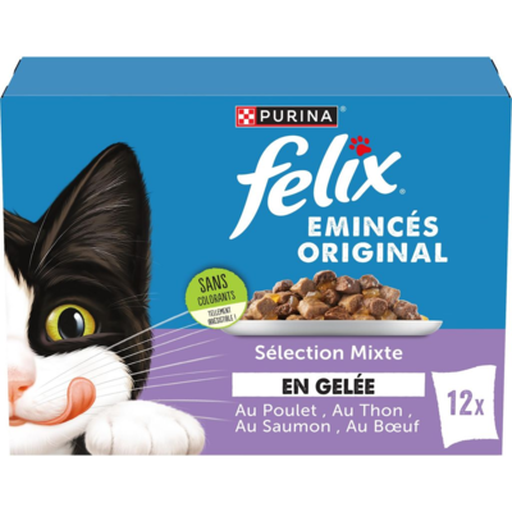
Why this choice suits this profile: The 12-pouch pack of 85g lets you try four flavours while serving easy-to-measure portions every day.
The product page states it’s a complete food and lists the varieties along with the percentages of certain highlighted proteins.
Individual portions, four flavours, 83% moisture and declared taurine content.
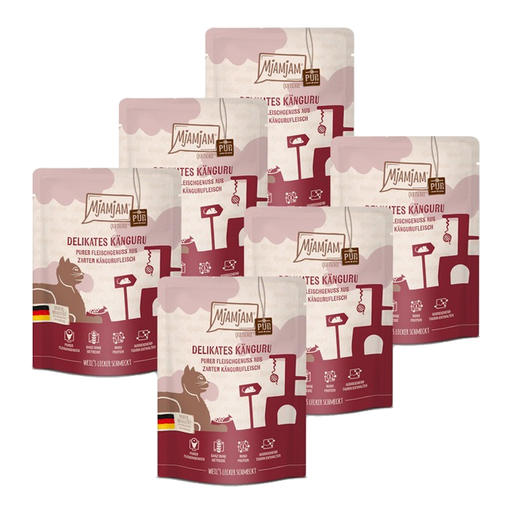
Why this choice suits this profile: This MjAMjAM recipe is aimed at those looking for a single-protein formula made with kangaroo, in a 1.8kg pack.
The product page clearly identifies the main animal source and states it’s a complete food, grain-free, gluten-free and with no added sugar.
71% kangaroo meat and offal, 11.5% crude protein, 4.5% fat and 79% moisture.
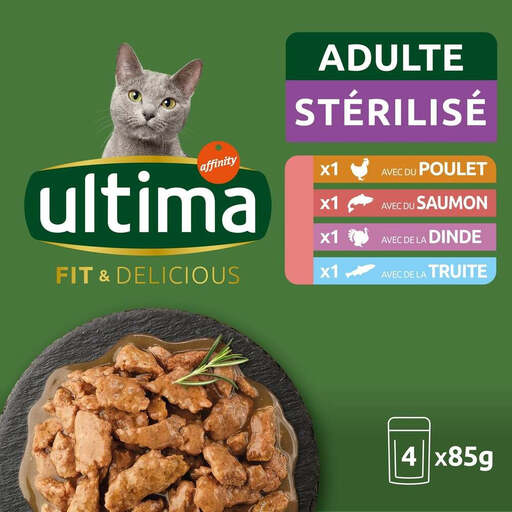
Why this choice suits this profile: The individual pouches and the guidance for neutered cats fit easily into a routine of split meals.
The recipe is presented as complete and balanced for adult neutered cats, with a feeding guide based on weight.
Four varieties, 82% moisture, 4% fat and 85g portions.
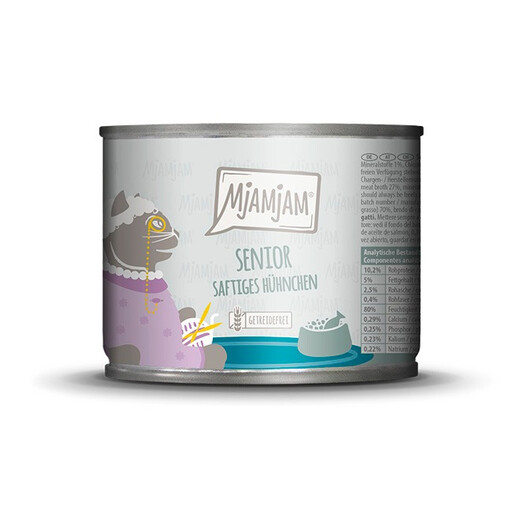
Why this choice suits this profile: This senior cat wet food is formulated for older cats and comes in a 200g can, a handy size for splitting into meals.
The target age and complete food status are stated on the product page, rather than relying on a simple marketing promise.
70% chicken and offal, 5% fat, 80% moisture and a single-protein recipe.
We’ve put together a full selection, updated in real time, of products that meet these exacting criteria as well as European safety regulations.
The daily amount depends on your cat’s weight, age, activity level, whether it’s neutered, and the energy density of the recipe. Several of the products shown recommend 200 to 400g per day for a cat weighing around 3 to 5kg, but this range should be adjusted on a case-by-case basis. Keep an eye on weight changes and split the amount into several meals if needed.
Yes, as long as you put it in the fridge promptly, in a clean, airtight container. Always follow the time stated on the label: some recipes must be eaten within 24 hours, others within two days. If the smell, texture or colour seems off, don’t serve it.
Not necessarily. It all depends on the composition you’re looking for and your cat’s tolerance. The first priority is that it’s a complete food, followed by whether it suits your cat’s age, weight and needs. If your cat has persistent digestive issues, is losing weight, or you suspect an intolerance, a vet can advise you on a suitable diet.