
Livraison le jour même ou le lendemain

Qualité garantie

Débloquez vos offres de bienvenue: Livraison GRATUITE | Jusqu'à -80 % | 30 jours d'essai gratuits à JoyPlus
Téléchargez l'application
A cat water fountain can make daily life much easier, especially if your pet doesn't drink much from a standard bowl or if you're away from home for several hours. Flow rate, tank capacity and filtration systems vary considerably from one model to the next. A good-looking design isn't enough on its own to pick the right appliance for your home and your cat's habits.
A pump can be discreet when properly submerged, but then become noisy as the water level drops, the filter clogs, or deposits build up around the rotor. To choose a quiet cat water fountain, check the operating conditions, whether there's a night mode, and the minimum water level required.
A filtered cat fountain doesn't let you off the hook when it comes to cleaning. Fur, dust and food residue can build up in the grille, the tank or the pump. As for a filter that's said to last several weeks or months, it must be replaced according to the instructions, taking into account your tap water quality and the number of animals using the fountain.
Before ordering, also check the price and availability of the replacement filter for the water fountain. An affordable appliance can end up costing more to run if its cartridges are hard to find.
A 2 L water dispenser for cats is often fine for a single pet, but how long it lasts depends on their drinking habits, evaporation and the flow rate you select. For a cat and a small dog, or for several animals, a larger tank can reduce how often you need to top it up. That said, it doesn't mean you can skip regularly changing the water.
For a single cat, models with 1.85 to 2.6 litres generally offer a good balance. A 3.3-litre fountain may be better suited to a household with several animals, provided you have a stable surface that's wide enough.
Measure the available space before you buy. The fountain should be placed indoors, on a flat, dry floor, away from furniture that could be damaged by moisture. Some models also need clearance around them for easy refilling and proper air circulation.
Filtration systems usually combine foam, activated carbon, resin or an ultrafiltration membrane. These elements don't all do the same job: some trap fur and visible particles, while others help reduce odours or certain elements in the water, depending on the features stated by the manufacturer.
Go for removable parts and clearly identified materials, such as 304 or 316 stainless steel, BPA-free plastic, or components designed for food contact. A filtration rating of 0.01 micron, as seen on some CATLINK models, should be treated as a technical specification of the product, not a medical guarantee.
With a wired pump, the cable must be protected from chewing and moisture. A cordless pet water fountain sometimes separates the pump from the cable, making cleaning easier and reducing the number of electrical connections inside the tank. However, you'll need to keep an eye on the battery level and recharge the appliance as the manufacturer instructs.
A smart cat water fountain can show you how much your pet is drinking, how often they visit, or send you alerts. This information is useful for tracking your pet's daily habits, but it's not a diagnosis. If their behaviour changes noticeably, it's best to ask your vet for advice.
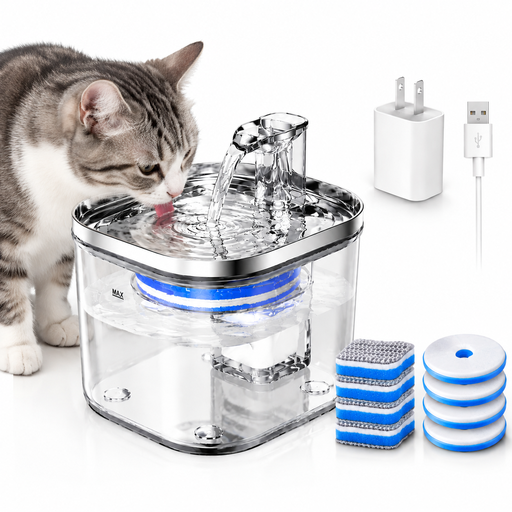
Why this suits this profile: This model offers a 2-litre capacity, automatic circulation and five replacement filters included. It's a great entry-level choice for a cat or small dog, with simple setup.
The pack of filters supplied lets you plan ahead for maintenance from the moment you start using it, reducing the risk of running out of consumables.
2 L tank, advertised as quiet operation, automatic circulation and five filters included.
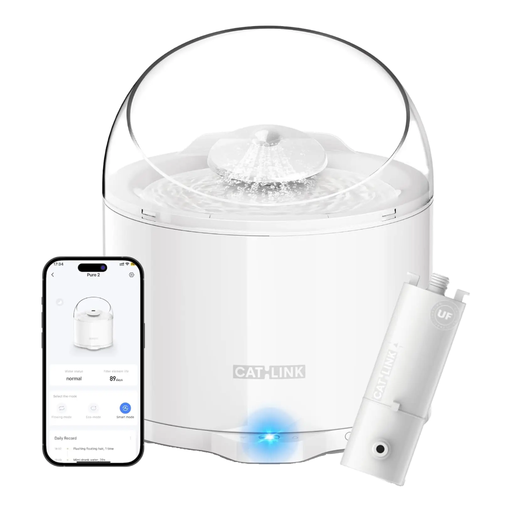
Why this suits this profile: Its 2.6 L capacity, four flow modes and companion app are ideal for households that want to check usage data and adjust the fountain's operation.
The app and replacement reminders make it easier to keep on top of maintenance and track your pet's drinking habits.
Cordless pump, advertised as ultra-quiet operation, ultrafine filtration rated at 0.01 micron and app-based monitoring.
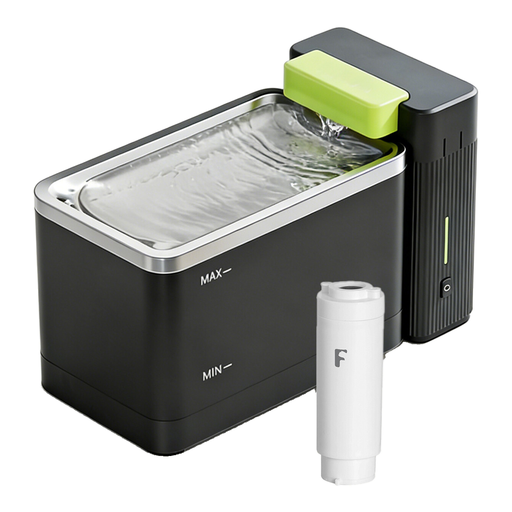
Why this suits this profile: Its 3.3 L capacity is ideal for homes with several cats or small dogs. The 316 stainless steel bowl and the advertised separation between water and electrical components meet the safety and durability expectations of regular use.
The larger volume reduces how often you need to refill, while indicator lights show the water level and when it's time to replace the filter.
3.3 L capacity, 316 stainless steel bowl, two operating modes and UF filter rated for 45 days.
We've put together a full list, updated in real time, of products that meet these demanding selection criteria and European safety regulations.
To keep running costs down, look up the exact reference for the consumable. The homerunPET filter sold in a pack of three, for example, is listed as compatible with the WF20, CF20 and BF10 models: see the homerunPET replacement filter.
It depends on the pump and the mode you select. USB or low-power appliances are generally designed to run on limited power. A cordless pump does need recharging though, and its battery life varies depending on the flow rate, the sensors used and the battery capacity.
How often depends on the model, the number of animals and your water quality. Recommendations often range from two to four weeks for composite filters to around three months for certain membranes. If the flow rate drops, you notice an unusual smell, or the cartridge looks visibly dirty, check the instructions and replace it.
Compare the capacity, the stability of the base and the height of the water access point. A 2.2 to 3.3 L dog and cat water fountain can reduce how often you need to refill in a shared household. For two animals, also choose a bowl that's easy to clean and a filter that's available separately.