
Livraison le jour même ou le lendemain

Qualité garantie

Débloquez vos offres de bienvenue: Livraison GRATUITE | Jusqu'à -80 % | 30 jours d'essai gratuits à JoyPlus
Téléchargez l'application
A cat water fountain can really make daily life easier, especially if your pet doesn’t drink much from a standard bowl or if you need to be away for several hours. But from one model to the next, maintenance, noise levels and the cost of consumables can vary enormously. A stylish design isn’t always enough to make up for the day-to-day hassles.
Before you place an order, check the actual usable capacity of the tank, the availability of replacement filters and how easily the pump can be removed and cleaned. Here are the criteria to examine when comparing automatic cat water fountains, beyond the marketing claims.
A quiet water fountain can quickly start humming, or even vibrating, when the water level drops, when fur builds up in the pump, or when the unit is placed on an unstable surface. Decibel values give you a rough idea, but they don’t always reflect the noise you’ll actually hear in a quiet room.
To reduce the risk of unpleasant surprises, look for:
A fountain with a pet filter needs regular replacements. How often depends on your water quality, the number of pets and the amount of fur or dust in your home. A unit that comes with several cartridges might seem like a good deal, but the key point is the availability of compatible replacement filters.
An activated carbon or resin-based filter can help reduce certain odours and trap visible impurities. However, it won’t make non-potable water safe to drink. Always use clean water and follow the manufacturer’s recommendations.
A 2 to 3 litre tank lets you go longer between refills, but that doesn’t mean the water can sit for days without being changed. The parts that come into contact with water need to be taken apart and washed regularly to limit limescale, deposits and dirt build-up.
So the capacity should match the number of pets, how much they drink and your routine. Don’t rely solely on the promise of long autonomy.
For one cat or a small dog, a tank of 1.85 to 2.6 litres is usually fine for home use, as long as you check the level every day. Models with 2.2 or 2.3 litres often offer a good balance between size and how often you need to refill them. A 3.3 litre capacity can be useful for multiple pets, but the unit will take up more space.
Measure the area available near a power socket or charging point. Avoid spots that get direct sunlight, wooden furniture that could be damaged by moisture, and high-traffic areas where the fountain might get knocked over.
A cordless pump usually separates the pump unit from the submerged cable, making it easier to remove and clean. Battery-powered models give you more freedom over where you place them, but they need regular recharging and you’ll need to pay attention to the USB cable.
Never run a pump dry. Before cleaning, unplug the unit or disconnect its power supply. Don’t submerge the electronic base in water, and check the cables regularly, especially if your pet likes to chew them. For a connected fountain, also check that it’s compatible with a 2.4 GHz Wi-Fi network if required.
Choose a fountain where the different parts can be taken apart without tools. The tray, tank, filter holder and pump should all be easy to access. A unit that’s complicated to open is likely to end up being less well maintained.
Replacement recommendations vary from brand to brand: some manufacturers suggest changing standard filters every two to four weeks, while certain cartridges claim a longer lifespan. However, these guidelines depend on usage and don’t replace a visual check of the filter’s condition.
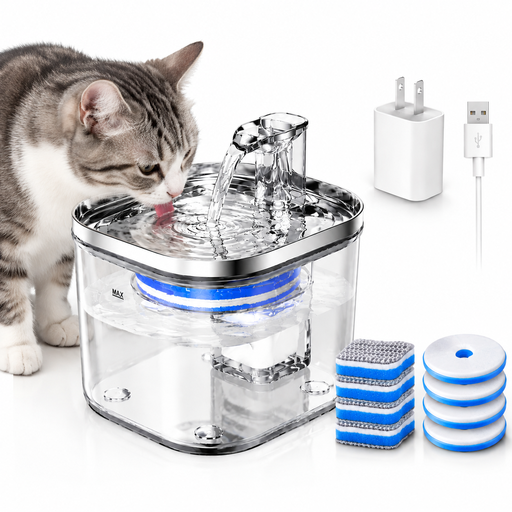
Why this choice suits this profile: Its 2-litre tank and five included filters let you try a cat fountain without having to buy consumables straight away.
The pack of filters makes it easier to estimate the ongoing maintenance cost from the start. You’ll still need to check their availability before long-term use.
2-litre tank, automatic circulation and replacement filters included.
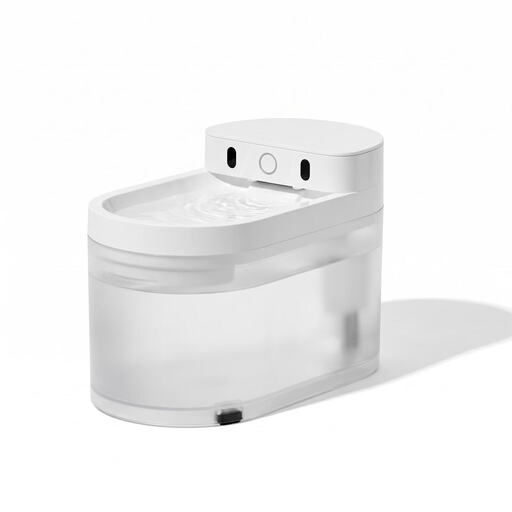
Why this choice suits this profile: Its 5,000 mAh battery, four operating modes and app make it ideal for households looking for a connected cat fountain.
Water consumption tracking, plus level and filter alerts, make maintenance much easier to plan ahead.
2.3-litre capacity, cordless pump, claimed seven-level filtration and operation rated at 30 dB.
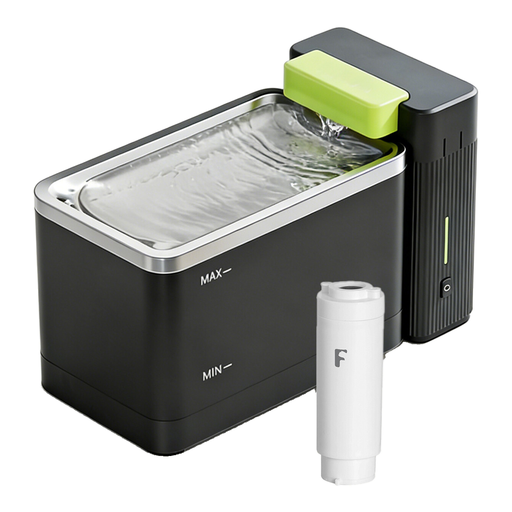
Why this choice suits this profile: Its 3.3-litre capacity and 316 stainless steel tray make it suitable for multiple cats or a household with a small dog.
Indicator lights show the water level and when it’s time to replace the filter. The claimed separation between water and electrical components also makes handling simpler.
3.3-litre tank, 316 stainless steel tray and two operating modes.
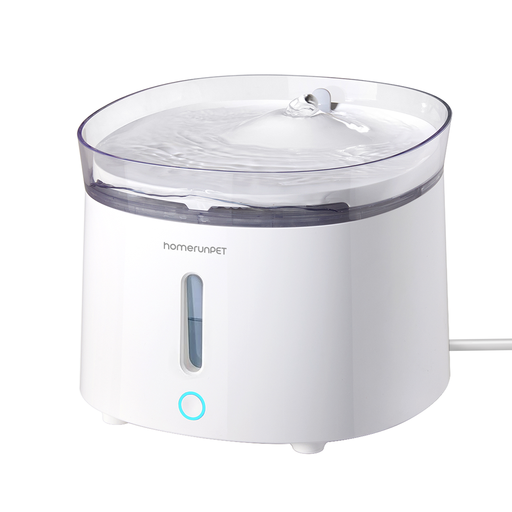
Why this choice suits this profile: Its cordless pump and level indicator meet the needs of a home where the power socket is far from the living space.
The removable pump and the claimed separation between water and power supply reduce the hassle of dealing with submerged cables.
Built-in level indicator, claimed quiet operation and dishwasher-safe parts according to the instructions provided.
We’ve put together a comprehensive, real-time updated selection of products that meet these demanding criteria, while also taking European safety regulations into account.
It all depends on the tank capacity, the number of pets and the circulation mode you choose. A 2-litre tank doesn’t guarantee a precise amount of autonomy. Check the level every day and top it up with clean water as soon as needed.
USB models and those with a low-power pump are generally designed to run on limited power. However, the cost depends on the mode used, how long it runs and your electricity supplier’s rates. Battery-powered units avoid running on mains power all the time, but they do need regular recharging.
Clean the removable parts at least once a week, or more often if several pets use the fountain. Replace the filter according to the instructions and its condition – typically every two to four weeks for standard cartridges. Cloudy water, an unusual smell or a drop in flow are all signs that maintenance is needed.