
Livraison le jour même ou le lendemain

Qualité garantie

Débloquez vos offres de bienvenue: Livraison GRATUITE | Jusqu'à -80 % | 30 jours d'essai gratuits à JoyPlus
Téléchargez l'application
An automatic cat water fountain can make daily life easier, especially if your pet doesn’t drink much, you have several pets at home or you’re often away. But not all fountains are equal, and they don’t all meet the same needs.
Some product listings promise “quiet” operation without specifying a measured noise level. Others claim several days of use between refills, even though the pump and filter still need regular maintenance. And a large capacity doesn’t mean you can leave the water unchanged for several weeks.
Here are the main things to consider to avoid any unpleasant surprises and choose a pet water dispenser that suits your home and your cat’s or small dog’s habits.
A 2 or 4 litre reservoir simply means you won’t need to refill it as often. Consumption varies according to the number of pets, their size and the room temperature. Refill a cat and dog water fountain as soon as the level gets too low, even if its capacity looks generous on paper.
Noise depends on the pump, the water level, the surface the fountain sits on and the condition of the filter. Models that give a decibel rating offer a more useful guide: some list around 20 to 30 dB, while others come in below 40 dB. However, these figures are provided by the manufacturer and are generally measured under specific conditions.
Depending on its design, a filter can trap hairs and some impurities. It doesn’t remove the need to empty, rinse and regularly clean the reservoir and pump. Check that replacement cartridges are readily available and how often they need changing. Several manufacturers recommend replacing them every two to four weeks, depending on water quality and usage.
For one cat, a capacity of between 1.8 and 2.5 litres may be suitable for everyday use, as long as you check the water level regularly. If several pets use the fountain or you’re away for longer, a 3 to 4.5 litre model means fewer refills, but you’ll still need to keep an eye on it.
Check the dimensions of the fountain, too. A model that’s too tall may not suit some cats, while a lightweight or narrow one could be knocked over. Place it on a flat, stable, dry surface, away from furniture that could be damaged by moisture.
A stainless steel water fountain, particularly one made with 304 or 316 stainless steel as specified by the manufacturer, is generally easy to rinse and resistant to corrosion during normal use. Models made from ABS or food-grade polypropylene can also be suitable, provided you follow the care instructions.
Unplug the fountain before cleaning it. Never immerse the base, control module or electrical components in water. For battery-powered models, carefully separate the reservoir from the electronic section.
A quiet cat water fountain needs a properly submerged pump. Never run it dry, as this could damage the motor. Activated carbon, ion-exchange resin, foam and filter fabric all have different functions. Check the instructions to find out how often to replace the filter.
A cordless cat water fountain gives you more flexibility when choosing where to place it, but you’ll need to keep an eye on battery life, charging time and USB cable protection. Models with a motion sensor can prevent the pump from running continuously. A water fountain with an app may offer consumption tracking, low-water alerts or filter-change reminders. However, these features require a compatible connection and regular set-up.
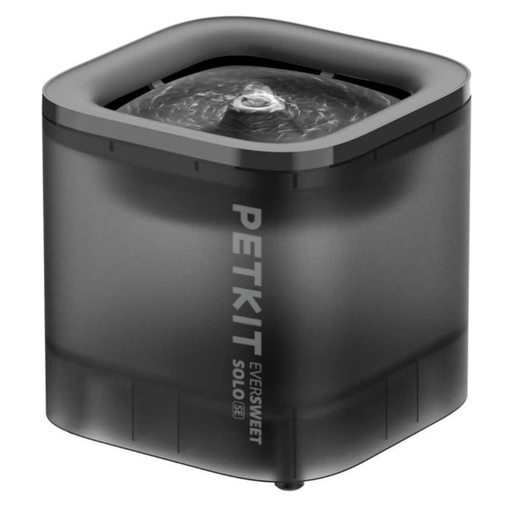
Why it suits this type of user : With its 1.85 L reservoir and LED indicator, this model is easy to get started with and makes a good first indoor fountain.
You can see the water level at a glance, and the cordless pump comes apart for easier cleaning.
Claimed operating noise below 25 dB, activated-carbon filtration and 5 V USB power.
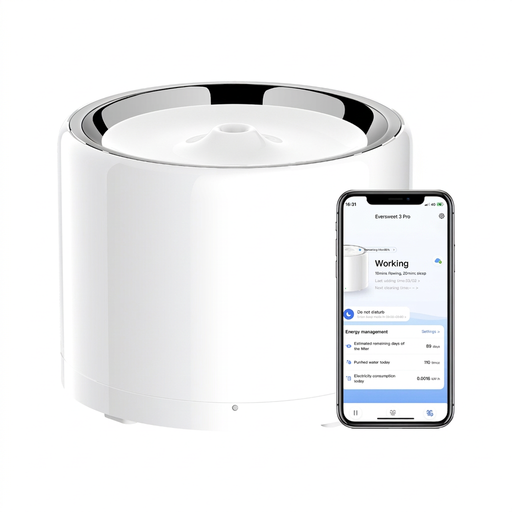
Why it suits this type of user : This model is designed for people looking for a connected fountain, with several tracking features and a cordless pump.
The app and filter reminder make it easier to plan routine maintenance.
1.8 L reservoir, multi-stage filtration, app connectivity and a claimed noise level of up to 26 dB.
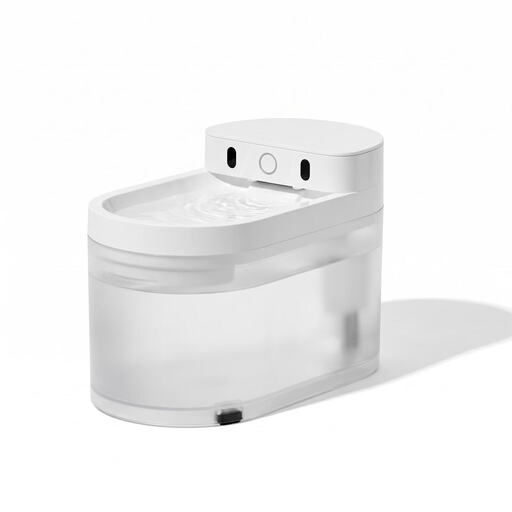
Why it suits this type of user : Its 2.3 L capacity, claimed 5 000 mAh battery and app-controlled modes offer real flexibility for homes where the fountain will be used frequently.
Water-level and filter alerts help you remember routine checks, but don’t replace manual maintenance.
Four operating modes, claimed seven-stage filtration and a stated noise level of 30 dB.
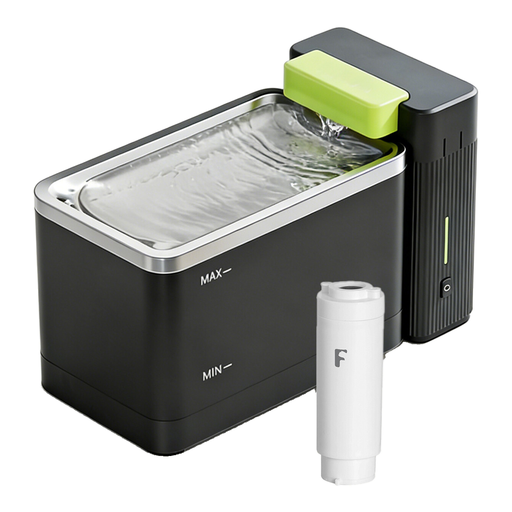
Why it suits this type of user : Its 3.3 L capacity and 316 stainless steel tray make it a good fit for a shared space used by several cats or small dogs.
The stated separation between the electrical components and the reservoir makes the fountain easier to handle when washing it.
316 stainless steel, 3.3 L capacity, two operating modes and a filter claimed to last 45 days.
We’ve put together a comprehensive, real-time updated list of products that meet these strict selection criteria and European safety regulations.
Remember to factor in the cost of filters, electricity or recharging, and any accessories. A motion-sensor fountain can reduce how long the pump runs, but whether it’s useful mainly depends on your pet’s behaviour.
Small pumps generally run on low-voltage USB power and have a limited output, sometimes around 1 to 2 W. Actual consumption varies according to the selected mode, how long it runs and how often cordless models need recharging.
It’s best to refresh the water regularly and clean the reservoir at least once a week, even if the fountain has a filter. Warm weather, hairs and the number of pets may mean you need to clean it more often.
No. A standard fountain with a visible water level may be perfectly adequate. Wi-Fi or Bluetooth connectivity can be useful if you want to receive alerts, check consumption data or adjust several settings in an app. However, it won’t remove the need to refill the reservoir or clean the fountain.