
Livraison le jour même ou le lendemain

Qualité garantie

Débloquez vos offres de bienvenue: Livraison GRATUITE | Jusqu'à -80 % | 30 jours d'essai gratuits à JoyPlus
Téléchargez l'application
As a product expert for Joybuy, I witness the same daily dilemma among cat owners: how can you provide your feline companion with a space for play and rest that satisfies their natural instincts, without sacrificing your home's aesthetics or safety? Far from being a simple accessory, the cat tree is a cornerstone of your pet's well-being, especially for indoor or apartment-dwelling cats.
This guide is designed to give you clear, concrete selection criteria to help you find the perfect model for you, your cat, and your home. We'll break down the key points to check before you buy and present a selection of products that have proven themselves for different needs.
Before you start, it's essential to master the three fundamental criteria that will guarantee a successful purchase.
A cat tree that wobbles is one your pet will certainly avoid, and it can even be dangerous. Its stability depends on several factors:
The size of the tree should match both your cat's build and the space you have available.
A cat tree is also a piece of furniture. Its integration into your decor is a point not to be overlooked.
We have selected three models that stand out for their features and meet specific needs.
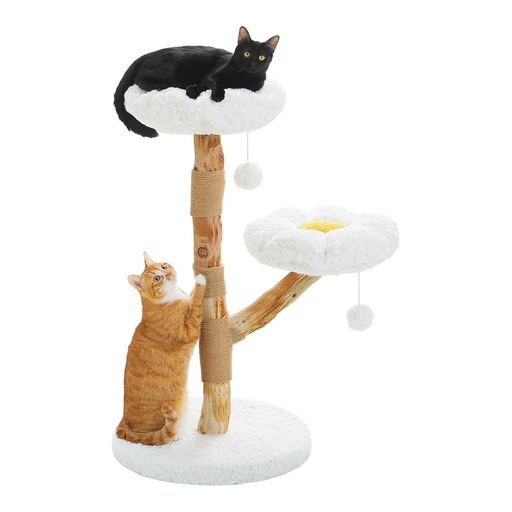
Why it stands out: This model is the perfect blend of aesthetics and functionality. Its floral design makes it a unique cat tree that fits elegantly into a living room, a far cry from traditional models. Its solid wood structure ensures unbeatable sturdiness.
Key Features:
Best for: Owners of one or two cats who are looking for a designer cat tree that is both sturdy and stylish, and who prioritise quality materials and aesthetics.
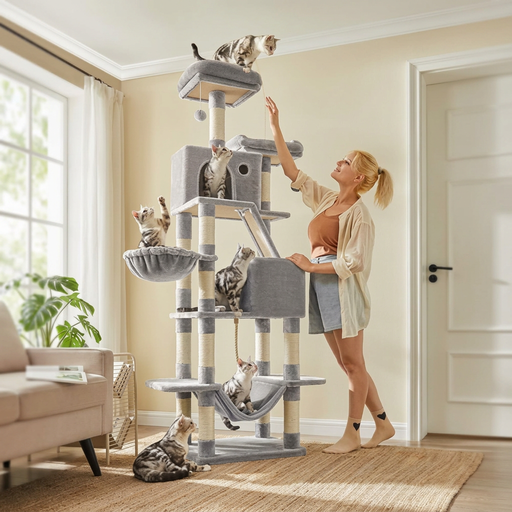
Why it stands out: At 206 cm tall, this cat tower is a true climber's paradise. It's the ultimate solution for households with multiple active cats.
Key Features:
Best for: Families with multiple cats or owners of very energetic cats who need a tall cat tree to burn off energy safely.
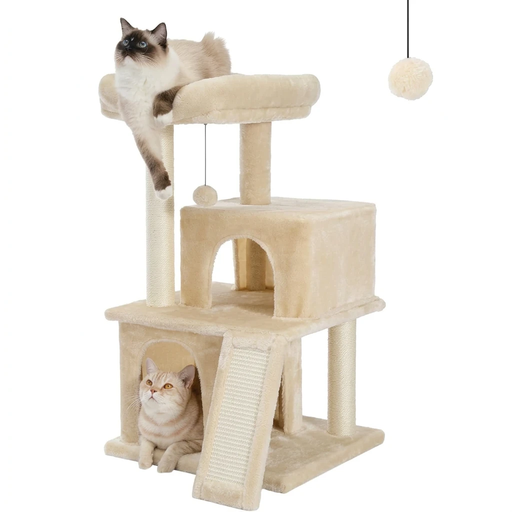
Why it stands out: This model is a smart solution for small spaces. It offers multiple functions (scratching, resting, playing) in a compact format that doesn't clutter the room.
Key Features:
Best for: Owners of small cats or kittens living in a limited space, who are looking for a functional and easy-to-maintain product.
This selection is just a glimpse of the possibilities. Every cat and every home is unique. If these models don't exactly match what you're looking for in terms of size, colour, or features, other options are available.
? Explore our full collection to find the cat tree that will delight your companion.
Location is key. Place the tree in a living area where the family spends time, ideally near a window so they can watch the outside world. You can rub it with a little catnip or place their favourite toys on it to encourage them to explore. Reward them with treats when they use it.
The lifespan of a cat tree depends on its quality and how heavily it's used. Keep an eye on the condition of the sisal posts. On some models, they can be replaced when they are heavily worn. Also, regularly check the stability of the structure and tighten the screws if necessary. A tree should be replaced when it is no longer stable or its scratching areas are worn out.
As a general rule, a solid wood cat tree is denser and heavier, which contributes to better stability compared to an entry-level particle board model. It is also often more durable. However, high-quality particle board trees with a thick, well-designed base can prove to be just as robust and safe. The key lies in the overall design of the structure and the width of its base.