
Livraison le jour même ou le lendemain

Qualité garantie

Débloquez vos offres de bienvenue: Livraison GRATUITE | Jusqu'à -80 % | 30 jours d'essai gratuits à JoyPlus
Téléchargez l'application
A cat tree with a scratching post can combine several functions in one piece of furniture: climbing, observing, resting, playing and keeping claws in check. But a poorly chosen model may end up unused, lack stability or wear out quickly. The advertised height alone is not enough to compare different products.
Before you order, keep three common pitfalls in mind:
A large cat tree makes use of vertical space – a real advantage in a British home where every square metre counts. However, measure your ceiling height, the available width and the distance from windows, radiators and other furniture.
Above two metres, the anti-tip device is not just an optional extra. It must be fitted according to the instructions, on a sufficiently solid part of the wall. Also check:
A cat tree intended for several animals should also make it easy for them to move around. Multiple platforms and separate access points help avoid traffic jams when one cat is occupying a cubby or hammock.
A scratching post for cats should be placed where your pet will naturally want to sharpen its claws: near a resting area, an entrance or a piece of furniture it has already targeted. The material matters just as much as the shape.
Sisal and jute rope offer a texture well suited to vertical scratching. A scratching pole for cats needs to be tall enough for your cat to stretch out fully. Horizontal surfaces, such as a scratching mat for cats, complete the set-up and are particularly suitable for cats that prefer to scratch the floor or carpets.
To better protect your furniture, place the scratching post right next to the sofa or chair in question. You can attract your cat with a toy or a small amount of catnip, but never force it to use it.
A versatile cat furniture piece can include an observation platform, cubbies, a hammock, a grooming brush or an interactive toy. Each element meets a different need:
Also think about maintenance. A dense fabric can offer a comfortable surface, but it needs to be vacuumed or dusted regularly. Ropes should be checked for significant wear, any lifting or parts that could be chewed.
The following models meet different needs. The dimensions, materials and recommendations mentioned correspond to the information available on each product page.
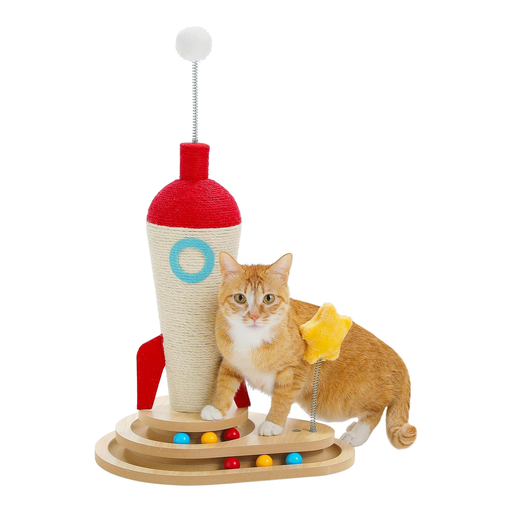
Why this model suits this profile: This 63 cm tower is ideal for a first set-up or a small space. It combines scratching, play and exploration without taking up as much room as an XXL cat tree.
Its solid wood base and sisal pole cover the essential needs, while its compact size makes it easy to place on a stable surface.
Ball track, feather, sisal pole and dimensions of 40 × 30 × 63 cm. No batteries required.
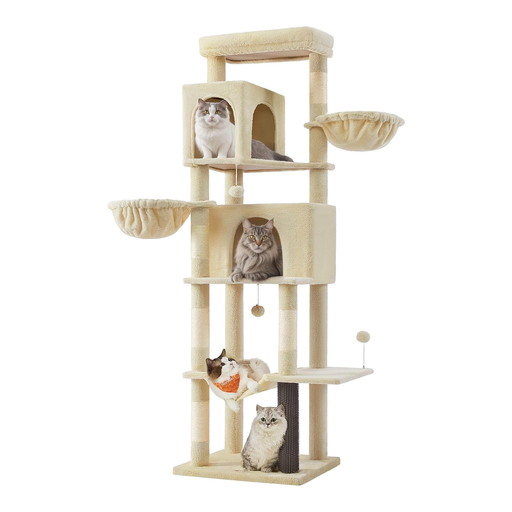
Why this model suits this profile: At 190.7 cm, this model is aimed at households looking for a vertical piece of furniture offering several resting areas and an integrated scratching solution.
Its five poles covered in jute rope multiply the scratching zones. The supplied wall fixing must be installed before first use.
Two cubbies, two platforms, a hammock, a large observation platform and an integrated grooming brush. The stated weight is 19.5 kg.
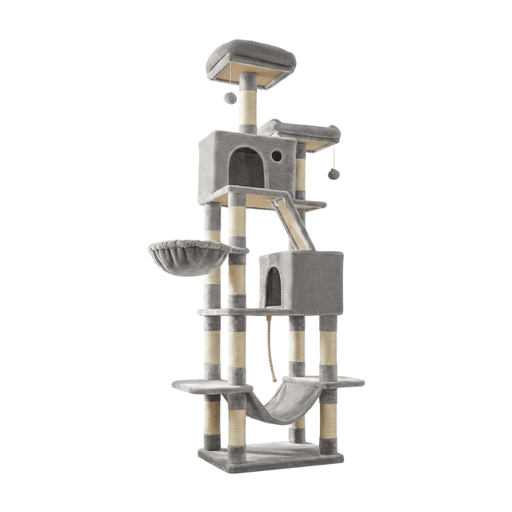
Why this model suits this profile: This 206 cm cat tower was designed for households with several cats or particularly active pets, provided the stated load limit is respected.
Thirteen sisal poles and a scratching board prevent wear from being concentrated on a single area. At this height, wall anchoring is essential.
Five levels, two cubbies, a hammock, a basket and a recommended load for six cats each weighing up to 7 kg.

Why this model suits this profile: This foldable mat is ideal for those looking to protect a chair, table or a specific area of the home.
Its reusable self-gripping system avoids the need for permanent adhesive. The surface must be clean and dry, and the grip should be checked during the first few uses.
Size 54 × 51 cm, hemp rope, can be used as a scratching mat or resting area, folds or rolls up for storage.
We have put together a comprehensive, real-time updated selection of products that meet these strict selection criteria as well as European safety regulations.
For a reliable set-up, follow these steps:
Do not soak the wood, sisal or hemp with liquid. To clean the surfaces, a slightly damp cloth is usually sufficient, subject to the manufacturer's instructions. Any detached, heavily frayed or damaged part must be removed or replaced.
Put it in a room where your cat spends time, near a resting area or a secure window. To distract it from the sofa, first place the scratching post next to the targeted piece of furniture, then gradually move it away if needed.
Its lifespan depends on how often it is used, the number of cats and the quality of the rope. Inspect the fibres and fixings regularly. A heavily worn or unstable pole should no longer be used, even if the main structure still seems in good condition.
Not necessarily. The most important thing is to compare the recommended load, the number of platforms and the distribution of spaces. A tall model with several cubbies and scratching surfaces can suit a household with multiple cats, provided it is properly fixed and maintained.