
Livraison le jour même ou le lendemain

Qualité garantie

Débloquez vos offres de bienvenue: Livraison GRATUITE | Jusqu'à -80 % | 30 jours d'essai gratuits à JoyPlus
Téléchargez l'application
A cat tree with a scratching post can serve several purposes: letting your cat climb, observe its surroundings, sleep and sharpen its claws. But a towering or particularly stylish model isn't necessarily right for your pet or your home. To avoid a purchase that ends up gathering dust, focus first on stability, footprint and the quality of the scratching surfaces.
A tall cat tower naturally catches the eye, but height isn't everything. A base that's too narrow, poorly spaced platforms or a lack of fixings can make the whole thing unstable, especially with an energetic cat or multiple pets in the house.
Check the floor footprint, the weight of the furniture and whether it comes with an anti-tip system. A large cat tree also needs to go in a spot where your cat can move around easily, without blocking a door or getting in the way.
A plush covering is perfect for a nap, but it doesn't replace a proper sisal scratching post or another surface designed to withstand claws. If the scratching areas are too short, hard to reach or fray quickly, your cat will likely head straight back to the sofa.
Look closely at the diameter and height of the posts, as well as where they're placed. A vertical scratching post suits cats that like to stretch; a scratching mat for cats can complement the setup on the floor or near a piece of furniture.
A multi-level cat tree over two metres tall needs enough ceiling height and a clear area around it. You'll also need to factor in vacuuming fur, cleaning the platforms and regularly checking the ropes, seams and any hanging elements.
In a small flat, a scratching mat or foldable scratching panel can be much easier to incorporate than a bulky cat house. The goal is to create a space your pet will actually use every day, not a cumbersome piece of furniture that nobody touches.
Before comparing models, measure the intended spot, including the available height. For a setup designed for multiple cats, prioritise:
As a guide, the PAWZ Road model featured below measures 60 × 60 × 130 cm and weighs 14.6 kg. Its product page also mentions central posts with a 12.5 cm diameter. This information lets you assess the actual footprint and sturdiness of the structure, rather than relying on marketing claims alone.
Sisal is the most common material for scratching posts. Check that the rope covers a sufficient length and is positioned where your cat will naturally reach it. A sloping ramp, a horizontal panel or a mat can also complement a vertical post.
The zeze Caterpillar model, for example, uses a hemp rope surface and measures 54 × 51 cm. Its reusable self-adhesive back is designed for installation on a clean, dry, smooth surface, and according to the description it leaves no sticky residue. It can be placed on the floor, on furniture or against a wall. As always, supervision is recommended during initial use.
An indoor cat tree should offer several functions without turning the structure into an obstacle course. Cats generally appreciate being able to choose between an open area for watching, a hideaway for solitude and a comfortable surface for sleeping.
In a multi-cat household, several sleeping spots can help avoid squabbles over a single hammock. Also check whether hanging toys are easy to replace and whether the different levels remain accessible for cleaning.

Why this suits this profile: This foldable mat is a great introduction to scratching without taking up much space, especially in a flat or near an armchair.
No need for a large, potentially unstable structure: its dimensions are clearly stated and its self-adhesive back attaches to a smooth, dry surface.
54 × 51 cm format, hemp rope surface and dual use: scratching and resting.
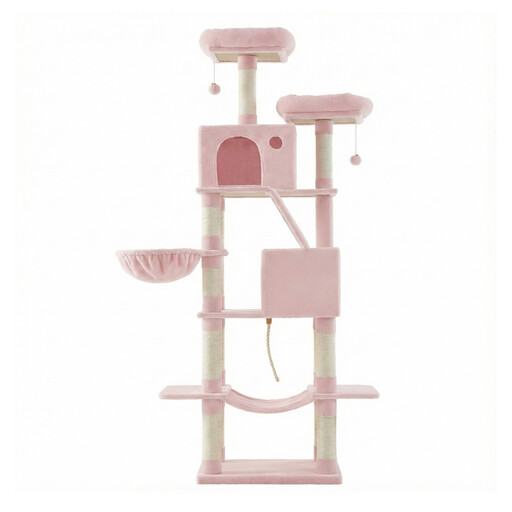
Why this suits this profile: Its very tall design and numerous spaces suit a home with good ceiling height and clear vertical space.
The product page mentions an anti-tip base and wall fixing: these must be installed according to the instructions.
206 cm height, 13 scratching posts, two cubbies, two platforms, a basket and a hammock.
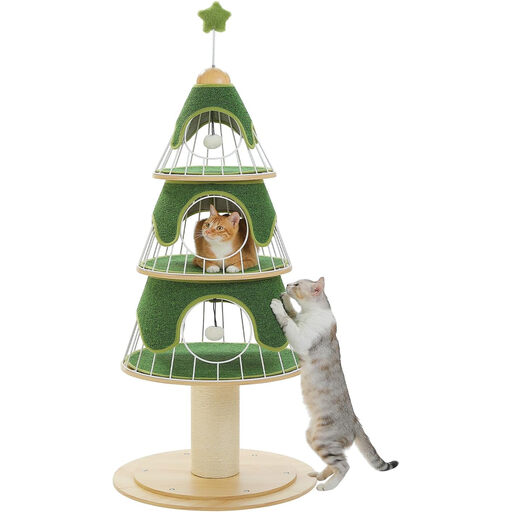
Why this suits this profile: This tower will suit households looking for several resting spots, with a seasonal decoration that certainly stands out.
Its stated 60 × 60 cm base and 12.5 cm central posts give concrete reference points for judging its footprint and structural sturdiness.
130 cm height, three levels, three large cubbies and sisal-covered posts; all in a Christmas cat tree shape.
We've put together a comprehensive, real-time updated list of products that meet these demanding selection criteria and European safety standards.
Place the cat tree near a living area, a window or a piece of furniture your pet already frequents. This will help them adopt the new space more easily. For a wall-mounted scratching post or mat, the surface must be clean, dry and compatible with the fixing system.
When assembling:
Vacuum the fabrics regularly and inspect the ropes. Replace any loose parts, damaged cubbies or heavily worn surfaces before letting your cat continue using the setup.
Choose a stable, accessible spot that's far enough away from walkways. Being near a window will encourage watching, while a spot next to the sofa can offer an appealing alternative to it. Avoid radiators, doors and slippery surfaces.
It depends on the number of cats, how often they scratch and the length of rope actually used. Check frayed areas and fixings regularly. A post can remain in use as long as it's stable and its surface has no loose parts that could be dangerous.
Yes, provided you choose a structure suited to their size and activity level. Several platforms, cubbies and scratching surfaces help spread out usage and prevent a single spot from becoming a point of tension. For very active cats, compare the base width, the furniture's weight, the number of levels and the possibility of fixing the structure to the wall.