
Livraison le jour même ou le lendemain

Qualité garantie

Débloquez vos offres de bienvenue: Livraison GRATUITE | Jusqu'à -80 % | 30 jours d'essai gratuits à JoyPlus
Téléchargez l'application
A cat tree with scratching post can serve several purposes: climbing, observing, resting, playing and sharpening claws. But a structure that looks appealing in a photo won't necessarily suit your home or your pet's temperament.
Some models disappoint after just a few weeks: a base that's too narrow, flimsy scratching posts or platforms that aren't suited to your cat's weight. Before comparing different options, here are the main pitfalls to avoid and the criteria to examine so you can make a truly informed choice.
A tall cat tree isn't necessarily more stable. A high tower with a lightweight base can wobble when your cat jumps from one level to another. For an XXL cat tree, check the width of the base, the total weight and whether a wall-mounting system is included.
A multi-level cat tree may have lots of platforms without offering enough space for an adult cat. Some are too small or too close together. The number of cubbies and sleeping areas matters less than their accessibility, surface area and layout.
A scratching post covered in sisal that's too thin or too short may not allow your cat to stretch properly. The covering needs to be tall enough and securely fixed. The quality of the joints also counts: a post that works loose becomes noisy and can weaken the whole structure.
Measure the available space before ordering, making sure there's enough room to walk around the structure. A 60 × 60 cm base, for example, doesn't just take up that floor area – you also need a safety zone for when your cat jumps.
For an active cat, height provides a valued vantage point. In a small flat, a more compact model with a vertical scratching post can actually be more practical than an XXL cat tree.
Choose a wide base, properly screwed-in columns and well-spaced platforms. For very tall structures, a wall fixing may be mandatory, according to the manufacturer's instructions. It must be installed on a solid part of the wall, with accessories compatible with the wall material.
Place the tree on a level floor and regularly check the screws, posts and platforms. No structure can be considered completely risk-free: supervision and maintenance are essential.
Sisal is well suited to the surface of a scratching post for cats: its texture is different from that of furniture and can encourage scratching behaviour. However, check the density of the wrapping and which areas are actually covered.
A thick plush covering offers more comfort, but also traps more fur. Regular vacuuming or brushing helps keep the cubbies and hammock clean. Avoid soaking the wood and sisal: when the instructions allow it, a slightly damp cloth is usually sufficient.
The three options below cater to different needs. The dimensions and features are those stated on the product pages available at the time of writing.
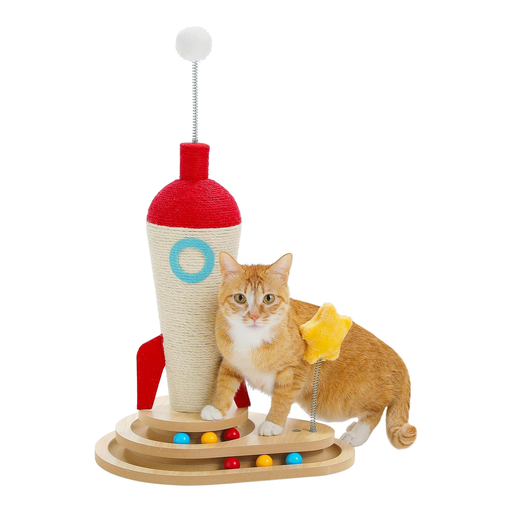
Why this choice suits this profile: At 63 cm tall, this model is ideal for households that want a multi-functional set-up without installing a large tower. It combines a sisal post, a ball track and a feather wand.
Its solid wood base and compact size keep the footprint small. The model doesn't rely on great height to offer both scratching activity and play.
Dimensions: 40 × 30 × 63 cm. Stated materials: sisal, solid wood and plastic. The balls are designed to minimise noise.
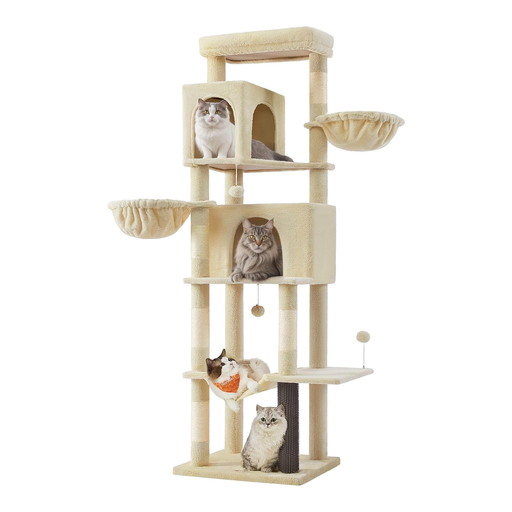
Why this choice suits this profile: At 190.7 cm tall, this structure is aimed at those with a sufficiently spacious room who want to provide multiple resting areas for one or more cats.
The anti-tip wall fixing is stated as mandatory. It addresses the risk associated with tall structures, provided it is installed correctly.
Two cubbies, two perches, a hammock, a large platform, five sisal columns and an integrated grooming brush. Stated weight: 19.5 kg.
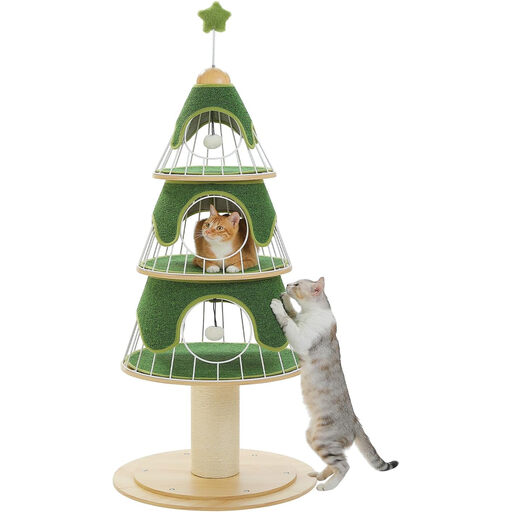
Why this choice suits this profile: Its Christmas cat tree look can easily fit into a festive décor. Its three levels and three large cubbies meet the resting needs of several cats.
Its widened 60 × 60 cm base and central posts stated at 12.5 cm diameter provide concrete points to check during assembly and regular inspections.
Height of 130 cm, three levels, three cubbies and sisal-covered posts. The manufacturer recommends indoor use and regular inspection.
We've put together a comprehensive, real-time updated selection of products that meet these strict selection criteria as well as European safety requirements.
A quiet spot that's still in a living area is often better than a completely isolated corner. Near a window, your cat can watch the outside world; placed close to its usual resting spots, the tree is more likely to be used. However, keep a good distance from radiators and narrow walkways.
It depends on how often it's used, your cat's weight, the quality of the sisal and how well it's maintained. Regularly inspect the ropes, screws, platforms and toys. When the covering is very worn or a part is damaged, replace it if the manufacturer allows. If not, stop using the structure.
Cubbies offer a more enclosed space, often favoured by cats that like to get away from it all. A hammock provides a soft, open surface, but it must be properly fixed and suited to your pet's size. For multiple cats, combining cubbies, platforms and sleeping areas spread across the tree can help reduce conflicts over a single spot.