
Livraison le jour même ou le lendemain

Qualité garantie

Débloquez vos offres de bienvenue: Livraison GRATUITE | Jusqu'à -80 % | 30 jours d'essai gratuits à JoyPlus
Téléchargez l'application
A cat tree isn't just another piece of furniture: it's a vital territory for your companion's well-being. It allows them to climb, sharpen their claws, observe their environment, and rest in complete safety. Yet, too many owners end up with an expensive accessory that their cat pointedly ignores. The reason? Design flaws or misleading marketing claims. Before you invest, it's crucial to recognise the three most common pitfalls that render a cat tree completely useless.
To avoid falling into these traps, focus on a few key points that guarantee the durability, safety, and appeal of your future cat tree.
A stable cat tree is the absolute priority. Its sturdiness depends on three main factors:
A good cat tower should be much more than a simple perch. It must meet several of your pet's fundamental needs.
A designer cat tree should not sacrifice functionality. The materials are an excellent indicator of overall quality. Particleboard panels (MDF type) form the structure of most trees; their density is a guarantee of sturdiness. The plush covering should be soft but also dense to withstand wear and tear. Neutral colours like grey, beige, or cream white integrate more easily into most interiors.
To help you see more clearly, here are a few models that perfectly illustrate these criteria, adapted to different profiles of cats and owners.

Why it's a great fit: With its 5 levels, 2 condos, 2 perches, a basket, and a hammock, it provides enough personal space for several cats to coexist without rivalry. Its structure is even designed to accommodate up to 6 cats.
Its reinforced base and included anti-tip kit overcome the instability pitfall, a crucial point for a household with several very active cats.
The variety of resting areas and 14 scratching surfaces (13 posts + 1 ramp) meet the diverse needs of a small feline tribe.
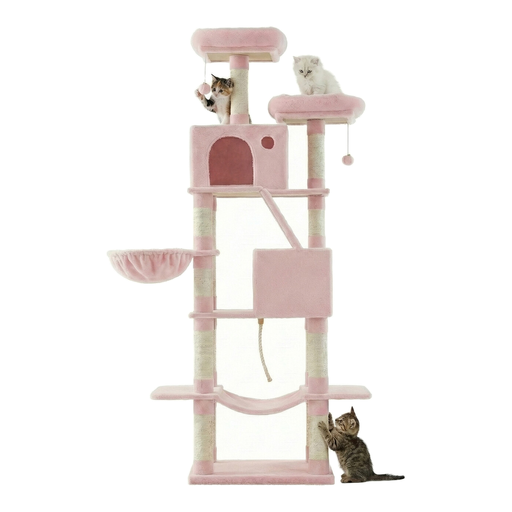
Why it's a great fit: Standing at 206 cm tall, this tower offers maximum vertical space for cats who love to climb and survey their kingdom. It's a true playground for energetic felines.
It avoids the poor design pitfall by offering a multi-level layout that encourages natural, fluid climbing, without the design "dead ends" sometimes seen elsewhere.
Its exceptional height stimulates a cat's climbing instinct and provides a dominant viewpoint over their territory, thereby boosting their sense of confidence.

Why it's a great fit: Its smokey grey colour is a modern alternative to traditional beige. It integrates elegantly into a contemporary living room without compromising on features.
It proves that a designer cat tree doesn't have to be flimsy. Built on a stable base with durable materials, it doesn't sacrifice durability for the sake of aesthetics.
It combines a sleek aesthetic and a trendy colour with a complete and robust structure. The best of both worlds.
We have curated a full range of products that meet our standards for quality and safety.
The most reliable method is to use the provided anti-tip kit to secure it firmly to the wall. Place it on a flat, non-slip surface, ideally in a corner for added stability. Also, remember to regularly tighten all the screws, especially during the first few weeks of use.
For two or more cats, a large cat tree of at least 150 cm is recommended. Look for a model that offers multiple platforms, condos, or hammocks at different heights. This allows each cat to have its own space and reduces territorial tension. The base must be particularly wide and heavy to support their weight and play.
Take it slow. Place the tree in a living area where the family spends time, like the living room. Place a few of their favourite treats, like CATISFACTIONS Chicken Treats, on the different platforms. You can also use a toy, like a cat teaser wand, to encourage them to climb and explore their new structure. Be patient! Trust is earned.